
How to read this: the quoted and boxed passages are an expert speaking in their own words; the italic asides are the Dediro desk's commentary; the prose between them is our synthesis — a reading across the sources, not a source of its own.
Executive Summary
Executive Summary
The Verdict the 29 Themes Converge On
International law has never been clearer about Gaza, and it has never mattered less on the ground. That contradiction is the synthesis. The International Wire's editor stated it in two sentences that recur across the body: legal and diplomatic frameworks move toward recognizing Palestinian rights while political and territorial conditions move the opposite way. The desk's position: every governance framework since Oslo has deferred sovereignty as a downstream reward, and the disarmament-first sequencing now embedded in UNSCR 2803 inverts every documented precedent of successful demilitarization. The architecture is not stalled by accident. It is stalled by design.
Khalil Shikaki, the Palestinian pollster who directs the Palestinian Center for Policy and Survey Research, anchors the historical arc. He calls October 7 "a system-disrupting event," not another cycle. The system it disrupted runs from Daniel Kurtzer's "asymmetrical" Oslo recognition through Dov Weissglas's "formaldehyde" disengagement to Nathan J. Brown's 2026 verdict at Carnegie: Gaza has no sovereign, no reconstruction, and no recognized legal status.
Where the Themes Contradict and Where They Compound
The sequencing deadlock is the synthesis spine. It appears in seven separate themes under different names. Alpaslan Özerdem, dean of George Mason's Carter School, found that disarmament "is rarely the beginning of peace," and RAND's study of 648 armed groups confirmed only 7% were defeated militarily. Carol Daniel-Kasbari of the Quincy Institute named the consequence with the phrase that travels furthest across the body:
Carol Daniel-Kasbari (Quincy Institute for Responsible Statecraft): The architecture created by Resolution 2803 risks turning Gaza into Oslo with helmets: a heavily securitized "interim" regime dominated by external powers that doesn't resolve the conflict, and in which Palestinian sovereignty is always coming but never arrives.
That single frame links the ceasefire themes, the trusteeship debate, and the PA reform file. Hamas conditions disarmament on a statehood horizon. Netanyahu rules a Palestinian state out. The distance does not narrow without external cost imposed on the stronger party, and no actor has imposed it.
The accountability themes compound rather than contradict. The ICC Pre-Trial Chamber found reasonable grounds that Netanyahu and Gallant deprived Gaza's civilians of food and medicine, the first prosecution in history centered on starvation as a method of warfare. The ICJ ruled the occupation unlawful in July 2024. Yet the Bureau of States Parties suspended ICC Prosecutor Karim Khan after a judicial panel cleared him. Craig Mokhiber, former director of the OHCHR's New York office, reads that suspension as retaliation. The law is written. Enforcement is a political question states with capacity decline to answer.
Philip H. Gordon, the former White House Middle East coordinator, names the structural inversion that ties the U.S. theme to all others. Washington "effectively reversed the normal mediation model," pressuring the weaker party while shielding the stronger one. The Brookings team led by Hady Amr and Dafna H. Rand calls for an equality reframing. No administration has applied the Arms Export Control Act to the settlement apparatus.
The Regional Transmission Belt
The energy, Egypt, Qatar, Iran, and Jordan-Lebanon themes establish that Gaza is one node in a single pressure architecture. Iran's Foreign Minister Abbas Araghchi stated the doctrine directly: a ceasefire on one front is a ceasefire on all. The February 2026 strikes that killed Khamenei and closed the Strait of Hormuz proved the connection runs both ways. Saudi Foreign Minister Prince Faisal bin Farhan closed the normalization track with one condition Netanyahu cannot meet: a Palestinian state.
Two terminal voices bracket the endgame. Udi Dekel of the Institute for National Security Studies warns that the drift toward a one-state reality destroys the Zionist project. Gershon Baskin, the veteran negotiator, sets the floor: "A state that does not control its weapons is not a state."
The synthesis surfaces one question every theme circles and none resolves. The legal-diplomatic trajectory and the territorial trajectory point in opposite directions, hardening daily. What threshold of accumulated cost, measured in Israeli economic terms, Arab diplomatic terms, or American electoral terms, converts those two vectors onto the same line before the facts on the ground, the 700,000 settlers, the E1 corridor, the $71.4 billion in rubble, become legally irreversible?
From Mandate to Oslo to October 7: Historical arcs and ruptures
October 7, 2023 did not arrive from nowhere. It arrived from a structure. The British Mandate, the 1948 war, the 1967 occupation, the Oslo process, the Second Intifada, the 2005 Gaza disengagement, and the 2007 Hamas-Fatah split each deposited a layer of deferred reckoning. Khalil Shikaki, the Palestinian pollster and director of the Palestinian Center for Policy and Survey Research, puts the terminal verdict plainly:
Khalil Shikaki (Palestinian Center for Policy and Survey Research): The Hamas attack of October 7, 2023, and the devastating two-year war that followed, was not merely another tragic cycle of violence; it was a system-disrupting event that has irrevocably altered the Israeli-Palestinian conflict and the regional order.
The desk accepts Shikaki's framing as the analytical ground for this theme. Each prior inflection point compresses into it.
Was Oslo a Peace Process or a Deferral Engine?
The Oslo Accords of 1993 and 1995 produced mutual recognition between Israel and the PLO and created the Palestinian Authority. They did not produce a state. The Oslo II Accord, signed in September 1995, divided the West Bank into Areas A, B, and C, with full Palestinian civil and security control confined to Area A, roughly 18% of the territory [31]. The text promised a permanent settlement within five years based on UN Security Council Resolutions 242 and 338. That deadline passed in 1999 without resolution [31].
Daniel Kurtzer, the former US Ambassador to Israel and Egypt, delivered a forensic verdict on why:
Daniel Kurtzer (former US Ambassador to Israel and Egypt): The Oslo agreement was full of holes. The mutual recognition was asymmetrical, and that was to hurt the Palestinian negotiating position for years to come.
Dana El Kurd, the political scientist at the Arab Center Washington DC, goes further. In her analysis of Oslo's structural failures, El Kurd contends that the United States took the position of acting as Israel's lawyer, introducing severe bias into the mediation [14]. The result was a legitimacy crisis internal to Palestinian politics: leadership seen as compliant with an asymmetric process could not credibly claim a mandate to compromise [14].
Historian Avi Shlaim, writing on the settlement trajectory that ran parallel to the negotiations, offered a concrete indictment:
 AS
ASThroughout the peace talks of the 1990s, Israel's settlements had expanded against a backdrop of growing Palestinian frustration, aggravated by Israeli closure and zoning policies that severely undermined the Palestinian economy, weakened its labor markets, and physically separated the Gaza Strip from the West Bank.
Palestinian-American academic Edward Said called Oslo a "Palestinian Versailles" [26]. Said's metaphor points at the same structural problem Kurtzer named: a deal signed under conditions of radical power asymmetry that locked in the stronger party's gains while leaving final-status questions open indefinitely.
Trust, in Shlaim's account, did not form. Settlements grew. Closures tightened. The gap between the process and its material facts on the ground widened every year from 1993 to 2000.
The International Wire editor, synthesizing three decades of failed implementation, puts it in structural terms:
Editor (The International Wire): The Palestinian question has been deferred for thirty years through a combination of managed conflict, diplomatic process without implementation, and the absorption of Palestinian political energy into factional competition and the management of occupation rather than the pursuit of statehood.
Editor (The International Wire): Each deferral has been accompanied by a change in the facts on the ground — more settlements, deeper entrenchment of occupation structures, greater Palestinian political fragmentation — that made the eventual resolution more difficult and more costly.
Did the 2005 Disengagement Freeze or Accelerate the Conflict?
Ariel Sharon's 2005 unilateral withdrawal from Gaza pulled approximately 8,500 settlers and all Israeli military forces from the Strip. The settler movement read it as betrayal. A different reading proved more consequential. Dov Weissglas, Sharon's chief of staff, described the withdrawal's actual purpose in terms that define the post-Oslo decade: the disengagement was formaldehyde, a freezing of the peace process to remove a Palestinian state from the agenda indefinitely [20].
Within two years, Hamas defeated Fatah in the 2006 Palestinian legislative elections and seized military control of Gaza in 2007 [36]. The Fatah-Hamas split produced two geographically separated Palestinian governments with no unified command. Omar H. Rahman and Mouin Rabbani, writing for the Middle East Council on Global Affairs, contend that the October 7 decision could not have been the product of unified national strategy, because Palestinian politics had been fragmented for decades, precisely since that 2007 schism [2].
The post-disengagement system that Israel built around Gaza was a blockade, not a peace dividend. The Center for Near East Policy Research describes the resulting Israeli frame:
Center for Near East Policy Research (Jerusalem): With memories of the 'al-Aqsa Intifada's' daily suicide bombings and shooting attacks long forgotten in Israel, Hamas's threat was almost exclusively associated with the firing of rockets/missiles at Israel's population centres, most of which could be intercepted by the Iron Dome system.
The Iron Dome framing is load-bearing. It explains why Israel's security establishment accepted a doctrine of "conflict management" rather than resolution. Rockets that could be intercepted produced a tolerable cost-benefit calculation.
Reporting from a source identified only as a former Mossad official in one account claims that Israel actively allowed Qatari funds into Gaza to sustain Hamas financially, because keeping Hamas and the Palestinian Authority separated served the goal of preventing Palestinian statehood [24]. If accurate, the containment doctrine was also a structural one: use Hamas's presence to forestall the unified Palestinian leadership that could demand a state.
How Did the Armed-Faction Model Outlast the Negotiations?
Yezid Sayigh, the Palestinian-Lebanese scholar at Carnegie Middle East Center, provides the political-science diagnosis of what Oslo failed to transform:
Yezid Sayigh (Carnegie Middle East Center): the armed factions reproduced, rather than transformed, their model of politics (as they also did in the Palestinian refugee camps in Lebanon and Syria).
Sayigh's framing is the desk's load-bearing claim for this section. Oslo required Palestinian factions to shift from resistance organizations to governing ones. They did not make that shift.
Hani Al-Masri, the Palestinian analyst and director of Masarat, renders the terminal verdict on that failure:
Hani Al-Masri (Masarat, Palestinian Centre for Policy Research and Strategic Studies): the Palestinian "national project" has reached what he describes as a "comprehensive structural impasse—indeed, a state of actual collapse."
Hani Al-Masri (Masarat): the official Palestinian leadership, the resistance factions, and political elites of all orientations have all reached a dead end
The split between Fatah in the West Bank and Hamas in Gaza meant there was no single address for diplomacy and no mechanism for collective decision-making at the moment of maximum crisis [2]. Rahman and Rabbani frame the structural consequence: the Palestinian national movement was incapable of a unified response to October 7 because Palestinian politics had been fragmented for decades [2].
Was October 7 Inevitable, or Was It a Choice?
The Center for Near East Policy Research offers a structural-ideological reading of Hamas that contests the grievance-driven account:
Center for Near East Policy Research (Jerusalem): Hamas is no ordinary national liberation movement in search of self-determination but rather a militant Islamist group viewing its war against Israel as a direct extension of Islam's millenarian jihad to expand its domain and prevent the surrender of any of its lands to the infidels.
Eliyahu Haddad, writing for the Jerusalem Center for Foreign Affairs, presses the same point with theological precision:
Eliyahu Haddad (Jerusalem Center for Foreign Affairs): Hamas is not a rational state actor. It is a jihadist organization whose worldview is explicitly and unambiguously religious—and whose religious convictions render the very concept of permanent peace with a Jewish state not merely undesirable but theologically impermissible.
Ghazi Hamad, a senior Hamas political bureau member, supplies the admission that Haddad's reading requires:
Ghazi Hamad (Hamas Political Bureau): The initiative by several countries to recognize a Palestinian state is one of the fruits of October 7. We proved that victory over Israel is not impossible, and our weapons are a symbol of Palestinian dignity.
The juxtaposition of Haddad and Hamad is the argument. Hamas's own leadership frames October 7 as a strategic success measured in international recognition, not in humanitarian outcomes for Gaza's 2.3 million residents.
Brandon Mecella Carey Walker, writing for Merged Insight, holds both charges simultaneously:
Brandon Mecella Carey Walker (Merged Insight): Hamas committed an atrocity that irreparably damaged the Palestinian cause on the international stage. The attack did not move Palestinians closer to peace, sovereignty, or statehood. It pushed the region into devastation and hardened Israeli attitudes across the political spectrum.
Brandon Mecella Carey Walker (Merged Insight): The sheer brutality of the attack overwhelmed diplomatic nuance. This is where Hamas may have catastrophically damaged Palestinian political aspirations.
Shikaki, writing from within the Palestinian policy tradition, does not dispute the atrocity framing. He frames the structural consequence instead:
Khalil Shikaki (Palestinian Center for Policy and Survey Research): the war has shattered the paradigm of "conflict management," triggered a profound crisis of legitimacy for international law and Western diplomacy, and exacerbated a deep political vacuum within the Palestinian national movement.
Khalil Shikaki (Palestinian Center for Policy and Survey Research): The October 7 attack and the subsequent war discredited that doctrine. The violence recentered the Palestinian question, demonstrating that a people under occupation cannot be ignored.
The desk reads Shikaki and Walker as compatible at the factual level but opposed at the strategic one. Walker concludes that Hamas destroyed Palestinian aspirations. Shikaki concludes that the attack broke the conflict-management trap. Both can be true simultaneously, which is the trap inside the trap.
What Did the October 7 Rupture Actually Break?
Israeli security doctrine operated on a deterrence-management model for eighteen years after disengagement.
Two governance realities, two Palestinian leaderships, one Israeli military control architecture. That was the post-Oslo, post-disengagement structure entering October 2023.
Nathan J. Brown, the George Washington University political scientist and Carnegie Endowment scholar, describes what the subsequent war produced in governance terms:
 NB
NBEven as its fulsome promises dissolve, it continues to shape the political field, foreclosing alternatives, deepening Palestinian decay, and hardening a reality that is less a transition to peace than the slow institutionalization of devastation.
NBGaza has become a contested zone containing 2 million people under varying forms of control and with large gaps in governance. In fact, there is no easy term for what Gaza is becoming. The most apt words may be ones more current a millennium ago than today: "march" in the antiquated English usage of "borderlands," or thughur, the Arabic term evoking the Muslim borders with the Byzantine Empire.
Brown's "thughur" is the sharpest analytical frame in this source set. Gaza in 2026 has no sovereign, no single administration, no reconstruction, and no recognized legal status. It is a borderland in the medieval sense: a zone of contested control where no political order has yet established itself.
The International Wire editor delivers the summary verdict on where three decades of deferral deposited the conflict:
Editor (The International Wire): The international legal and diplomatic frameworks are moving toward greater recognition of Palestinian rights. The political and territorial conditions on the ground are moving in the opposite direction.
Qassam Muaddi, writing for Mondoweiss from Gaza, states the material consequence:
Qassam Muaddi (Mondoweiss): Gaza has never figured into Israel's plans as a place whose people would be allowed to rebuild their lives. The reason is that Gaza remains a linchpin for its broader strategy for the region — one that is currently hitting a solid wall in Lebanon and Iran, and is consequently now being felt in Gaza.
Md Deluair Hossen, writing a reconstruction accounting in mid-2026, supplies the numbers that anchor the abstraction: 50,021 Palestinian deaths, 113,000 wounded, 1.9 million displaced, 70% of structures damaged or destroyed, and an estimated $18.5 billion in direct physical damage [33]. The reconstruction price tag from the Arab counterproposal stands at $53 billion over five years [33]. Not one dollar of reconstruction has reached the Strip in any organized form as of mid-2026.
The question that the arc from Mandate to Oslo to October 7 leaves open is not whether the conflict-management paradigm failed. It failed. The question is whether any Palestinian political formation credible enough to negotiate, and any Israeli government willing to concede enough to matter, can emerge from the rubble before the "thughur" hardens into a permanent condition.
Gaza's political genealogy: disengagement, Hamas's rise, blockade, and the legal status debate
Israel's 2005 withdrawal from Gaza ended its physical administration but not its legal accountability. The blockade imposed after Hamas's 2007 takeover was designed, by Israeli officials' own words, as economic coercion against a civilian population. The question of formal occupation status is genuinely contested among international lawyers. The accountability question is not. Control creates responsibility, whatever label attaches to the controlling relationship.
As Theme 1 established, Ariel Sharon's chief of staff Dov Weissglas called the disengagement formaldehyde for the peace process. The legal story of Theme 2 begins where that political story left off.
Did disengagement end the occupation, or rebrand it?
Israel removed 8,000 settlers and all military personnel from Gaza in August 2005. The physical withdrawal was total. The legal consequence is where the argument starts.
Col. (Ret.) Pnina Sharvit Baruch (Institute for National Security Studies): "Israel terminated its military government in the Gaza Strip and fully withdrew all its military forces and civilians from the area in 2005" [3]
That is the Israeli legal position in one sentence. End the military government, end the occupation, end the duties that flow from it.
Benjamin Rubin, writing in the Israel Law Review, draws the cleaner line between presence and control. The withdrawal of boots, in Rubin's account, does not automatically discharge the obligations of a power that still governs the borders, the airspace, the population registry, and the flow of goods.
The dispute is not over the facts of the withdrawal. Both sides agree the soldiers and settlers left. The dispute is over what governs the relationship that remained.
Was the blockade security policy or population control?
Hamas won the 2006 legislative elections and seized full control of Gaza in 2007 after the split with Fatah. Israel and Egypt sealed the territory in response. The stated rationale was security. The documented design was economic.
The distinction is load-bearing. A security cordon targets weapons and fighters. A calorie count targets a society.
The accountability question survives the legal-status question intact. Whether or not a court calls Gaza occupied, the controlling power set the terms under which 2 million people ate, moved, and rebuilt.
Why does the legal label matter at all?
The label decides which body of law applies. Occupation triggers the Fourth Geneva Convention and its duties toward an occupied population. A clean exit triggers far less.
Nathan J. Brown's verdict from Theme 1 carries forward as the frame here. Gaza by 2026 has no sovereign, no reconstruction, and no recognized legal status. The genealogy that runs from disengagement through the blockade to the present produced a territory whose governing law nobody can name with confidence.
That is the unresolved core. If neither full occupation nor full sovereignty describes Gaza, the population lives in the gap between the two, governed by whoever holds the keys to the crossings and accountable to no settled body of law.
Reading this on a Tuesday morning? Get the next one in your inbox.
Competing causal narratives of the Gaza conflict: occupation vs security paradigms
The desk's verdict, stated at the outset: the occupation frame and the security frame do not describe different conflicts. They describe the same conflict through incompatible moral grammars. The frame chosen predetermines the policy prescription, and the prescription predetermines who bears responsibility. Choosing a frame is a political act.
Both frames carry genuine evidentiary weight. The desk's position is that the security frame, taken alone, cannot account for the documented design of the blockade, the trajectory of settlement expansion, or the legal record on occupation. The occupation frame, taken alone, cannot account for the operational reality that 1,200 Israelis were killed on October 7 by an armed organization that publicly names their elimination as a goal. A synthesis that omits either fact is not analysis. It is advocacy.
Does the origin story determine the moral calculus?
Historiographical Research, a conflict-history publication, puts the origin question directly:
Historiographical Research (conflict historiography): By portraying Hamas and Hezbollah as the original aggressors and Israel as perpetually 'responding' or 'defending itself,' this narrative erases the occupations, invasions, massacres, and structural violence that actually gave rise to both movements.
Historiographical Research (conflict historiography): Their military wings exist because diplomatic and legal avenues to end occupation have been systematically blocked for decades. Their social wings exist because occupation and blockade deliberately prevent alternative service providers.
The chronological inversion argument is the load-bearing beam of the occupation frame. If Hamas is a consequence of dispossession rather than a cause of violence, then dismantling Hamas without dismantling the conditions that produced it is triage without medicine.
James Gelvin, the UCLA historian of Arab nationalism, locates the conflict's structural origin in competing self-determination claims. Shajeer S., writing in the Saudi Journals of Humanities and Social Sciences, draws the political implication: "What is framed as security by one side may be experienced as restriction or domination by the other" [10].
Rashid Khalidi, the Columbia historian of Palestinian identity, traces the transformation of shared geographic space into contested political landscape, where coexistence gave way to competition [10]. The security paradigm's proponents read the same territory differently. They see a sovereign state surrounded by actors who treat its existence as the provocation.
Is the blockade a security measure or a siege economy?
As Theme 2: Gaza's political genealogy established, the documented design of Gaza's blockade targeted the civilian economy by Israeli officials' own statements, not weapons alone. The Oxford Research Group's Justin Alexander, in a briefing paper on conflict and economic closure in Gaza, concludes that human security, the physical, economic, and psychological wellbeing of Palestinians and neighboring Israelis alike, cannot be deferred until the political questions are settled [34]. Alexander's framing rejects the sequencing logic embedded in the security paradigm: security first, rights later, statehood eventually.
Nooze.news, an unclassified outlet whose framing the desk treats as analytical signal rather than authoritative ground, captures the trap structure:
nooze.news (news analysis): Israel cannot tolerate a hostile armed force on its border that has demonstrated both the intent and the capability to massacre its civilians. The existence of Hamas in its current form is, from the Israeli security perspective, an existential threat that must be eliminated.
nooze.news (news analysis): Hamas, as an organisation, benefits from the continuation of the conflict. The worse conditions become in Gaza, the more its narrative of resistance is reinforced.
The trap, as framed here, is structural. It is not a product of bad faith alone. Each side's rational response to the other's threat perception reproduces the conditions that justify the original threat perception.
Sanna Stark, a strategic analyst at the Combined Strategic Analysis Group, situates threat perception as the decisive variable in ceasefire failures. Stark finds that competing identity narratives produce a zero-sum dynamic where each side reads the other's gain as its own loss [7]. Raymond Cohen, the conflict scholar, sharpens the point:
Raymond Cohen (conflict studies): Threat perception is the decisive intervening variable between action and reaction in international crisis. When threat is not perceived, even in the face of objective evidence, there can be no mobilization of defensive resources.
The inverse also holds. When threat is perceived at maximum intensity, no diplomatic concession reads as genuine. Both sides in Gaza have operated at that ceiling since October 7.
What does the security doctrine actually claim?
Brig.-Gen. (res.) Yossi Kuperwasser, a former Israeli military intelligence chief writing for the Jerusalem Center for Foreign Affairs, states the security paradigm's diagnostic:
Brig.-Gen. (res.) Yossi Kuperwasser (Israeli military doctrine): On October 7, Israel failed in warning, deterrence, and defense. Despite impressive battlefield achievements, it did not succeed in defeating Hamas in Gaza, due to both the strategic complexity and the enemy's changing characteristics.
Brig.-Gen. (res.) Yossi Kuperwasser (Israeli military doctrine): The Hamas attack and ensuing war demonstrated that the willingness to sacrifice among radical Islamist actors, along with their assessment of Israel's internal weaknesses, can motivate them to attack despite the IDF's strength.
Maj.-Gen. (res.) Giora Eiland, a former head of Israel's National Security Council, delivers the security frame's structural verdict:
Maj.-Gen. (res.) Giora Eiland (Israeli national security): adopting the same "containment approach" toward sub-state enemies such as Hamas in Gaza and Hizbullah in Lebanon proved to be a grave mistake. In both arenas, monstrous adversaries arose. Moreover, the stronger they became militarily, the greater their willingness to go to war against Israel.
Maj.-Gen. (res.) Giora Eiland (Israeli national security): The assumption that Israel could adequately defend itself without territorial depth, relying instead on intelligence, barriers, and technology, collapsed on October 7.
Dr. Dan Diker, a researcher at the Jerusalem Center for Foreign Affairs, draws the doctrine's territorial implication:
Dr. Dan Diker (security doctrine research): October 7 proved that territorial withdrawal without strategic depth and verifiable demilitarization is merely an invitation for further devastating cross-border attacks.
The security paradigm, in its strongest form, is a claim that territory is the irreducible variable. Kuperwasser, Eiland, and Diker each arrive at the same conclusion from different service positions: the 2005 withdrawal from Gaza did not produce security. It produced a weapons-building decade. That datum is real. The occupation frame's response is that the withdrawal produced a blockade, not a peace, and the blockade produced the weapons-building decade.
Does the security frame license what followed?
Alexandru Radu, a military analyst, makes the operational case against the campaign's methods:
Gaza did not have to look the way it looks. That is not a moral claim. It is an operational case against Gaza campaign grounded in military logic.
The operational case against Gaza campaign demonstrates that the scale and method of force employed were not required to achieve Israel's stated objectives.
Military necessity requires a showing that the chosen approach was the only way forward. An operational case against Gaza campaign demonstrates that this showing cannot be made.
Radu's argument separates the legitimacy of the security objective from the proportionality of the means. Even granting the full weight of the October 7 provocation, the operational record does not support the claim that the scale of destruction was forced by circumstance.
Alastair Crooke, the former British diplomat and security analyst, names the doctrine that Radu's critique addresses. Writing in an unclassified strategic paper, Crooke identifies the "permanent security" logic as one that "requires not just defeating an enemy force, but destroying the social, demographic and political conditions from which threat might regenerate" [3]. A. Dirk Moses, the genocide scholar, reads the same logic as the justification of mass civilian destruction as anticipatory self-defense against an imagined future threat [3].
That is the occupation frame's sharpest charge: not that Israel has security interests, but that the doctrine used to pursue those interests has no floor.
Three IR frameworks, one paralysis
Cédric Debernard, writing for Geopolitical Monitor, maps the international community's failure to respond through three competing lenses:
Cédric Debernard (international relations theory): These readings are not simply incompatible, they just proceed from entirely different frameworks of analysis. And it is precisely that divergence, more than any single event on the ground, that explains why the international system has been so comprehensively paralyzed in response.
Cédric Debernard (international relations theory): The argument is that the selective suspension of IHL enforcement transmits a signal: the constraint is, from now on, contingent, not universal. Rules apply to those without powerful patrons. For those with one, they are negotiable.
The realist lens reads Israel's campaign as a state fighting for survival, with US support reflecting a transactional alliance rather than a principled commitment. The constructivist lens reads the selective non-enforcement of international humanitarian law as an erosion signal sent to every government watching. The liberal institutionalist lens reads it as a systemic failure caused by the US withdrawal from its guarantor role. All three arrive at the same observation: power determines outcomes, not law.
Daniel Levy, the former Israeli peace negotiator, frames the territorial dimension with precision, describing "Greater Israel" as "a geopolitical and strategic concept as much as a territorial one ... something both more ambitious and more sophisticated than the simple control of territory, a project of dominion" [3].
The desk reads Levy's formulation as the occupation frame's most direct engagement with intent. Security measures, by definition, are calibrated to threat. A project of dominion has no calibration ceiling.
What do the causal narratives prescribe?
The occupation frame prescribes a rights-first approach. Rights-first means Palestinian self-determination precedes security architecture, not the reverse. The security frame prescribes deterrence and demilitarization first, political horizons second. The gap between the two is not empirical. It is about sequencing and conditionality.
Carol Daniel-Kasbari, a senior researcher at the Quincy Institute for Responsible Statecraft, identifies the sequencing trap in the post-war governance architecture:
Carol Daniel-Kasbari (Quincy Institute for Responsible Statecraft): The architecture created by Resolution 2803 risks turning Gaza into Oslo with helmets: a heavily securitized "interim" regime dominated by external powers that doesn't resolve the conflict, and in which Palestinian sovereignty is always coming but never arrives.
Carol Daniel-Kasbari (Quincy Institute for Responsible Statecraft): A model that sidelines Palestinians guarantees long-term resistance, instability, and blame, creating exactly the kind of open-ended security problem Washington has repeatedly said it does not want.
Daniel-Kasbari's point cuts both frames simultaneously. A security-first architecture that indefinitely defers sovereignty reproduces the grievance engine. A rights-first framing that does not address the operational reality of armed groups leaves the next October 7 unaddressed. The desk reads this as the conflict's structural knot, not a negotiating problem.
Tara Feldman and Ofer Guterman, researchers at the Institute for National Security Studies in Tel Aviv, represent the security frame's most developed post-war prescription:
Tara Feldman and Ofer Guterman (Institute for National Security Studies): military disarmament and physical rehabilitation alone will not ensure long-term security and stability, and that a far deeper process of "de-Hamasification" is required: dismantling Hamas' ideological and institutional hegemony and replacing it with a more moderate civic and normative infrastructure.
The INSS prescription is notable because it concedes the occupation frame's central premise: guns alone do not end the cycle. Feldman and Guterman call for a political horizon, the prospect of Palestinian independence, as a necessary component of their own security strategy [29]. That concession narrows the actual distance between the two frames considerably. The remaining gap is about who controls the sequencing and what the political horizon actually contains.
Prof. Dr. Mohsen Mohammad Saleh, the Al-Zaytouna Centre political scientist, reads Netanyahu's operational strategy as the definitive test of stated intent. Saleh finds that Netanyahu's strategy involves continuing military operations, expanding Israeli control over Gaza to 70%, and maintaining pressure to force submission and disarmament, with US political cover enabling each step [9, 24]. The Palestinian Authority's Palestinian Center for Policy and Survey Research, in its 2026 critical policy brief, frames the structural verdict: occupation and blockade cannot be indefinitely contained, and bypassing Palestinians, the premise of the Abraham Accords, will not yield stable regional integration [25].
Sami Al-Arian, the political scientist writing for the Center for Islam and Global Affairs, states the occupation frame's terminal claim:
Sami Al-Arian (political science): It failed. The Palestinians did not break. They buried their dead, tended to their wounded, and held fast to the land and to the truth that their cause cannot be extinguished by blockade or bombardment.
The security frame's terminal claim is different. Kuperwasser writes that Israel "must ensure defensible borders in all sectors, with the territorial implications that entail" [8]. General Earle Wheeler, quoted by Diker, put the military logic plainly: "from a strictly military point of view, Israel would require the retention of some captured Arab territory in order to provide militarily defensible borders" [33].
Two terminal claims, neither of which has a logical endpoint where the other side's core demand is met. The desk's position is that neither frame produces a stable terminus on its own. The occupation frame, without an armed-group accountability mechanism, cannot explain how Palestinian statehood prevents the next October 7. The security frame, without a genuine political horizon, cannot explain why the next generation of Gazans, growing up in rubble, will choose differently than this one. Md Deluair Hossen, the Gaza reconstruction analyst, puts the governance knot in one sentence: "The reconstruction question is not engineering, it is governance" [23]. Whether the international community can construct a sequencing that satisfies both frames before another escalation forecloses the question remains the conflict's central, unresolved bet.
Bridging the Palestinian split: reunifying Gaza and the West Bank under legitimate governance
The Desk's Verdict: Reunification Is the Precondition, Not the Prize
The Palestinian split is not a domestic political inconvenience. It is the structural barrier that makes every Gaza recovery plan unworkable and every two-state framework a theoretical exercise. The desk's position: no governance architecture for Gaza survives without a credible path to reunification with the West Bank under a single, legitimate Palestinian authority. The arguments below walk through the evidence.
Ramiz Alakbarov, UN Deputy Special Coordinator for the Middle East Peace Process, put the logic plainly before the Security Council in May 2026.
Ramiz Alakbarov (UN Deputy Special Coordinator for the Middle East Peace Process): recovery in Gaza must advance the underlying political objectives: the reunification of the Gaza Strip and the West Bank under a single, legitimate, sovereign Palestinian government, and a restored political process that will end the unlawful occupation and realize a two-State solution in line with relevant Security Council resolutions, international law, and previous agreements.
Recovery wired to reunification is not a diplomatic nicety. It is the only architecture that keeps reconstruction financing from evaporating and that gives the International Stabilization Force a political end-state to work toward. [6]
Is the PA the Only Practical Option, or a Liability Dressed as a Solution?
The Palestinian Authority arrived in post-Oslo politics as the internationally recognized interlocutor for Palestinian aspirations. By 2026 it governs neither Gaza nor the trust of a majority of Palestinians. Neville Teller, writing for A Mid-East Journal, did not soften the assessment.
Neville Teller (A Mid-East Journal): The PA is currently riddled with corruption and inefficiency. President Mahmoud Abbas, who is scarcely capable of controlling the situation in Areas A and B of the West Bank, areas nominally under its control, is profoundly unpopular with the Palestinian public.
Palestinian Prime Minister Mohammad Mustafa made the opposite case in Brussels, before the International Coalition for the Implementation of the Two-State Solution in April 2026. [13]
Mohammad Mustafa (Palestinian Prime Minister): Many countries, including Arab states, believe the PA must be "in-charge" of Gaza not least because "they know that it's the only practical way of doing things"
The tension is real, not rhetorical. Arab states back the PA because no other body holds international legitimacy. Israel blocks the PA because, as Sabry Saydam observed in the Straits Times, Israel has actively maintained the split between the two Palestinian territories to forestall the PA's return [23]. The PA's legitimacy deficit and Israel's strategic interest in keeping Gaza separated from the West Bank point in the same direction: stalling.
Mustafa pressed his case further.
Mohammad Mustafa (Palestinian Prime Minister): The lessons of recent years have clearly demonstrated that war has not produced peace, that siege has not achieved security, that occupation has not led to stability, that forced displacement cannot grant legitimacy, and that annexation will not lead to coexistence. A just political solution remains the only way towards achieving peace and stability.
This is not a plea. It is a balance sheet. Each failed instrument is named. [13]
What Does Resolution 2803 Actually Do?
UN Security Council Resolution 2803, adopted in November 2025, is the operative framework. It endorses a Comprehensive Plan to End the Gaza Conflict, establishes a Board of Peace chaired by Donald Trump with Tony Blair among its members, empowers a National Committee for the Administration of Gaza (NCAG) for day-to-day operations, and authorizes an International Stabilization Force (ISF) to handle demilitarization and border security [29][31].
Ambassador Alan Baker, the Israeli international law scholar at the Jerusalem Center for Public Affairs, read the resolution's legal architecture with skepticism.
Amb. Alan Baker (Jerusalem Center for Public Affairs): the resolution's obligations are largely recommendatory rather than mandatory. Legally, this carefully calibrated language creates a gray zone: It strengthens the political authority of the plan. It provides Security Council endorsement of it. Yet withholds the full coercive weight of Chapter VII
Baker's further verdict was blunt.
Amb. Alan Baker (Jerusalem Center for Public Affairs): the success of Res. 2803 will depend upon the political will of its guarantors, the coherence of its newly created institutions, and the ability of all parties to navigate the legal ambiguities embedded within its structure.
Political will is precisely what the framework cannot legislate. The guarantors, Egypt, Qatar, Turkey, and the United States, have developed a 15-point Roadmap. Talks on that Roadmap remained ongoing as of May 2026, with Hamas's refusal to accept verified decommissioning identified as the principal obstacle. [17]
Nickolay Mladenov, High Representative for Gaza on the Board of Peace, described the underlying problem without euphemism.
Nickolay Mladenov (High Representative for Gaza, Board of Peace): The risk is that the deteriorating status quo becomes permanent: a divided Gaza, Hamas holding military and administrative control over two million people across less than half the territory.
Nickolay Mladenov (High Representative for Gaza, Board of Peace): Those people are likely to remain trapped in the rubble, dependent on aid with no meaningful reconstruction, because reconstruction financing will not flow where weapons have not been laid down.
The reconstruction figure is not abstract. As of April 2026, the UN Special Coordinator put Gaza's reconstruction bill at USD 71.4 billion [7]. Financing on that scale requires sovereign guarantees that only a unified, recognized Palestinian government can provide. [7]
"Oslo with Helmets": The Case Against the Current Architecture
Carol Daniel-Kasbari, the Middle East policy analyst at the Quincy Institute for Responsible Statecraft, has produced the sharpest structural critique of Resolution 2803.
Carol Daniel-Kasbari (Quincy Institute for Responsible Statecraft): The architecture created by Resolution 2803 risks turning Gaza into Oslo with helmets: a heavily securitized "interim" regime dominated by external powers that doesn't resolve the conflict, and in which Palestinian sovereignty is always coming but never arrives.
Carol Daniel-Kasbari (Quincy Institute for Responsible Statecraft): A model that sidelines Palestinians guarantees long-term resistance, instability, and blame, creating exactly the kind of open-ended security problem Washington has repeatedly said it does not want.
The Oslo comparison is load-bearing. As Theme 1: From Mandate to Oslo to October 7 established, the Oslo Accords of 1993 promised a Palestinian state within five years. That deadline passed in 1999 without resolution. Daniel-Kasbari reads 2803 as a structural repeat: sovereignty deferred becomes sovereignty denied. [22]
Safia Southey, writing in a legal analysis for Transcend, put the constitutional problem in sharper terms. Resolution 2803 imposes an administration without Palestinian consent, and by making statehood contingent on reform benchmarks defined by the Board of Peace, the resolution transforms an inalienable right into a conditional privilege [26]. The ICJ's July 2024 Advisory Opinion declared Israel's presence in the Occupied Palestinian Territory unlawful and affirmed the Palestinian right to self-determination. A Security Council resolution that places an external body as the arbiter of Palestinian readiness for statehood sits in tension with that ruling.
Dr. Igal Shiri, the Israeli intelligence analyst at the Jerusalem Center for Public Affairs, approached the same architecture from the security side.
Dr. Igal Shiri (Jerusalem Center for Public Affairs, ITIC): In ITIC assessment, despite the importance of the Security Council resolution as an outline for a course for "the day after" in Gaza which includes full demilitarization and a stable, non-Hamas rule, it is a declarative step and it is unclear whether it can be implemented.
Dr. Igal Shiri (Jerusalem Center for Public Affairs, ITIC): In all probability, the refusal of Hamas and the other terrorist organizations to disarm, and the threat that they will regard the international force as an "occupying force," will increase friction between them and the foreign forces arriving in the Strip and lead to violent clashes which might also affect IDF forces.
Shiri and Daniel-Kasbari reach their warnings from opposite starting points. Shiri fears the ISF lacks the capacity to force Hamas disarmament. Daniel-Kasbari fears the ISF has exactly the capacity to entrench an occupation. [34][22]
Does the West Bank Fiscal Crisis Kill the Reunification Logic?
Gaza cannot be treated in isolation. Alakbarov made this explicit before the Ad Hoc Liaison Committee.
DSC/RC/HC Alakbarov (UN, Ad Hoc Liaison Committee): This humanitarian crisis is now threatening to become entrenched. After two years of brutal war and horrific deprivation, the people of Gaza deserve better.
The Palestinian Authority that is supposed to reunify governance faces its own structural collapse in the West Bank. As of April 2026, the UN Special Coordinator reported nine months of withheld clearance revenues, public debt exceeding USD 14 billion, and correspondent banking relationships under strain [7]. Benjamin Netanyahu has stated that reconstruction in Gaza should not begin before Hamas is disarmed [30]. Israel's Finance Minister Bezalel Smotrich has pressed settlement expansion east of Jerusalem that, by the UN Special Coordinator's read, would make a contiguous Palestinian state physically impossible [30].
Sigrid Kaag (UN Special Coordinator for the Middle East Peace Process): If not reversed, this will make the two-State solution physically impossible.
Rosemary A. DiCarlo, UN Under-Secretary-General for Political and Peacebuilding Affairs, made the same observation before the Security Council.
Rosemary A. DiCarlo (UN Under-Secretary-General for Political and Peacebuilding Affairs): We are witnessing the gradual de facto annexation of the West Bank, as unilateral Israeli steps steadily transform the landscape.
The fiscal strangling of the PA and the territorial fragmentation of the West Bank operate on separate timelines but toward the same destination: a Palestinian authority too weak and too territorially discontinuous to govern Gaza even if it were allowed to do so. [7][20]
Hiba Qasas, the Palestinian diplomatic representative, told the Security Council what this means operationally.
Hiba Qasas (Palestinian representative): the second phase of the Gaza Strip peace plan will only be sustainable if it is aligned and linked with the West Bank
That sentence is the desk's closing frame for this section. Gaza-only governance without West Bank continuity is not a state. It is a municipality under international supervision. [19]
Elections, Reform, and the "One Authority, One Law, One Gun" Standard
Gershon Baskin, the Israeli-Palestinian peace advocate and veteran Oslo-era negotiator, made the electoral argument most directly.
Gershon Baskin (peace negotiator, Jerusalem): The war in Gaza must genuinely end not only with the silence of guns but with the birth of a new political reality. Otherwise, it will become another chapter in the same failed history: destruction, mourning, promises of reconstruction, more occupation, more extremism, more despair, and then the next explosion.
Gershon Baskin (peace negotiator, Jerusalem): A state that does not control its weapons is not a state. A government that cannot enforce the law equally on all is not a government. A political system in which armed factions compete with elected institutions is not democracy.
Baskin's "one authority, one law, one gun" standard is not utopian. It is the minimum threshold that reconstruction financing requires and that any post-conflict governance framework must meet. [21]
The Beijing Declaration, brokered by China in 2024, brought Hamas, Fatah, and 12 other factions to sign an agreement on an interim national reconciliation government. The declaration aimed at ceasefire, complete Israeli withdrawal, relief, reconstruction, and elections [25]. A history of failed reconciliation deals and Israel's categorical rejection of any governing role for either faction in post-war Gaza left the declaration's durability in question. Hamas rejected Resolution 2803 as imposing "an international guardianship mechanism" [31]. That rejection, combined with its refusal to accept verified decommissioning, is the documented bottleneck.
Nickolay Mladenov (High Representative for Gaza, Board of Peace): The principle is reciprocity. Each step by one side triggers a step by the other. It is also built around a fact that none of us can wish away: the tragedy that trust between Israelis and Palestinians is below zero today.
Mladenov's 15-point Roadmap rests on reciprocity precisely because it cannot rest on trust. The question the desk cannot answer from the available record: whether Hamas will accept any disarmament formula that does not carry an explicit, binding commitment to Palestinian statehood, and whether Israel will accept any statehood commitment that precedes verified disarmament.
UN Secretary-General António Guterres put the non-negotiable floor before the Committee on the Exercise of the Inalienable Rights of the Palestinian People in February 2026. [32]
António Guterres (UN Secretary-General): Any sustainable solution in Gaza must be consistent with international law, and result in Gaza and the West Bank – including East Jerusalem – being governed by a unified, legitimate, and internationally recognized Palestinian Government.
The desk reads this as the correct terminal condition. The path to it runs through the obstacles named above: Hamas disarmament, PA fiscal viability, West Bank territorial continuity, and an international framework that commits to a time-bound sovereignty horizon rather than a performance-gated one that can be stalled indefinitely. [32]
The UK Foreign Secretary, addressing the Security Council, drew the line plainly.
Foreign Secretary (United Kingdom): security cannot be achieved by an indefinite or humiliating occupation that denies security and sovereignty to the Palestinian people.
Foreign Secretary (United Kingdom): Gaza must not get stuck in a no-man's land between peace and war.
Those two sentences describe the only failure mode that is fully within the current trajectory's logic. As Theme 3: Competing causal narratives of the Gaza conflict established, a security-first architecture that indefinitely defers sovereignty reproduces the grievance engine. Resolution 2803 as written gives external powers the discretion to define when Palestinians are "ready" for sovereignty. That discretion, unchecked by a hard sunset clause and genuine Palestinian co-authorship, is the mechanism by which the no-man's land becomes permanent. Whether the guarantors, Egypt, Qatar, Turkey, and the United States, will enforce a time-bound political horizon against Israeli resistance is the question on which reunification rises or falls.
Humanitarian devastation and the politics of reconstruction
$71.4 Billion and Counting: Who Controls the Keys to Gaza's Rebuild?
The numbers are settled. The politics are not. A joint World Bank-EU-UN Rapid Damage and Needs Assessment, released April 2026, puts Gaza's total recovery and reconstruction bill at $71.4 billion over ten years, with $26.3 billion required in the first 18 months alone [1][2][3]. Physical infrastructure damage runs to $35.2 billion. Economic and social losses add $22.7 billion [4]. The desk's verdict: the scale of destruction renders any reconstruction framework that lacks a durable political settlement structurally insolvent before the first bag of cement crosses the wire.
The damage figures are not projections. Over 371,888 housing units have been destroyed or damaged, more than 50% of hospitals are non-functional, and nearly all schools have been destroyed or damaged [5]. Gaza's economy contracted by 84%, one of the steepest declines recorded in a conflict-affected territory in recent decades [19]. Human development has been set back by 77 years [1].
United Nations and European Union (joint institutional assessment): The scale and extent of deprivation across living conditions, livelihoods/income, food security, gender equality, and social inclusion, have pushed back human development in the Gaza Strip by 77 years.
That figure is not rhetorical. It measures the aggregate regression across health, education, and income indicators against pre-war baselines. Gaza in 2026 sits where Gaza sat in 1949.
Is Reconstruction Palestinian-Led in Practice, or Only on Paper?
The EU-UN joint statement, issued alongside the April 2026 assessment, reads without qualification: recovery and reconstruction should be Palestinian-led and incorporate building-back-better and building-forward-better approaches that actively support the transition of governance to the Palestinian Authority in line with UNSCR 2803 [6][8][13]. The language is unanimous across institutional signatories.
The gap between the institutional declaration and the operational reality is where this theme lives.
Tor Wennesland, the UN Special Coordinator for the Middle East Peace Process, drew the line plainly in the UN's September 2024 draft early recovery strategy:
Tor Wennesland (UN Special Coordinator for the Middle East Peace Process): The UN and its partners will need a more secure environment within which to work and Palestinians institutions with which to relate.
The early recovery strategy was explicit that the Palestinian Authority must be at the center of planning for and the implementing of recovery and reconstruction in Gaza [9]. Seven months after the October 2025 ceasefire, that center has not held. Israel refuses to allow the National Committee for the Administration of Gaza (NCAG) to operate, refuses entry of construction materials, and has blocked the committee from functioning [26].
Saif al-Din Odeh, an economist tracking Gaza's post-ceasefire economy, offered the on-the-ground verdict:
Saif al-Din Odeh (Gaza-based economic observer): Economically, the situation in Gaza has not changed since the ceasefire until now.
Mamoun Besaiso, reporting on material shortages, described the practical consequence: Israel continues to restrict the entry of cement, steel, and other essential materials, forcing residents and aid agencies to rely on debris from destroyed buildings [26]. Recycled rubble permits minor repairs. It does not rebuild a city where 85% of housing units are completely destroyed [11].
Does Reconstruction Require Ending Occupation First, or Can Both Run in Parallel?
The deepest institutional fault line in the April 2026 assessment runs between its financing architecture and its political preconditions. The HLRN, reviewing the World Bank-EU-UN prospectus, observed that a new recovery and reconstruction document does not mention liability or reparations, and that Israel's conduct, Hamas, and human rights are words unspoken [3]. That omission is not accidental. It reflects the donor community's strategic choice to sequence money before accountability.
Six independent UN Special Rapporteurs, including Balakrishnan Rajagopal, the UN Special Rapporteur on the right to adequate housing, and Francesca Albanese, the UN Special Rapporteur on human rights in the Occupied Palestinian Territory, rejected that sequencing directly:
Balakrishnan Rajagopal, Francesca Albanese, George Katrougalos, Tlaleng Mofokeng, Michael Fakhri, and Reem Alsalem (UN Special Rapporteurs): The occupation must end, and the dispossession and discrimination against Palestinians must stop if rebuilding is to have any real chance of success.
Balakrishnan Rajagopal, Francesca Albanese, George Katrougalos, Tlaleng Mofokeng, Michael Fakhri, and Reem Alsalem (UN Special Rapporteurs): The data confirms a pattern of structural discrimination that reconstruction efforts must urgently correct, rather than reproduce.
Two positions. Neither is procedural. The rapporteurs say occupation-first-then-rebuild is the only sequence that does not reproduce the condition that generated the destruction. The donor framework says build-now-reform-later, on the theory that material improvement generates political leverage.
Stephane Dujarric, spokesperson for the UN Secretary-General, framed the institutional consensus more cautiously:
Stephane Dujarric (UN Secretary-General spokesperson): What we wanted to see is reconstruction restart in a way that doesn't lead us to another cycle of build, destroy, rebuild, which the Gazans have seen all too often.
The 2021 Gaza RDNA, launched after the May 2021 conflict, used near-identical language about immediate and short-term recovery needs [14]. The 2026 assessment now covers damage on a completely different scale from 2014 and 2021 [4]. Each assessment has accurately described the destruction. None has interrupted the cycle.
Is Reconstruction a Humanitarian Operation or a Political Instrument?
Noa Shusterman Dvir, writing for the Israeli policy institute Mitvim, rejected the humanitarian framing from the other direction:
Noa Shusterman Dvir (Mitvim, Israeli Institute for Regional Foreign Policies): The reconstruction process of the Gaza Strip, whose cost is estimated at approximately $70 billion, is not limited to a purely humanitarian response but constitutes a strategic decision point for building a governing alternative to Hamas, which may reshape the entire Palestinian arena.
Noa Shusterman Dvir (Mitvim, Israeli Institute for Regional Foreign Policies): The reconstruction process should serve as a tool to weaken Hamas's power centers by creating economic and diplomatic dependence of the population on the West and Gulf states, while attempting to transform Gaza from a "resistance enclave" that threatens Israel into a functioning political entity integrated into the vision of regional stability.
This is the frank version of what conditional reconstruction actually means. Aid as leverage. Cement as coercion. The technocratic committee becomes a political project.
Shusterman Dvir also identified the structural trap the Palestinian Authority faces inside this model:
Noa Shusterman Dvir (Mitvim, Israeli Institute for Regional Foreign Policies): While the committee's potential success may positively affect the entire Palestinian arena and regional dynamics, at the geopolitical level the committee is expected to face a range of challenges, including: Tension with the Palestinian Authority, which is in a "strategic trap" – the committee's success may highlight Ramallah's lack of relevance, while its failure will prevent the Authority's future return to Gaza.
As Theme 4 established, the Palestinian Authority already carries over USD 14 billion in public debt and nine months of withheld clearance revenues. The PA is too fiscally depleted to govern Gaza even if Israel permitted it. The Mitvim framework assumes a Palestinian Authority capable of absorbing governance handover. That authority does not currently exist.
The Ukraine Comparison: What Does $587 Billion Buy That $71 Billion Cannot?
The fifth Ukraine Rapid Damage and Needs Assessment, published February 2026, estimated $195.1 billion in direct damage and $587.7 billion in recovery and reconstruction needs over ten years [10][25]. Gaza's $71.4 billion figure is smaller by raw scale. The comparison, however, is not about magnitude. It is about governance conditions.
Ukraine's RDNA5 operates inside a framework where the sovereign government is the primary counterpart for international financing, construction contracts flow through state institutions with international oversight, and donor conferences carry binding pledge mechanisms [10]. Gaza's RDNA has no sovereign counterpart. The PA cannot govern Gaza, Hamas will not disarm, Israel blocks the NCAG, and the ceasefire remains contested.
The research by محمد حموده and إيمان الخضري, published in the Arab Journal of Development Studies, concluded that previous reconstruction efforts have faced major challenges related to governance, financing, and coordination, and called for the Palestinian Authority to establish an independent national reconstruction authority with political and popular support [20]. The recommendation is sound. The preconditions it requires do not yet exist.
Who Controls Access, Contracts, and Sequencing?
The EU and UN declared, without qualification, that progress on Gaza's recovery and reconstruction, the implementation of UNSCR 2803, and the realisation of a two-state solution are not parallel tracks, but inherently interconnected [8][21][22]. The declaration links reconstruction money to a political outcome Israel has not accepted.
Nickolay Mladenov, the former UN Special Coordinator and diplomat with direct Gaza experience, offered a more cautious read:
Nickolay Mladenov (former UN Special Coordinator for the Middle East Peace Process): I'm fairly optimistic that we will be able to come up with an arrangement that works for all sides and, most importantly, works for the people in Gaza.
Optimism is not a sequencing plan. The UN's own early recovery strategy identified the bottlenecks: no security framework, no Palestinian institutional counterpart, no predictable goods entry. All three remain unresolved.
The April 2026 RDNA was explicit that it does not assess or propose specific implementation arrangements for recovery [15]. The assessment gives donors a price tag and a damage inventory. It does not give them a mechanism. The mechanism is the political question this theme cannot answer with the sources available, because no actor with the authority to answer it has answered it.
The desk's position: $71.4 billion in assessed need, sitting behind an access blockade, constitutes not a reconstruction challenge but a political hostage situation. The question left open is whether any configuration of international pressure, Gulf financing, and Israeli security calculation can unlock construction material entry before the 1.9 million displaced Gazans spend a third winter in temporary shelters.
Ceasefire frameworks since 2025: design, sequencing, and why they stalled
The October 10, 2025 Gaza ceasefire produced three things: a pause in sustained bombardment, a hostage-for-prisoner exchange, and a surge of humanitarian aid. Beyond those three, the 20-point plan announced by President Trump has delivered nothing it promised. The desk's verdict: the framework was architecturally sound in outline and institutionally hollow in execution. Both Israel and Hamas bear documented responsibility for the stall. The sequencing dispute, which side must move first on disarmament and withdrawal, is not a technicality. It is the conflict itself, restated in diplomatic language.
What did the October 2025 framework actually promise?
The 20-point plan, formalized through UN Security Council Resolution 2803 adopted November 17, 2025, established four interlocking mechanisms [1]. First, a Board of Peace (BoP) chaired by High Representative Nickolay Mladenov to oversee transitional governance and reconstruction. Second, a National Committee for the Administration of Gaza (NCAG), a technocratic Palestinian body led by Dr. Ali Sha'ath, to handle civilian administration. Third, an International Stabilization Force (ISF) to support demilitarization and border security. Fourth, a phased Israeli Defense Forces withdrawal tied to verified Hamas disarmament milestones [22].
US envoy Steve Witkoff declared on January 14, 2026 that Stage Two had begun, describing its aim as "forming a transitional committee to govern Gaza and the 'full demilitarisation and reconstruction' of the Strip" [13]. The declaration was premature. Stage Two had not begun in any operational sense.
The gap between the announcement and the reality on the ground opened immediately and has not closed.
Liam Hamama, policy analyst at J Street, put the six-month balance sheet plainly [2]:
Liam Hamama (J Street): the 20-point peace plan announced by President Trump has largely stalled on all its promises beyond the initial pause in fighting, hostage exchange, and surge in humanitarian aid.
Is the sequencing dispute a technical disagreement or a political veto in disguise?
The plan's logic was sequential: Hamas disarms, Israel withdraws, reconstruction begins. Each actor refuses to move first. The result is paralysis dressed as negotiation.
Hamas conditioned any disarmament on Israel first halting military operations and allowing full humanitarian aid entry [2]. Israel, through Prime Minister Netanyahu, held that reconstruction could not begin before Hamas disarmed [13]. Neither position is irrational on its own terms. Combined, they produce a permanent deadlock.
Liam Hamama (J Street): Hamas has rejected the Board of Peace's proposed sequenced disarmament plan, conditioning any disarmament on Israel first halting military operations in Gaza and allowing the full entry of humanitarian aid \u2013 obligations the group insists Israel already committed to under the October 10, 2025 ceasefire.
Liam Hamama (J Street): Israel has not conducted any further withdrawals since the initial pullback on October 10. The IDF is building additional fortifications along the ceasefire line and reinforcing its existing positions.
Jared Hillel, writing for Responsible Statecraft, went further [8]:
Jared Hillel (Responsible Statecraft): Israel never fully implemented its side of Phase 1, opting instead to continue striking the enclave and restricting the flow of aid into Gaza.
Jared Hillel (Responsible Statecraft): Israel, the U.S., and much of the international community have pointed to this rejection to frame Hamas as the sole obstacle to peace, blaming the militant group for the stalled second phase.
The framing of Hamas as the sole obstacle, which the Board of Peace's own report adopted, does not survive contact with the documented Israeli record on Phase 1 compliance.
The Board of Peace itself, in its May 2026 report to the UN Security Council, named Hamas the "principal obstacle" [17]:
Board of Peace (UN Security Council report): At this stage, the principal obstacle to full implementation remains Hamas' refusal to accept verified decommissioning, relinquish coercive control and permit a genuine civilian transition in Gaza.
Nickolay Mladenov, the BoP's High Representative, disputed the single-obstacle framing in the same reporting period [6]:
Nickolay Mladenov (Board of Peace, High Representative for Gaza): Implementation cannot advance through Palestinian obligations alone. The continued killings, Israeli restrictions, and delays affecting humanitarian flows are not abstract issues.
Two positions, one institution. The Board of Peace simultaneously blamed Hamas as the principal obstacle and acknowledged Israeli noncompliance as a structural barrier. That internal contradiction is not a minor tension. It is the plan's central failure.
What did Mladenov's 15-point roadmap actually propose?
The roadmap Mladenov presented to the Security Council outlined a phased, five-stage process for Hamas demilitarization [6]:
Nickolay Mladenov (Board of Peace, High Representative for Gaza): does not call for immediate surrender or unilateral disarmament. It outlines a phased, Palestinian-led and internationally verified process carried out gradually and according to an agreed timetable.
His framing of the BoP's purpose extended beyond disarmament [6]:
Nickolay Mladenov (Board of Peace, High Representative for Gaza): not simply to preserve a ceasefire. It is to move Gaza out of a permanent cycle of war and humanitarian collapse toward recovery, reconstruction and Palestinian self-governance. It is built around restoring civilian life, rebuilding Gaza's economy and institutions, and creating a credible pathway toward Palestinian self-determination and statehood.
Brian McDonald, writing in the Times of Israel, identified the roadmap's structural gap [30]:
Brian McDonald (Times of Israel): The most immediate problem is that the roadmap has no plan for how to deal with armed groups that refuse to disarm. Hamas has publicly rejected disarmament. The roadmap assumes a gradual, cooperative process, but offers no backup plan when groups resist disarmament.
Brian McDonald (Times of Israel): This creates a trust-based system rather than a verification-based one, dependent on the good faith of terrorist groups who have spent years building extensive underground infrastructure specifically designed to hide weapons and fighters, and have shown deception tactics time and time again.
Dr. Igal Shiri, writing for the Intelligence and Terrorism Information Center, put the ITIC's institutional assessment on the record [31]:
Dr. Igal Shiri (Intelligence and Terrorism Information Center): In ITIC assessment, despite the importance of the Security Council resolution as an outline for a course for "the day after" in Gaza which includes full demilitarization and a stable, non-Hamas rule, it is a declarative step and it is unclear whether it can be implemented.
Dr. Igal Shiri (Intelligence and Terrorism Information Center): In all probability, the refusal of Hamas and the other terrorist organizations to disarm, and the threat that they will regard the international force as an "occupying force," will increase friction between them and the foreign forces arriving in the Strip and lead to violent clashes which might also affect IDF forces.
Does Resolution 2803 have enough legal teeth to compel compliance?
Alan Baker, former Israeli ambassador and international law scholar at the Jerusalem Center for Foreign Affairs, identified the resolution's legal architecture [22]:
Amb. Alan Baker (Jerusalem Center for Foreign Affairs): the resolution's obligations are largely recommendatory rather than mandatory. Legally, this carefully calibrated language creates a gray zone: It strengthens the political authority of the plan. It provides Security Council endorsement of it. Yet withholds the full coercive weight of Chapter VII.
Amb. Alan Baker (Jerusalem Center for Foreign Affairs): the success of Res. 2803 will depend upon the political will of its guarantors, the coherence of its newly created institutions, and the ability of all parties to navigate the legal ambiguities embedded within its structure.
As Theme 4: Bridging the Palestinian split established, Baker read the resolution's obligations as largely recommendatory. That reading has been vindicated by seven months of non-compliance with no enforcement consequence.
Safia Southey, writing for Transcend Media, went to the deeper constitutional question [19]. Southey argued that Resolution 2803 imposes an administration without Palestinian consent and that the Board of Peace functions not as an interim steward preparing a territory for independence but as a gatekeeper empowered to determine if and when the population is ready for sovereignty. By making statehood contingent on reform benchmarks defined by the BoP, Southey contended, the resolution transforms an inalienable right into a conditional privilege [19].
Carol Daniel-Kasbari of the Quincy Institute for Responsible Statecraft named the risk with precision [16]:
Carol Daniel-Kasbari (Quincy Institute for Responsible Statecraft): The architecture created by Resolution 2803 risks turning Gaza into Oslo with helmets: a heavily securitized "interim" regime dominated by external powers that doesn't resolve the conflict, and in which Palestinian sovereignty is always coming but never arrives.
Carol Daniel-Kasbari (Quincy Institute for Responsible Statecraft): A model that sidelines Palestinians guarantees long-term resistance, instability, and blame, creating exactly the kind of open-ended security problem Washington has repeatedly said it does not want.
Why is the donor architecture frozen?
The reconstruction question compounds the governance deadlock. Md Deluair Hossen, writing in a consultancy analysis of the Gaza reconstruction file, identified the core failure [15]:
Md Deluair Hossen (Deluair Consultancy): The reconstruction question is not engineering, it is governance: the Trump administration February 2025 Gaza takeover proposal, the Arab counterproposal of 4 March 2025 priced at 53 billion dollars over five years with no Palestinian displacement, and the unresolved Palestinian Authority reform agenda are the three frames that have not converged.
Md Deluair Hossen (Deluair Consultancy): The disbursement bottleneck is not the pledge envelope but the access architecture.
Bishara Bahbah, a Palestinian-American political analyst, told reporters why the NCAG cannot deploy [33]:
Bishara Bahbah (Palestinian-American political analyst): They know that if they go to Gaza, people are going to flood to them to ask for assistance, and they have no tools, no means.
The NCAG has no entry, no tools, and no funds in its official channel. The World Bank-managed account pledged by donors has been routed instead to a JPMorgan account, leaving the board's legal status under congressional scrutiny [33].
Khaled Elgindy, senior fellow at the Middle East Institute, identified whose interests shaped the architecture [25]:
Khaled Elgindy (Middle East Institute): The primary shapers of the US approach are what is in Israel's interests and what is in our own interests, whether financial or political. Somewhere much further down the list is what is in the interests of Palestinians.
Is there a military logic running parallel to the diplomatic track?
By mid-2026, Israel controlled 64% of Gaza's territory, with IDF forces building fortifications along the ceasefire line rather than withdrawing [32]. Tania Hary, executive director of Gisha, told Foreign Policy what the territorial expansion signaled [32]:
Tania Hary (Gisha): Israel has been very forthcoming about its desire for Palestinians to leave Gaza, they are not even hiding it. [Defense Minister Israel] Katz has even said that he is looking for countries willing to take Palestinians from Gaza. The policy goal is very clear.
Anchal Vohra, writing for Foreign Policy, read the signals from both parties [32]:
Anchal Vohra (Foreign Policy): Both sides are waiting for Trump's exit from the White House and a quiet death of the Board of Peace.
Qassam Muaddi, writing for Mondoweiss, placed Gaza's stall inside the broader US-Israeli strategic picture [26]:
Qassam Muaddi (Mondoweiss): Gaza is paying the price for the faltering U.S.-Israeli strategic vision for the region.
Qassam Muaddi (Mondoweiss): Gaza has never figured into Israel's plans as a place whose people would be allowed to rebuild their lives. The reason is that Gaza remains a linchpin for its broader strategy for the region \u2014 one that is currently hitting a solid wall in Lebanon and Iran, and is consequently now being felt in Gaza.
The desk reads this as the structural diagnosis the diplomatic record supports. The ceasefire framework was always downstream of regional strategic calculations it was not designed to resolve.
Sunny Peter, writing for Diplopolis, named the pattern by its documented record [3]:
Sunny Peter (Diplopolis): Israel was not at the table. Israel signed nothing. This is not the first time this sequence has played out. The pattern has a name and a documented record. Call it the Gaza Template.
Abbas Araghchi, Iran's foreign minister, framed the American structural constraint [3]:
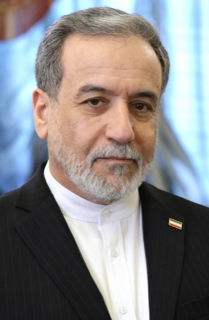 AA
AAthe US must choose \u2014 ceasefire or continued war via Israel. It cannot have both.
Itamar Ben Gvir, then Israeli National Security Minister, made the Israeli government's position explicit [3]:
Itamar Ben Gvir (Israeli National Security Ministry): Israel is "not bound by agreements that put an end to its ability to defend itself."
What do mediators say about the path forward?
A Middle Eastern diplomat told the Times of Israel what the guarantee problem looks like from the mediating side [9]:
Middle Eastern diplomat (Times of Israel interview): But [Hamas] asks us if they agree to a deal, whether we can guarantee that Israel will stick to it. Given the way the ceasefire has gone to date, it's harder for us to answer that in a satisfactory way.
Middle Eastern diplomat (Times of Israel interview): The closer we get to elections, the harder it gets to convince Israel to even respond to requests, let alone accept them.
A US official told the same outlet what continued stall means on the ground [9]:
US official (Times of Israel interview): The status quo in Gaza wouldn't be maintained in the interim. It could well get worse.
Gershon Baskin, Israeli-Palestinian dialogue practitioner and Jerusalem Post columnist, gave the clearest prescription for what the Board of Peace should do absent a final agreement [29]:
Gershon Baskin (Jerusalem Post): But the people of Gaza cannot be held hostage to hesitation or endless negotiations. Even without a final Hamas agreement, the Board of Peace must begin now with concrete, visible, irreversible steps on the ground.
Gershon Baskin (Jerusalem Post): Law and order cannot be postponed until the end of the political process; it is the beginning of the process.
Gershon Baskin (Jerusalem Post): if Gaza is once again allowed to be under the bombardment of Israel and the terror of Hamas, if implementation is delayed until every political issue is resolved, then the ceasefire will officially come to an end, Hamas will try to control larger parts of the territory, Israel will remain inside Gaza, and the people of Gaza will continue to live without security, shelter, dignity, or hope.
Baskin's logic is correct and his prescription has not been followed. The Board of Peace has not begun irreversible steps. The NCAG has not entered Gaza. Israeli fortifications are going up, not coming down. Seven months of managed paralysis have produced a framework that exists on paper and nowhere else.
Rami Hijjo, a Gaza civil society representative who testified before the Security Council, reduced the situation to one sentence [20]:
Rami Hijjo (Gaza civil society, UN Security Council): The ceasefire has yet to bring safety.
Jonathan Miller, Israel's deputy ambassador to the UN, told the Security Council what the Israeli government's bottom line on diplomacy is [27]:
Jonathan Miller (Israeli Mission to the UN): diplomacy can only work when the parties involved are prepared to treat it as a path to implementation, rather than as a mechanism for delay.
Miller's statement applies with equal force to Israel's own conduct on Phase 1 withdrawal and aid access. The desk reads it as a verdict the Israeli government has not enforced against itself.
The question no actor has answered: if the Board of Peace's mandate expires December 31, 2027, and the 15-point roadmap is still unfinalized, what institution inherits the transition and under what authority does it operate?
Disarmament‑for‑governance tradeoffs: can sovereignty be sequenced?
The desk's verdict: disarmament-first sequencing, as currently designed, cannot produce Palestinian sovereignty. It can only defer it. The eight-month Board of Peace plan conditions reconstruction, Israeli withdrawal, and a governance handover on Hamas laying down weapons first. That sequencing inverts every documented precedent of successful demilitarization. The IRA did not fully disarm until 2005, eleven years after the 1994 ceasefire. The FARC integration process ran reconstruction parallel to decommissioning. Demanding surrender before security is a formula for collapse, not stability.
Is Disarmament the "Single Factor" or a Category Error?
Nickolay Mladenov, the Board of Peace's high representative for Gaza, told the UN Security Council that Hamas's refusal to decommission is the primary bottleneck blocking all downstream progress [5].
Nickolay Mladenov (Board of Peace, High Representative for Gaza): "not simply to preserve a ceasefire. It is to move Gaza out of a permanent cycle of war and humanitarian collapse toward recovery, reconstruction and Palestinian self-governance. It is built around restoring civilian life, rebuilding Gaza's economy and institutions, and creating a credible pathway toward Palestinian self-determination and statehood."
The Board of Peace's formal report to the Security Council put the bottleneck in plainer language [16]:
Board of Peace (official report to UN Security Council): "The critical variable — the single factor that unlocks every other element of the plan — is the conclusion of an agreement on the Roadmap for the full implementation of the plan that includes full decommissioning by Hamas and all armed groups in Gaza."
The logic is internally coherent: no donor government will finance reconstruction where armed factions retain operational capacity. Mladenov made that financial argument explicit before the Security Council [23]:
Nickolay Mladenov (Board of Peace, High Representative for Gaza): "Those people are likely to remain trapped in the rubble, dependent on aid with no meaningful reconstruction, because reconstruction financing will not flow where weapons have not been laid down."
Alan Shatter, a Board of Peace member, read the same imperative as a moral premise [1]:
Alan Shatter (Board of Peace member): "The first Board of Peace report to the UN Security Council depicts Hamas disarmament as the 'single factor' needed to unlock reconstruction in Gaza, Israeli withdrawal and a pathway to Palestinian statehood."
The problem is not the goal. The problem is the sequence.
What Does the Precedent Record Actually Show?
Alpaslan Özerdem, dean of George Mason University's Carter School for Peace and Conflict Resolution, reviewed the demobilization literature and found that the Board of Peace's sequencing inverts what actually works [9]:
Alpaslan Özerdem (George Mason University, Carter School for Peace and Conflict Resolution): "Disarmament is 'rarely the beginning of peace.'" Özerdem lists a slew of reciprocal steps usually required before disarmament such as "ceasefire consolidation, withdrawal arrangements, security guarantees, third-party monitoring, humanitarian access, and reconstruction."
The Northern Ireland case is instructive. Thomas Leahy, the conflict historian, found that even after the IRA and British government signed the 1994 ceasefire, a mediation gap produced two years of stalling [9]:
Thomas Leahy (conflict historian): "In Northern Ireland, even after the Irish Republican Army and the British government signed a ceasefire in 1994, a lack of proper mediation led to two years of stalling. Leahy notes that the Irish government 'took the initiative to bring in a third party because talks were going nowhere.'"
Jared Hillel, writing for Responsible Statecraft, drew the Colombia parallel directly [2]:
Jared Hillel (Responsible Statecraft): "The plan to disarm Hamas presumes military surrender precedes political inclusion, yet Northern Ireland and Colombia prove the opposite sequence works."
The RAND Corporation studied 648 armed groups across six decades. Its research found that only 7% were defeated militarily. Forty-three percent ended through a transition to a political process, dialogue, or peaceful accommodation with their government. The share that accepted disarmament before political inclusion was negligible [22].
Muhammad Shehada of the European Council on Foreign Relations read those numbers and drew an operational conclusion. Shehada, a Palestinian analyst who studies Hamas's internal politics, found that moderate factions inside Hamas have signaled openness to decommissioning offensive arms, but only within a genuine political track [22]:
Muhammad Shehada (European Council on Foreign Relations): "Hamas leaders envisage decommissioning as a gradual, negotiated process coupled with a genuine political track leading to an end of the broader Israeli-Palestinian conflict."
Nadav Eyal, the Israeli journalist and security commentator, went further and challenged the factual premise of the entire exercise [22]:
 NE
NEDisarming is really not going to happen for two reasons. First of all, Hamas isn't going to agree to that in the way we think about disarmament. And secondly, even if they will, no one will be able to verify it.
Ronen Bar, the former Shin Bet director, offered the structural limit in five words [22]:
Ronen Bar (former Shin Bet director): "As long as there are Palestinians in Gaza, there will be Hamas in Gaza."
Does the Eight-Month Plan Hold Together on Its Own Terms?
The Board of Peace's five-stage, eight-month plan, as reported by Al Jazeera from leaked documents, links Hamas decommissioning to reciprocal Israeli steps [7]. Mladenov's own framing was bilateral [7]:
Nickolay Mladenov (Board of Peace, High Representative for Gaza): "Decommissioning [arms] proceeds in parallel with staged withdrawal."
The plan also acknowledged that Israeli compliance is not guaranteed [5]:
Nickolay Mladenov (Board of Peace, High Representative for Gaza): "Implementation cannot advance through Palestinian obligations alone. The continued killings, Israeli restrictions, and delays affecting humanitarian flows are not abstract issues."
The text of the plan, and the practice of its implementation, diverged sharply. Jared Hillel reported the Phase 1 breakdown [2]:
Jared Hillel (Responsible Statecraft): "Israel never fully implemented its side of Phase 1, opting instead to continue striking the enclave and restricting the flow of aid into Gaza."
Hillel identified who absorbed the blame for that breakdown [10]:
Jared Hillel (Responsible Statecraft): "Israel, the U.S., and much of the international community have pointed to this rejection to frame Hamas as the sole obstacle to peace, blaming the militant group for the stalled second phase."
A senior Hamas official, speaking to the BBC, laid out the group's counter-sequencing demand [28]:
Senior Hamas official (Hamas political leadership): "We are waiting for Mladenov to provide a clear timetable for Israel to fulfil the remaining obligations of phase one, along with guarantees to halt Israeli violations, before any discussion of phase two begins."
Muhammad Shehada, analyzing the Arabic text of the roadmap, found a territorial asymmetry built into the plan's fine print [17]. The roadmap states that Israeli forces would withdraw in phases only after verified progress in the "identification, restriction and collection" of weapons. Even in the final phase, Israel would withdraw "except for a security perimeter" until Gaza is deemed secure from any renewed threat [17]. Shehada warned that the proposal could allow Israel to retain around 18 percent of the Strip, including some of Gaza's most fertile agricultural land, even after weapons and militias are removed [17].
That territorial asymmetry is not a drafting error. It reflects Israel's stated position.
Israeli Deputy Ambassador Jonathan Miller told the Security Council [3]:
Jonathan Miller (Israeli Deputy Ambassador to the UN): "diplomacy can only work when the parties involved are prepared to treat it as a path to implementation, rather than as a mechanism for delay."
Israeli Deputy Minister Yossi Fuchs put the alternative more directly: if Hamas does not disarm, the military will need to return to "complete the mission" in Gaza [20].
Can Hamas's Own Position Be Read as Negotiating Room?
Khaled Meshal, the former Hamas political bureau chief, framed disarmament as civilizational [20]:
Khaled Meshal (former Hamas political bureau chief): "to take away weapons from Palestinians was to take away their soul"
That formulation sounds absolute. The operational picture is more granular.
Husam Badran, a Hamas political bureau member, told reporters the group's real position: weapons would not be visible in public, but that is not a formal surrender [19]. Hamas also indicated to mediators that it would be willing to suspend military activities and store heavy weapons in warehouses under third-party supervision, or hand them over to the Palestinian Authority [24].
Jared Hillel (Responsible Statecraft): "When the Trump plan was announced, Hamas indicated support for sequenced decommissioning that proceeds in tandem with reciprocal steps by the Board of Peace and Israel. The group had previously indicated to mediators that it would be willing to suspend military activities and store its heavy weapons in warehouses under third party supervision or even hand them over to the PA."
Palestinian Islamic Jihad drew the ideological line underneath that flexibility [31]:
Palestinian Islamic Jihad (official statement): "The weapons of the resistance belong to the Palestinian people and constitute a fundamental means to achieve their national goals, foremost among them ending the occupation and establishing an independent state."
The gap between Meshal's soul-language and Badran's warehouse-storage offer is the negotiating space. Reuters reported that in private, Hamas officials have voiced openness to disarmament so long as it is done along a political track that would see the establishment of a Palestinian state [15]. The 12-point plan makes no mention of Palestinian statehood or independence, and Israel under Prime Minister Benjamin Netanyahu has repeatedly ruled out this possibility [15].
A plan that asks Hamas to relinquish its weapons while offering no political horizon is not asking for demilitarization. It is asking for surrender.
Hillel's analysis for Responsible Statecraft named the structural conclusion plainly [24]:
Jared Hillel (Responsible Statecraft): "A rigid stance demanding total, instant disarmament before political or humanitarian milestones are reached risks collapsing the entire negotiation structure, whereas prioritizing a phased, conditional template based on historical peace processes offers the only viable path to long-term stability and security regarding Hamas's weapons."
What Security Architecture Could Actually Bridge the Gap?
As Theme 6: Ceasefire frameworks since 2025 established, the October 2025 ceasefire produced a pause but no institutional architecture. The Board of Peace's 15-point roadmap remains unfinalized. The National Committee for the Administration of Gaza has not entered Gaza. The IDF controls 64 percent of Gaza's territory while building fortifications [previous themes context].
Mladenov's five-principle plan offers the clearest bridge proposal on record [14]. It calls for: reciprocity with IDF withdrawal; sequenced decommissioning starting with the most dangerous weapons; verification linked to reconstruction; reintegration pathways for armed group members into civilian life; and a flexible timeline. The plan also calls for a new professional Palestinian police force and a civilian administration with a stake in stability [14].
Nickolay Mladenov told the Security Council the risk of inaction [23]:
Nickolay Mladenov (Board of Peace, High Representative for Gaza): "The risk is that the deteriorating status quo becomes permanent: a divided Gaza, Hamas holding military and administrative control over two million people across less than half the territory."
Mediators from Egypt, Qatar, and Turkey proposed merging Phase 1 and Phase 2 obligations to accelerate progress [27]. Under that merged model, Hamas's weapons would be inventoried and surrendered under the supervision of a Palestinian party, mediators, and the UN-mandated International Stabilization Force. In exchange, Israel would announce a withdrawal timeline, allow humanitarian aid, and permit non-partisan Palestinian technocrats to administer Gaza's daily affairs [27].
Hamza Hendawi of The National reported the logic of the merged-phase proposal [27]:
Hamza Hendawi (The National): "Hamas had already signalled readiness to surrender heavy weapons under the terms of the Trump plan, but wants to keep its firearms for personal protection, a proposal Israel has already rejected, insisting the militant group must give up all its arsenal."
A Palestinian official close to the talks told Reuters the structural problem with any version of the current plan: it does not provide guarantees Israel would carry out its obligations, and it would risk causing the war to resume by linking reconstruction to political issues like disarmament before either side has demonstrated compliance [29].
Mediators operating with Egypt, Qatar, and Turkey summed up the architecture's dependency problem in plain terms [6]:
Middle Eastern diplomat (regional mediator): "But [Hamas] asks us if they agree to a deal, whether we can guarantee that Israel will stick to it. Given the way the ceasefire has gone to date, it's harder for us to answer that in a satisfactory way"
That admission is the clearest single statement of why every sequencing proposal has stalled. The mediators cannot guarantee Israeli compliance. Hamas will not move first without that guarantee. Israel will not withdraw without verified decommissioning. The triangle has no entry point.
The desk's position: the only architecture with a documented track record is decommissioning-as-outcome, not decommissioning-as-prerequisite. Mladenov's plan gestures at reciprocity but structurally privileges Israeli security thresholds over Palestinian political milestones. Until the plan carries a binding statehood horizon, Hamas's private flexibility will never translate into public compliance, and the warehouse-storage offer will expire without an institution to hold the keys. What no document in this record answers is who verifies Israeli withdrawal obligations with the same enforcement weight the Board of Peace applies to Hamas decommissioning.
International law fault lines: jus ad bellum/in bello, siege, and accountability
The Desk's Verdict Up Front
Israel's military campaign in Gaza violated jus ad bellum proportionality. The siege constitutes a war crime under the Rome Statute. The ICC prosecution of Netanyahu and Gallant for starvation as a method of warfare is legally grounded and historically unprecedented. International law did not fail in Gaza because its rules were absent. It failed because the states with the power to enforce them chose not to.
That verdict rests on the work of 27 sources read for this theme, 14 of which are quoted or paraphrased below.
Does Jus ad Bellum Survive Contact with an Ongoing War?
Israel's government maintained throughout Operation Swords of Iron that once armed conflict begins, jus in bello, the law governing how war is conducted, displaces jus ad bellum, the law governing whether force may be used at all. Gal Cohen, a public international law scholar at University College London, calls that position an outlier with no peer in state practice.
Gal Cohen (University College London, international law): No other state except for Israel has argued that the right of self-defence continues to justify the use of force throughout an armed conflict.
Gal Cohen (University College London, international law): the interaction between jus ad bellum and jus in bello should not be interpreted in a manner that would render their regulatory power practically meaningless for extended periods.
The displacement argument is not merely heterodox. It is strategically functional: if jus ad bellum drops away once hostilities begin, Israel faces no ongoing legal obligation to justify scale, duration, or targeting beyond the rules of engagement set by IHL alone. Cohen's UCL analysis rejects this directly.
Michael N. Schmitt, the West Point legal scholar who edited the Lieber Institute symposium series on this conflict, reaches the same structural conclusion. Schmitt contends that jus ad bellum and IHL are distinct bodies of law that generally do not displace each other. They apply in tandem. Self-defense criteria continue to govern both the lawful continuation of force (necessity) and its permissible scale and scope (proportionality), while IHL limits how operations may be conducted [1].
Schmitt does allow that "total victory" can be a lawful desired end state in certain contexts [1]. Claus Kreß, the international law scholar at the University of Cologne whose analysis appears in the Israel Law Review, pushes back on what that concession allows in practice. Kreß contends that Israel's operations likely became quantitatively disproportionate by March 2025 [15]. Proportionality under jus ad bellum, he makes clear, carries a quantitative dimension even against non-state armed groups operating from an unwilling or unable host territory.
Claus Kreß (University of Cologne, international law): the fact that the host state does not incur state responsibility for wrongful conduct with respect to the non-state attack does not mean that the host state could not be liable to tolerate, on its territory, forcible action by the victim state defending against the attack.
The "unable host" scenario opens the door to self-defense against non-state actors. Kreß reads that door as narrow. Israel walked through it at scale.
Was the Strategic Objective Itself Lawful?
Stanford Law School's international law faculty published a three-step proportionality analysis of Israel's stated war aim: removing Hamas from political power and eliminating its military capabilities. The analysis is unsparing.
Stanford Law School (international law faculty): Israel had a right of self-defense, and that Israel's specific war aim of removing Hamas from political power and eliminating its military capabilities fell within the legitimate boundaries of self-defense.
Stanford Law School (international law faculty): Israel's specific war aim required means that would foreseeably cause excessive damage and harm in this context, due to circumstances in Gaza that were well-known to Israeli officials.
Stanford Law School (international law faculty): Israel accordingly violated proportionality in pursuing this specific war aim.
Bailey Ulbricht and Allen Weiner, writing in Lawfare, frame the same conclusion in operational terms.
Bailey Ulbricht, Allen Weiner (Lawfare, international law): Israel should have anticipated even before it launched Operation Swords of Iron that it could not achieve this strategic objective without causing excessive damage and harm to civilians.
Former Israeli Prime Minister Ehud Olmert reaches the same verdict from inside the Israeli political class.
Ehud Olmert (former Prime Minister of Israel): what Israel is doing right now in Gaza is "a war of devastation," and that the war's continuation has been without justification, accusing the Israeli military of acting "over-aggressively" in Gaza.
The desk reads Olmert not as a moral witness but as a data point: when a former Israeli Prime Minister describes his country's military campaign as a "war of devastation" without justification, the proportionality violation is no longer a claim held only by external critics.
Caroline Turner, writing in a Q&A analysis for UK Lawyers for Israel, sets out the IHL proportionality standard in its formal terms.
Caroline Turner (UK Lawyers for Israel, international law): An attack is disproportionate if it may be expected to cause incidental civilian casualties and/or damage to civilian objects which would be excessive in relation to the concrete and direct military advantage anticipated.
Caroline Turner (UK Lawyers for Israel, international law): This is assessed by reference to the judgment of a reasonable military commander in the circumstances at the time with the information then known to the commander of the attack.
Turner's own framing cuts against Israel's operational record. The IPC confirmed Phase 5 famine in Gaza Governorate by August 22, 2025 [12]. No reasonable military commander standard absorbs a confirmed famine as within proportionate collateral expectation.
Does the Siege Cross the Legal Line into Starvation?
The law on siege warfare is deliberately calibrated. Sieges are not prohibited under IHL. What is prohibited is using siege conditions to starve a civilian population as a method of warfare. The line between military blockade and criminal starvation runs through intent.
The International Committee of the Red Cross drew the formal boundary clearly.
International Committee of the Red Cross: The prohibition of starvation as a method of warfare does not prohibit siege warfare as long as the purpose is to achieve a military objective and not to starve a civilian population.
The question is whether Israel's siege met that condition. The ICC Pre-Trial Chamber I concluded it did not.
Pre-Trial Chamber I of the International Criminal Court: The Chamber considered that there are reasonable grounds to believe that both individuals intentionally and knowingly deprived the civilian population in Gaza of objects indispensable to their survival, including food, water, and medicine and medical supplies, as well as fuel and electricity, from at least 8 October 2023 to 20 May 2024.
The opening statement came directly from the Israeli Defense Minister. Yoav Gallant, on October 9, 2023, addressed Israeli forces.
Yoav Gallant (Israeli Defense Minister): We are putting a complete siege on Gaza … No electricity, no food, no water, no gas – everything is closed.
Anjli Parrin, writing in Just Security's expert panel analysis of the ICC applications, places that statement in its legal context.
Anjli Parrin (Just Security, international law): the war crime of starvation has never been prosecuted at the international level. Moreover, for the first time, the ICC has brought to the fore the increasingly common overlapping fact-bases of (urban) siege warfare and concomitant starvation crimes that have been documented by independent fact-finding bodies.
Anjli Parrin (Just Security, international law): it is a crime of intent and not of result. There is no requirement that anyone should have died of starvation or that any military advantage was gained.
The intent standard is where Israel's defense most clearly collapses. Netanyahu's March 2, 2025 public policy shift, halting all aid to Gaza until a ceasefire and hostage release, transformed any "safeguard" defense into a documented quid pro quo. Rob McLaughlin, the international law scholar whose analysis feeds the ICC conditionality article, contends it would be perverse to discount the starvation offence simply because aid impediment was one mechanism among several rather than the sole mechanism [3].
Boyd van Dijk, writing in Foreign Affairs, frames the prosecution's historic significance.
Boyd van Dijk (Foreign Affairs, international law historian): By publicly declaring Israel's intention to impose a total siege of Gaza and then enforcing measures that deprive Gazans of food and other goods that are indispensable to civilians' survival, the ICC prosecutor alleges, Netanyahu and Gallant have committed the war crime of starvation. It is the first time in history that a major court has centered a war crimes prosecution on this particular charge.
Boyd van Dijk (Foreign Affairs, international law historian): Despite its long and devastating history, intentional starvation of a civilian population is notoriously difficult to prove, and belligerents that have used the tactic have rarely been held to account.
The prosecution difficulty is real. Lucy Gaynor and Anne Van Mourik, writing for Justice Info, identify the core evidentiary problem.
Lucy Gaynor; Anne Van Mourik (Justice Info, international law): Determining intent, a crucial element in legal proceedings (particularly in proving genocide), becomes particularly challenging in cases of starvation, where it can be seen as both a deliberate tactic and an unintended consequence of broader policies.
The ICC prosecutor's answer to that challenge is the documentary record. Gallant's October 9 statement, the Cogat internal famine warnings revealed in Shmuel Lederman's Israeli study, and Netanyahu's March 2025 aid halt together constitute a chain of documented intent that does not depend on inference.
Lederman, an Israeli scholar whose work was reported in Middle East Eye, concluded that starvation in Gaza resulted from deliberate planning, experimentation, and manoeuvring around the humanitarian "red line," aimed in part at managing international pressure on Israel during the war [16].
R. Field, writing in the Buffalo Human Rights Law Review, reaches the same legal conclusion from the IHL framework.
R. Field (Buffalo Human Rights Law Review, international law): Israel has thus far failed to meet its legal obligation under IHL because the small amount of aid it is allowing to enter Gaza is insufficient to prevent the mass starvation of Gazan civilians.
The UN's IPC mechanism, the Integrated Food Security Phase Classification, stated without qualification: "The worst-case scenario of Famine is currently playing out in the Gaza Strip" [14]. Tom Dannenbaum, the international law scholar at the Fletcher School at Tufts, and Alex de Waal, the famine scholar at the World Peace Foundation, wrote jointly with co-authors that for almost 22 months Israel pursued a policy of depriving Gaza's population of food, water, medical provisions, and the conditions of a dignified life [14].
How Did the Israeli Supreme Court Handle This?
Five Israeli human rights organizations petitioned the Israeli Supreme Court for an order requiring unimpeded humanitarian aid access to Gaza. Chief Justice Yitzhak Amit wrote the unanimous rejection. The Opinio Juris autopsy of the ruling identifies three strategies the Court deployed to legitimate Israel's position: restricting the applicable legal framework, disregarding the petitioners' submitted evidence, and using judicial timing as a tool of legitimation [4].
The Court's framework restriction had a specific doctrinal move at its center. It concluded Israel is not an occupying power in Gaza by requiring physical presence and actual exercise of governmental authority. Safaa Sadi Jaber and Ilias Bantekas, writing in the International and Comparative Law Quarterly, contest that reading directly. Their functional approach to occupation law holds that Israel's technological superiority, comprehensive regulation of all movement of persons and goods, and long prior occupation allow remote control that satisfies the effective control test without boots on the ground [13].
Nuremberg Military Tribunal (1945): Whether an invasion has developed into an occupation is a question of fact. The term invasion implies a military operation while an occupation indicates the exercise of governmental authority to the exclusion of the established government.
Jaber and Bantekas read that standard as satisfied by Israel's documented control over Gaza's borders, airspace, and population registry. The Israeli Supreme Court read the same standard and reached the opposite conclusion by requiring physical presence the law's text does not mandate.
As Theme 2: Gaza's political genealogy established, the formal occupation-status debate is a genuine disagreement among international lawyers. The accountability question, per the desk's reading across this source set, does not depend on its resolution. The starvation war crime charge does not require occupying power status. The IHL prohibition on using starvation as a method of warfare binds all parties to an international armed conflict.
Belligerent Intent and the Real-Time Evaluation Problem
Tom Dannenbaum, the Fletcher School international law scholar, and Janina Dill, the Oxford ethics of war scholar, identify what they call the functional differentiation problem at the center of international law's Gaza failure. IHL has three jobs: it must guide conduct before and during conflict (ex ante action-guidance), it must allow third states to evaluate ongoing conduct and meet their own legal obligations (concurrent evaluation), and it must establish accountability after the fact (ex post accountability). In Gaza, all three ran at once, under conditions of information warfare, classified targeting data, and political pressure.
Dannenbaum and Dill contend that IHL must discharge its action-guiding and evaluative functions while hostilities are ongoing or not at all [9]. The concurrent evaluation function is where third states bear their own legal exposure.
Vladyslav Lanovoy and co-authors, writing in Just Security's arms transfers analysis, put the third-state question plainly: business as usual is no longer an option for states providing arms and military equipment to Israel. They must undertake not only a moral and political but also a legal assessment of the implications of that support [22].
The UK's Strategic Export Licensing framework and Germany's own legal reviews were both cited in the Lanovoy analysis as examples where state interpretations diverged from the settled understanding of international law on knowledge and risk thresholds [22].
Lucy Gaynor and Anne Van Mourik, writing on the historical development of starvation law, place the codification problem in context.
Lucy Gaynor; Anne Van Mourik (Justice Info, international law): While starvation was undoubtedly recognized as a genocidal tactic, its place in the convention was reduced to an implication of Article 2(c), "deliberately inflicting upon the group conditions of life calculated to bring about its physical destruction in whole or in part."
The Rome Statute's explicit war crime of starvation at Article 8(2)(b)(xxv) filled that gap for international armed conflicts. The ICC prosecutor's Gaza applications are the first activation of that provision at prosecution level.
Can AI-Assisted Targeting Satisfy IHL Distinction and Proportionality?
The IDF's documented use of the Lavender, Where's Daddy, and Gospel AI targeting systems in Gaza compresses the kill chain from days to seconds [12]. Jackson Marwa Oringa and Stella Nyana Ahanor, in their East African Journal of Law and Ethics IHL analysis, frame the core legal problem: algorithm-driven systems must reliably differentiate combatants from civilians in densely populated environments, and proportionality assessments that require contextual human judgment cannot be meaningfully exercised when operational decisions rely on automated outputs [23].
John Merriam, whose 2015 research visit to IDF targeting facilities informed the Lieber Institute symposium analysis, contends that Israeli positions on targeting law fall within the mainstream, and that the IDF's Military Advocate General Corps provides real-time legal advice during operations [25]. Merriam also acknowledges that the IDF faces an enemy that uses civilians as cover not as a tactic but as its central strategy [25].
The desk reads the AI targeting question as the unresolved edge of IHL doctrine for this conflict and for every urban conflict that follows. The Lavender system reportedly assigned kill authorization at a civilian-to-combatant acceptable ratio that IDF commanders set in advance. If a predetermined statistical ratio substitutes for case-by-case proportionality assessment, the proportionality rule has been hollowed procedurally even when followed formally.
Jens Iverson, the Grotius Centre public international law scholar at Leiden, takes the infrastructure argument into territory the targeting debate rarely reaches. Iverson contends that Israel is legally, ethically, and prudentially obligated to protect, supply, and rebuild water resources in Gaza, and that this obligation runs before, during, and after the armed conflict [8]. The IPC confirmed famine in Gaza's Governorate on August 22, 2025 [12]. The December 2025 IPC update partially walked that declaration back after the October ceasefire, but classified the situation as "highly fragile" [12].
What Accountability Venues Actually Exist?
Three venues are active. The ICC holds arrest warrants for Netanyahu and Gallant on starvation charges. The ICJ is hearing South Africa's genocide case under the Genocide Convention, with provisional measures already issued. UN human rights bodies, including the six Special Rapporteurs cited in Theme 5: Humanitarian devastation and the politics of reconstruction, have made findings of their own.
None of these venues carries enforcement capacity independent of state cooperation. The United States withdrew from the ICC's jurisdiction and imposed sanctions on ICC prosecutor Karim Khan. Israel is not a Rome Statute signatory. ICC President Tomoko Akane told the European Parliament in March that the court faces an existential threat [21].
Boyd van Dijk frames the institutional stakes.
Boyd van Dijk (Foreign Affairs, international law historian): the ICC's prosecutor, Karim Khan, accuses them of orchestrating a criminal starvation policy against Gaza's civilian population. In its classification of war crimes, the Rome Statute, the 1998 treaty that established the ICC, includes "intentionally using starvation of civilians as a method of warfare," a tactic that can involve "willfully impeding relief supplies."
Jeremy Bowen, the BBC's international editor, states the basic normative claim.
Jeremy Bowen (BBC, international affairs): Even wars have rules. They don't stop soldiers killing each other but they're intended to make sure that civilians caught up in the fighting are treated humanely and protected from as much danger as possible. The rules apply equally to all sides.
Lord Sumption, the former UK Supreme Court Justice, makes the same point with a sharper edge.
Lord Sumption (former UK Supreme Court Justice): The terrible Jewish experience of persecution and mass killing in the past should give Israel a horror of inflicting the same things on other peoples.
Helena Kennedy, the British barrister and human rights advocate, places third-state complicity at the center.
Helena Kennedy (British barrister, human rights law): The Holocaust has filled us all with a high sense of guilt, and so it should because we were complicit. But it also teaches us the lesson that we mustn't be complicit now when we see crimes being committed.
The accountability gap in Gaza is not doctrinal. The law is written. The charges are filed. The proportionality violations are documented by satellite imagery, IPC famine classifications, and Israeli officials' own public statements. The gap is enforcement, and enforcement is a political question dressed in legal language.
Dannenbaum and Dill's framework closes the analytical circle. The coincidence of Israel's compliance claim with catastrophic civilian suffering demands that international law discharge its functions in real time, distinguishing ex ante action-guidance and concurrent third-party evaluation while hostilities are ongoing from longer-term ex post accountability [2]. The question their framework cannot answer is whether any institution will compel that discharge, or whether the ICC's Gaza prosecution becomes a monument to a legal order that named the crime and could not reach the defendant.
West Bank spillovers: settlements, settler violence, and dual legal regimes
Is Settler Violence a Spontaneous Problem or an Instrument of State Policy?
The desk's verdict is unambiguous: settler violence in the occupied West Bank is not a law-enforcement failure. It is a delivery mechanism for territorial annexation, operating with state authorization, military protection, and political impunity. The documentation comes not from advocacy groups alone but from UN treaty bodies, the Office of the High Commissioner for Human Rights, and the Secretary-General's own reporting to the Security Council.
Srinivasan Muralidhar, Chair of the UN Independent International Commission of Inquiry on the Occupied Palestinian Territory, put the causal chain in a single sentence.
Srinivasan Muralidhar (Chair, UN Independent International Commission of Inquiry): Violence by settlers is the direct outcome of Israeli policies that support, enable and protect their actions.
The Commission's June 2026 report did not stop there. Muralidhar named the structural convergence between state and non-state actors in the West Bank.
Srinivasan Muralidhar (Chair, UN Independent International Commission of Inquiry): What is alarmingly similar is the deliberate infliction of suffering on Palestinian civilians. While their origins and motivations differ, both operate within environments engineered by Israel.
The Commission attributed settler violence to a policy function: it "functions as a means of implementing Israeli state policy," with both settlers and Israeli security forces focused on "entrenchment of Israeli settlements, annexation of Palestinian territory and displacement of Palestinians from their land" [1][5][6].
That framing is contested. Israel has consistently rejected Commission findings as biased and has maintained that settlements do not violate international law [17]. The desk treats Israel's position as it stands: a documented formal denial, contradicted by the voting record of every UN Security Council resolution on the subject and by the ICJ's 2004 advisory opinion.
What Do the Numbers Actually Show?
The UN High Commissioner for Human Rights documented 1,732 incidents of settler violence causing casualties or property damage in the period up to October 31, 2025, up from 1,400 in the prior comparable period [8]. That is a 24-percent increase in one year [24]. Thirteen UN Special Rapporteurs, writing jointly in 2026, called it a threshold crossing.
UN Special Rapporteurs (thirteen mandate-holders, UN Human Rights Council): Settler brutality has reached unprecedented levels this year.
UN Special Rapporteurs (thirteen mandate-holders, UN Human Rights Council): Violence is used as a calculated, targeted tool to deny Palestinians access to essential services, agricultural and grazing areas, with the ultimate aim of severing the people's connection to the land.
By April 2026, OCHA documented 925 movement obstacles in the West Bank, the highest in 20 years [28]. More than 50 settler attacks occurred in a single week in May 2026 alone, producing casualties and property damage [11]. The Commission of Inquiry found that Israeli security forces directly accompanied settlers during attacks or acted to protect them, producing what Sana Khan, writing in Modern Diplomacy, described as "a climate of impunity" and "a structural breakdown in the distinction between civilian settlers and state security forces" [17].
At least 13 Palestinians were killed and nearly 500 injured by settlers in the first five months of 2026 [14]. In the West Bank overall, over 1,071 Palestinians were killed by Israeli forces and settlers after October 2023 [24].
The 2025 olive harvest season was the worst in decades. Settler interference prevented Palestinian farmers from reaching groves. OCHA has documented the demolition of roughly 550 structures in 18 Bedouin communities since 2009 for lacking Israeli-issued building permits, including 175 donor-funded humanitarian structures [11].
Is the West Bank on a Separate Diplomatic Track, or the Same One?
Ramiz Alakbarov, UN Special Coordinator for the Middle East Peace Process, delivered the April 28, 2026 Security Council briefing with a deliberate framing.
Ramiz Alakbarov (UN Special Coordinator, UNSCO): The tensions and hostilities that have upended the Middle East over the past weeks have shifted attention from the situation in the Occupied Palestinian Territory. Away from the spotlight, the situation in Gaza and the West Bank, including East Jerusalem, is steadily worsening.
The West Bank deterioration is not incidental to the Gaza war. The UN Human Rights Commissioner's report (A/HRC/61/26) concluded that Israeli practices across both territories "indicated a concerted and accelerating effort to consolidate annexation of large parts of the Occupied Palestinian Territory and to deny Palestinians' right to self-determination" [9]. The geographic simultaneity is the point: displacement in Gaza and displacement in the West Bank reinforce a single territorial logic.
As Theme 4: Bridging the Palestinian split established, the Palestinian Authority faces nine months of withheld clearance revenues and public debt exceeding USD 14 billion. The fiscal collapse compounds the West Bank security vacuum. The PA's erosion of governing authority leaves Area C, and increasingly Areas A and B, without a Palestinian administrative counterweight to Israeli Civil Administration expansion.
Settlement Expansion by the Numbers: What Resolution 2334 Required and What Happened
UN Security Council Resolution 2334, adopted in 2016, called on Israel to "immediately and completely cease all settlement activity in the occupied Palestinian territory, including East Jerusalem." Alakbarov told the Security Council in March 2026 what actually happened.
Ramiz Alakbarov (UN Special Coordinator, UNSCO): Security Council resolution 2334 (2016) calls on Israel to "immediately and completely cease all settlement activity in the occupied Palestinian territory, including East Jerusalem" and to "fully respect all of its legal obligations in this regard." Settlement activity has, nevertheless, continued at high levels.
Ramiz Alakbarov (UN Special Coordinator, UNSCO): During the reporting period, Israeli planning authorities advanced or approved over 6,000 housing units in the occupied West Bank, including approximately 3,160 housing units in Area C, and 2,850 housing units in East Jerusalem.
The Israeli Housing Ministry simultaneously published tenders for 5,375 additional housing units in Area C, with 3,401 of those located in the E1 corridor [19]. The E1 development is not an administrative footnote. The UN High Commissioner for Human Rights determined that "The E1 development will physically isolate East Jerusalem from the rest of the occupied West Bank, in a manner that contributes to the fragmentation of the Occupied Palestinian Territory and the ongoing denial by Israel of the Palestinian people's right to self-determination" [13][21].
Ramiz Alakbarov (UN Special Coordinator, UNSCO): Citing the lack of Israeli-issued building permits, which are almost impossible for Palestinians to obtain, Israeli authorities demolished, seized or forced people to demolish 429 structures in the occupied West Bank, including East Jerusalem, displacing 575 persons, including 290 children and 150 women.
The permit system is the mechanism. Israeli building permits in Area C are, by OCHA's own documentation, structurally inaccessible to Palestinians [11]. Demolishing structures built without unobtainable permits is not a neutral code-enforcement action. It is a population-management instrument.
On February 8, the Israeli cabinet approved measures transferring Hebron municipal authorities, including construction permits near the Ibrahimi Mosque/Tomb of the Patriarchs, to Israeli authorities. On February 15, it allocated 244 million shekels (approximately USD 78 million) to resume land registration in Area C [19]. The Israeli Defense Minister described the measures as "a revolutionary decision that does justice to the Jewish settlement enterprise in Judea and Samaria and will lead to its strengthening, consolidation and expansion" [21].
The Israeli Prime Minister's public statement on a future Palestinian state is recorded in the UN High Commissioner's report.
Israeli Prime Minister (public statement, documented in OHCHR A/HRC/61/70): There will be no Palestinian state! This place is ours.
Dual Legal Regimes: Two Populations, Two Systems of Law
The term "dual legal regime" describes a documented condition, not a contested framing. Israeli settlers in the West Bank live under Israeli civil law. Palestinians in the same territory live under military law administered by the Civil Administration, a body of the IDF. This distinction predetermines access to courts, property registration, permit systems, movement rights, and criminal procedure.
The UN High Commissioner for Human Rights concluded that Israeli practices amount to "an institutionalized regime of systematic discrimination, oppression, and violence by Israel against Palestinians, violating article 3 of the International Convention on the Elimination of All Forms of Racial Discrimination, which prohibits racial segregation and apartheid" [21]. That is not a metaphor. It is a treaty-law finding.
The appointment in October 2024 of a former engineer of the Shomron Settlement Regional Council as head of the planning bureau under the Civil Administration accelerated the pace of settlement approvals. UN reporting found that "plans often approved within days" replaced the slower prior administrative process [18]. The structural merger of settler organizational interests with the body that governs Palestinian construction permits in Area C closes the last administrative gap between state and settler action.
Ajith Sunghay, head of the UN Human Rights Monitoring Mission in the Occupied Palestinian Territory, framed the scale of the land seizure operation.
Ajith Sunghay (UN Human Rights Monitoring Mission): the pace of the concerted efforts by the Israeli government to seize as much Palestinian land as possible, with as few Palestinians in it as possible, is only becoming more relentless.
Ethnic Cleansing: When Does a Legal Category Apply?
Over 36,000 Palestinians were displaced in the West Bank in a single year, a figure the UN Human Rights Office described as unprecedented [24][26]. Since January 2023, over 100 West Bank villages have been fully or partially emptied, per UN data [27]. Amnesty International's 149-page June 2026 report, covering Bedouin and herding communities specifically, concluded that the forced displacement resulted from "a concerted state policy, and not just the actions of violent settlers" [27].
"Ethnic cleansing" as a legal threshold requires showing that displacement is deliberate, systematic, and aimed at permanent demographic change. The UN High Commissioner for Human Rights concluded in A/HRC/61/26 that "intensified attacks, the methodical destruction of entire neighbourhoods and the denial of humanitarian assistance appeared to aim at a permanent demographic shift" and that forcible transfers "appear to aim at a permanent displacement, raising concerns over ethnic cleansing in Gaza and the West Bank" [23].
A Palestinian resident identified only as Muntasi in the Amnesty International report described conditions on the ground.
Muntasi (Palestinian resident, Amnesty International documentation): What is happening right now is [the] erasure of humans, trees and stones, and anything that is Palestinian, by settlers under the support of the military.
Heba Morayef, Amnesty International's Middle East director, addressed a specific IDF killing of a Palestinian family.
Heba Morayef (Amnesty International, Middle East director): This horrific incident is the latest in a pattern of increasing use of deadly force by Israeli forces against Palestinians and tragically we continue to see families and children paying the price.
Heba Morayef (Amnesty International, Middle East director): We are deeply concerned that initial information and testimonies suggest the attack may amount to an extrajudicial execution.
Israel rejects the ethnic cleansing characterization and the apartheid finding. The desk records that rejection. The desk also records that 45 communities have been fully displaced since January 2023 [28], that Bedouin communities face demolitions, utility cuts, and coordinated settler attacks in areas like Umm al-Kheir [14], and that gender-based violence has become a driver of flight: over 70 percent of displaced households identified threats to women and children, including sexualized violence, as the decisive reason for leaving [28].
Can a Two-State Solution Survive What Is Being Built?
The UN Special Rapporteurs who issued the joint 2026 warning placed accountability at the center.
UN Special Rapporteurs (thirteen mandate-holders, UN Human Rights Council): Facing no pushback and no censure, Israel continues irreversibly eroding the Palestinians' right to self-determination enshrined in international law.
The word "irreversibly" is load-bearing. Settlement infrastructure, once built, does not unbuild itself. The E1 corridor, once developed, severs the territorial contiguity that a West Bank state requires. The land registration process in Area C, once completed under Israeli civilian law, creates property records that are legally and politically immovable.
Alakbarov's April briefing framed the Palestinian Authority's fiscal collapse as an existential threat to the institutional foundations of a future Palestinian state [4]. As Theme 5: Humanitarian devastation and the politics of reconstruction established, reconstruction in Gaza requires $71.4 billion over ten years and has not begun. West Bank administrative erosion runs in parallel, not in sequence.
UN human rights experts (joint statement, 2026): Relentless attacks by the settler-colonial movement, carried out with the support and acquiescence of the Israeli State, have become a daily terror in Palestinian lives.
UN human rights experts (joint statement, 2026): As diplomatic efforts are concentrated elsewhere in the region, accountability for the increasing violence of settlers and resulting displacement of people has slipped further from sight.
The diplomatic attention deficit is the structural risk. As Theme 6: Ceasefire frameworks since 2025 established, the sequencing deadlock consumes the political bandwidth of every regional mediator. The West Bank deteriorates in the gap. Samer Omar, a Palestinian resident of Deir al-Hatab, captured the lived arithmetic.
Samer Omar (Palestinian resident, Deir al-Hatab): There's no safety anymore. I want to raise the wall four or five metres higher, but will that help? May God protect us all.
The desk's position is this: the West Bank in 2026 does not face a law-enforcement problem that better policing could correct. It faces a territorial transformation with legal cover, military protection, and a stated policy goal of preventing Palestinian statehood. The accountability gap documented in Theme 8: International law fault lines applies here with equal force. Charges at the ICC address Gaza. The settlement enterprise in the West Bank operates, for now, outside any enforcement mechanism with teeth. What remains unanswered is whether any international actor with the capacity to impose costs will choose to do so before the physical infrastructure of annexation becomes the permanent baseline.
Two-State Viability vs One-State or Confederation: Re-Opening the Endgame Debate
The Verdict the Evidence Has Already Delivered
The classic two-state solution is not dying. It is dead as a near-term political project. The desk's position: the territorial, demographic, and political conditions that made partition conceivable in 1993 have been systematically demolished, and no credible voice in diplomacy, policy, or scholarship now believes the 1967-borders partition model is recoverable without a rupture in Israeli domestic politics that has no visible trigger. What survives is the principle of two-state outcomes, which can be delivered through architectures that the old Oslo framework never contemplated: confederation, federation, or parallel-state structures. Among those alternatives, confederation carries the most developed analytical support and the fewest catastrophic failure modes.
This is not a counsel of despair. It is the starting point for a more honest debate.
Is the Classic Two-State Model Already a Historical Object?
Khaled Elgindy, the Brookings Institution Middle East scholar, does not traffic in ambiguity on this question.
Khaled Elgindy (Brookings Institution): The Israeli-Palestinian peace process is dead—not "comatose" or on "life support," just plain dead.
Elgindy's bluntness is backed by arithmetic. Oslo's West Bank settlement population stood near 250,000 in 1993. Nigel Roberts and Riccardo Bocco, writing on Israeli-Palestinian federation at the Graduate Institute Geneva, put the current figure in plain view [19]:
Nigel Roberts; Riccardo Bocco (Graduate Institute Geneva): Oslo did nothing to halt the expansion of Israeli West Bank settlements, the population of which, at some 700,000, is three times what it was thirty years ago; nor has it done anything to resolve the plight of the Palestinian refugees, whose numbers have doubled to almost 6 million since the 1990s.
700,000 settlers across the West Bank and East Jerusalem. As Theme 9: West Bank spillovers established, Israeli planning authorities advanced over 6,000 additional housing units during the current reporting period, and the E1 corridor development threatens to permanently sever East Jerusalem from the rest of the West Bank. The geographic facts that a viable Palestinian state requires, contiguous territory, a capital in East Jerusalem, a defensible perimeter, are being erased faster than diplomacy can respond.
Elgindy's Brookings assessment extends the diagnosis [6]:
Khaled Elgindy (Brookings Institution): Although a two-state solution remains theoretically possible, the practical and political pillars of the classic two-state model have collapsed or are collapsing. This is mainly due to the enormous success of Israel's settlement enterprise.
Udi Dekel, the Institute for National Security Studies researcher, frames the same trend from within Israeli strategic analysis [8]:
Udi Dekel (Institute for National Security Studies): The central trend evident in the past decade within the Israeli–Palestinian conflict is a consistent and accelerated drift toward a one-state reality characterized by either Jewish supremacy or defined as binational, whether in principle or in practice, or a state for all its citizens.
Dekel's warning is directed at Israeli strategists who believe the status quo is stable. His analysis is that drift toward a one-state reality does not produce stasis. It produces escalation.
Udi Dekel (Institute for National Security Studies): Such an outcome is expected to severely undermine the Zionist vision of a Jewish, democratic, secure, and prosperous state.
Former Israeli Defense Forces Col. Pnina Sharvit Baruch, at INSS, reaches a similar dead-end reading all alternative one-state models. Her January 2026 memorandum, reviewing four configurations including unitary state, Palestinian autonomy, federal, and confederation formats, concludes that none of the models have any genuine prospect of being a permanent, stable, and successful solution to the Israeli-Palestinian conflict, primarily because free movement across populations with unresolved national claims generates friction that slides into armed confrontation [23].
The convergence of Elgindy, Dekel, and Baruch on the diagnosis is notable precisely because they arrive from incompatible political orientations. The Palestinian rights scholar, the Israeli national-security strategist, and the international-law specialist each read the trajectory the same way: the current path terminates badly.
What Does Netanyahu's Veto Actually Close Off?
Benjamin Netanyahu made his position permanent-sounding in a public video statement, documented by RAND's Shira Efron [18]:
Benjamin Netanyahu (Prime Minister of Israel): It will not happen. A Palestinian state will not be established west of the Jordan.
Shira Efron, the RAND Corporation Israel analyst, reads this declaration not as a stable endpoint but as an accelerant [18]. Netanyahu's defiance of international recognition produces a tit-for-tat dynamic that isolates Israel diplomatically, economically, and culturally while delivering no tangible benefit to Palestinians. Efron's position: the recognitions fail on their own to afford real benefits to Palestinian people or to help the struggling PA escape crisis. Instead, they give hard-line elements of the Israeli government more pretext to suppress Palestinian self-determination and further weaken the PA [18].
Liam Hamama, writing for J Street's policy center, names what the Israeli government's posture actually constitutes [7]:
Liam Hamama (J Street Policy Center): The most significant challenge to this vision is an Israeli government that actively opposes and works to undermine any form of Palestinian sovereignty, both in the West Bank and in Gaza.
Liam Hamama (J Street Policy Center): Between 2009 and October 7, 2023, successive Israeli governments have pursued a strategy of systematically weakening the PA while empowering Hamas as a way to prevent the establishment of a Palestinian state.
The Hamama claim is the most damaging indictment available in the policy record. If accurate, it transforms Hamas's strength from a consequence of Palestinian political failure into a product of Israeli governmental strategy. The desk reads the documented record, the published Dov Weissglas interview on Gaza disengagement as formaldehyde for the peace process, the IDF's facilitation of Hamas cash transfers into Gaza through 2023, as corroborating the structural logic of Hamama's charge, if not an explicit policy memorandum.
The Brookings multi-author analysis, signed by Hady Amr, Scott R. Anderson, Asli Aydintasbas, Kemal Kirisci, Suzanne Maloney, Itamar Rabinovich, Dafna H. Rand, Natan Sachs, Kevin Huggard, and Robert Kagan, delivers the indictment of Washington's role [2]:
Hady Amr, Scott R. Anderson, Asli Aydintasbas, Kemal Kirisci, Suzanne Maloney, Itamar Rabinovich, Dafna H. Rand, Natan Sachs, Kevin Huggard, Robert Kagan (Brookings Institution): Traditional U.S. policy has maintained a rhetorical commitment to the two-state solution while being unwilling to commit leverage to that goal. Absent such pressure, Washington's enormous diplomatic and financial investments in recent decades have failed to resolve, narrow, contain, or even manage this conflict, which has lurched in an increasingly zero-sum direction.
John Kerry, as Secretary of State, put the democratic contradiction in terms no successor has been willing to repeat [6]:
John Kerry (former U.S. Secretary of State): How does Israel reconcile a permanent occupation with its democratic ideals? How does the U.S. continue to defend that and still live up to our own democratic ideals? Nobody has ever provided good answers to those questions because there aren't any.
The Economic Case for Two States: Does It Still Hold?
RAND Corporation's cost-benefit analysis across six scenarios over ten years produced a finding that has not been displaced by a competing study [15, 20]. A two-state solution provides by far the best economic outcomes for both Israelis and Palestinians: $123 billion in gains for Israelis and $50 billion for Palestinians over a decade, with Palestinian per capita income rising approximately 36 percent against a 5 percent Israeli gain [20].
Charles P. Ries, co-leading the separate RAND durable peace roadmap, adds three structural barriers that the economic case cannot dissolve on its own [1]. First: there are few credible Israeli or Palestinian partners to exert leadership for peace. Second: the territorial claims of both sides are incompatible. Third: the conflict attracts much international involvement, not always in support of compromise and peace [1].
The economic incentive is real. The political architecture to capture it does not exist. RAND's own infrastructure report, released April 2025, proposed nearly 200 projects across six sectors in the West Bank and Gaza designed to improve daily life and support long-term political solutions [11]. The projects are implementable in the West Bank immediately and post-conflict in Gaza. The constraint is political will, not technical capacity [11].
The RAND alternatives study, drawing on 33 focus groups with over 270 Israelis and Palestinians including West Bank Palestinians, Gazan Palestinians, Israeli Jews, and Israeli Arabs, found growing belief across both publics that the two-state solution might not be feasible owing to political, demographic, and structural developments on the ground [21]. The study was designed to identify areas of overlap between the populations that might form the basis for renewed dialogue [21]. Its finding was not optimistic: public confidence in the two-state model had collapsed before its researchers finished their focus groups.
James Dobbins, the RAND senior diplomat, articulates the trap in plain terms [14]: most Palestinians and other Arab governments and Israelis have preferred the status quo to any alternative outcome that the other side would accept. Status quo preference, however, is not stability. Dobbins calculates that continued status quo promotes resistance and instability, results in military incursions, feeds the radical narrative throughout the Middle East, and will likely make Israel more dependent on U.S. support as it loses sympathy in Europe [14].
What Does Confederation Actually Solve, and What Does It Leave Open?
Omar M. Dajani, the international law scholar at the University of the Pacific McGeorge School of Law, and Limor Yehuda, the Israeli civil liberties attorney, published the most-cited confederation proposal in Foreign Affairs in September 2024. Their private admission is the thesis's honest foundation: in private conversations, almost no one they speak to, not other analysts, diplomats, or policymakers, actually believes that the long-imagined two-state solution is attainable [5].
The confederation model they propose is specific [22]:
Israelis and Palestinians would each get their own distinct states with clear borders and the right to pass their own laws. Following a transitional period, the border would be open, and both peoples would ultimately have the right to live across all the land between Jordan and the Mediterranean Sea, which both see as their historic homeland [22].
Yasmina Abouzzohour and Noha Aboueldahab, Brookings fellows in governance and conflict, set the frame for why confederation addresses what partition cannot [9]:
Yasmina Abouzzohour; Noha Aboueldahab (Brookings Institution): By providing pathways toward open or soft borders, permanent residency status, and aspects of shared sovereignty, a confederal system of governance expands opportunities beyond those envisioned under the classic two-state formula, in ways that could minimize zero-sum competition over the most intractable areas of conflict and resolve the security/sovereignty dilemma.
Yasmina Abouzzohour; Noha Aboueldahab (Brookings Institution): At present, the inequitable one-state reality being imposed by Israel is deeply disturbing and harmful. It also fails to offer any resolution to the underlying conflict.
Emanuel Shahaf, writing at the Times of Israel, frames the October 7 rupture as the empirical refutation of the separation thesis [12]:
Emanuel Shahaf (Times of Israel): The idea that walls, fences and technology could separate Israelis and Palestinians, that we could manage the conflict by disengaging from it, collapsed in a single day. What replaced it is harder to confront: we are not separate, and we never really were.
Emanuel Shahaf (Times of Israel): Economically, infrastructurally, and territorially, the space between the Jordan River and the Mediterranean is already a single system. One labor market, one set of supply chains, one overarching security framework.
Shahaf's claim is not about preference. It is about prior fact. The integration he describes has been built over 57 years of occupation. Partition would require dismantling an economic architecture, not drawing a line through empty land.
Roberts and Bocco identify the two specific obstacles that federation handles better than partition [19]:
Nigel Roberts; Riccardo Bocco (Graduate Institute Geneva): A federation offers practical possibilities for addressing two major stumbling blocks to peace: Israeli settlements and the return of Palestinian refugees.
Sharaf's federation model points toward governance differentiation within shared territory: two national communities govern themselves while sharing responsibility for what cannot be divided [12]. John V. Whitbeck, the international law authority quoted in Omar H. Rahman's Brookings State-Plus paper, frames the normative bar [10]:
John V. Whitbeck (international law): any solution to the Israeli-Palestinian conflict as a whole, must have two characteristics if it is to produce a durable peace: It must be workable, and, at least in some measure, it must be inspirational. If a potential solution is technically workable but fails to inspire hearts and minds, it is unlikely to succeed.
Where Does the Rights-First, Anti-Solutionist Case Land?
Ed McNally, writing in New Left Review's Sidecar, mounts the sharpest challenge to the entire framing of this debate [26]:
Ed McNally (New Left Review): Solutionism risks abrogating this basic principle, and even making major strategic and ethical judgements on their behalf. While two-state models tend to deny Palestinians the right of return, one-state discourses might mean telling them to surrender the fight for decolonization, make friends with their oppressors and permit all settlers to stay.
Karma Nabulsi, the Oxford political theorist, delivers the rights-first position in its purest form [26]:
Karma Nabulsi (Oxford University): Allow the injustice to be rectified . . . Once people can return to their homes, let those people democratically decide, the people that live there, what kind of framework they want.
McNally's counter to both the two-state and the one-state camps follows [26]:
Ed McNally (New Left Review): For no 'solution' that fails to command mass support from the Palestinians will endure, and only an endpoint that upholds their inalienable rights is likely to have such democratic standing.
McNally and Nabulsi are making an ordering argument: the political form must follow from the rights settlement, not precede it. This is a coherent position. Its practical implication, however, is to defer the governance architecture question indefinitely, which is exactly what the status quo does, and what Dekel, Elgindy, and Dobbins all identify as catastrophic.
Gideon Levy, the Israeli journalist and long-time Ha'aretz critic, reads the public opinion dimension without illusion [27]:
Gideon Levy (Ha'aretz): I think the majority of Israelis want separation, a big big majority. I believe that a certain majority of the Palestinians are dreaming and talking about living together. There is a very deep gap between the two communities, societies and people, and I think that the one-state solution has many more supporters among the Palestinians than among the Israelis.
Gideon Levy (Ha'aretz): the more we wait, the more we don't do anything, the more we live in this illusion that problems will be solved by themselves, the more we live in this vary dangerous bubble, the more painful it will be when this bubble explodes in our faces.
Can Palestinian Political Reform Run in Parallel with Endgame Architecture?
Gershon Baskin, the Israeli-Palestinian peace negotiator who brokered the Gilad Shalit exchange, sets the bar for Palestinian self-governance that any endgame architecture must clear [3]:
Gershon Baskin (Israeli-Palestinian negotiator): The war in Gaza must genuinely end not only with the silence of guns but with the birth of a new political reality. Otherwise, it will become another chapter in the same failed history: destruction, mourning, promises of reconstruction, more occupation, more extremism, more despair, and then the next explosion.
Gershon Baskin (Israeli-Palestinian negotiator): A state that does not control its weapons is not a state. A government that cannot enforce the law equally on all is not a government. A political system in which armed factions compete with elected institutions is not democracy.
Baskin's formulation operates as a constraint on every endgame model, not just the two-state variant. A confederation with two sovereign addresses still requires each address to hold a monopoly on legitimate force. A federation requires the same. The Palestinian Authority's fiscal collapse, carrying over $14 billion in debt and nine months of withheld clearance revenues as Theme 4: Bridging the Palestinian split established, makes that monopoly a remote prospect absent a structured international fiscal intervention.
The Brookings multi-author team calls for U.S. policy to shift from rhetorical commitment to applied pressure, advocating an equity-based approach rooted in equal freedoms, rights, and prosperity for both peoples [2]:
Hady Amr, Scott R. Anderson, Asli Aydintasbas, Kemal Kirisci, Suzanne Maloney, Itamar Rabinovich, Dafna H. Rand, Natan Sachs, Kevin Huggard, Robert Kagan (Brookings Institution): The United States needs to shift toward an equity-based approach that is rooted in the long-standing American political tradition encoded in the Declaration of Independence: that all are "endowed by their Creator with certain unalienable Rights, that among these are Life, Liberty and the pursuit of Happiness."
Liam Hamama warns that Arab normalization, the main lever J Street and the Abraham Accords framework both rely on, has a precondition that Netanyahu's government refuses to satisfy [7]:
Liam Hamama (J Street Policy Center): As long as Gaza remains in a state of humanitarian catastrophe and is occupied by the Israeli military, no Arab states will normalize relations with Israel.
The Desk's Position on What the Endgame Debate Actually Requires
The two-state outcome as a principle retains the only documented economic case for durable peace, RAND's $123 billion to $50 billion gain projection over ten years, and the only international legal consensus in UNSCR 242, 338, 2334, and the ICJ advisory opinion [15, 20]. That consensus does not specify partition as the delivery mechanism. It specifies withdrawal from occupied territory, self-determination for Palestinians, and security for Israel.
Confederation, as Dajani and Yehuda frame it, and as Abouzzohour and Aboueldahab develop it, can satisfy all three requirements without the population transfers that the 1967-borders partition model now makes unavoidable [5, 9]. It can allow settlers who accept Palestinian law to remain under Palestinian jurisdiction. It can allow Palestinian refugees to return to their family land under Israeli civil law. It dissolves the binary that makes each negotiation a zero-sum transaction.
The obstacle is not architectural. Rami G. Khouri, the Lebanese-American journalist and Carnegie fellow, names the confederation model built into the Parallel States Project as deserving very serious consideration by all interested parties [28]:
Rami G. Khouri (Carnegie Endowment): The Parallel States concept to resolve the Palestinian-Israeli conflict is the most daring and intriguing new idea for a permanent peace that has come along in two generations of failed negotiations. It deserves very serious consideration by all interested parties, because in its entirety or in some of its component elements it could spark a more productive new path to peace, justice, and coexistence.
Omar H. Rahman, the Brookings governance scholar, identifies the political barrier honestly: while many will cast doubt on the feasibility of confederation, the same could once be said for the two-state solution, which came to hold a monopoly over peacemaking efforts [10]. The monopoly was never earned by success. It was inherited by default.
The desk's verdict: confederation is not ready to be negotiated, because no Israeli government that currently exists will enter the negotiation, and no Palestinian government has the fiscal or institutional base to function as a credible confederal partner. Those are political conditions, not permanent facts. The more durable question is whether October 7 and its aftermath, the $71.4 billion reconstruction bill, the ICC arrest warrants, the accelerating settler annexation, and the collapse of the PA's fiscal base, have finally changed the cost calculus enough for Israeli strategic elites to recognize what Udi Dekel already wrote in January 2026: that the drift toward a one-state reality does not preserve the Zionist project, it destroys it [8]. And if that recognition arrives, the question no analyst has yet answered is what institution, what leader, and what moment can convert it into a negotiating room.
Final-status files after Gaza: borders, Jerusalem, refugees
The Verdict Before the Negotiation
The three permanent-status files that Oslo deferred in 1993 — borders, Jerusalem, and refugees — are not closer to resolution in 2026 than they were in 1999. They are further away. Every changed fact on the ground moves against a negotiated settlement. Seven hundred thousand Israeli settlers now live east of the Green Line [6]. The E1 corridor, as Theme 9 documented, threatens to sever East Jerusalem from the West Bank permanently. UNRWA's 2026 Flash Appeal covers 2.4 million people in Gaza alone, a population whose displacement has compounded the refugee question rather than clarified it [28]. The desk's verdict: the traditional sequencing of permanent-status talks, borders first, Jerusalem second, refugees deferred, produced thirty years of managed failure. No actor with authority has proposed a credible alternative sequence. The final-status files are not stalled. They are buried under facts.
NBIn policy discussions about Israel and Palestine, concepts often outlive reality. They continue to organize debate long after they have stopped describing the world they claim to explain.
That sentence describes the permanent-status architecture precisely. The vocabulary of final-status talks persists. The ground it claimed to describe has moved.
Are Borders Even Negotiable After October 7?
Dr. Dan Diker, a fellow at the Jerusalem Center for Public Affairs, builds the post-October 7 Israeli security case on territorial depth.
Dr. Dan Diker (Jerusalem Center for Public Affairs): "October 7 proved that territorial withdrawal without strategic depth and verifiable demilitarization is merely an invitation for further devastating cross-border attacks."
Maj.-Gen. (res.) Yaakov Amidror, former National Security Adviser to Netanyahu, presses the argument further.
Maj.-Gen. (res.) Yaakov Amidror (Jerusalem Center for Public Affairs): "Diplomatic agreements can aid stability but cannot replace self-reliant defense."
Amidror and Diker are making a structural claim: any border line that does not include Israeli military presence in the Jordan Valley and buffer zones around Gaza is a line that cannot hold. Yitzhak Rabin, the architect of Oslo, said something similar. In his final Knesset speech in October 1995, Rabin stated that the IDF would be deployed in any future agreement framework with the Palestinians "in the Jordan Valley in the broadest sense of the term" [17]. That is the anchor of the Israeli security consensus across three decades.
Those two positions cannot be bridged procedurally. Diker and Amidror want demilitarized buffer zones as the precondition for any territorial agreement. The opposing position treats statehood commitment as the precondition for security cooperation. The dispute is not tactical. It is about which side bears the cost of the first move.
Alan Baker, former Israeli Ambassador and legal adviser, locates the procedural failure in a different place.
Amb. Alan Baker (Jerusalem Center for Public Affairs, former Israeli Ambassador): "The Oslo Accords made no mention of international conferences, U.N. intervention or any form of unilateral or other third-party determination. There was no reference by international leaders to prejudging or imposing a resolution of the Middle East dispute."
Baker's position is that the border question belongs exclusively in bilateral talks. The international community's insistence on the 1967 lines as the baseline already prejudges an outcome that Oslo left open. The desk reads this as legally defensible and politically untenable: bilateral talks have produced nothing since Taba in 2001, and no bilateral track is currently active.
Chuck Freilich, the former Israeli deputy national security adviser, put the strategic failure plainly: there is "a great gap between the military picture and the strategic picture" [18]. Israel's battlefield reach has not translated into a stable order. Military control of 64% of Gaza's territory by mid-2026 [5] has generated no border settlement and no political horizon.
Jerusalem: Who Breaks the Status Quo First?
The Jerusalem file has moved faster than any other permanent-status track, and all the movement runs against the 1967 baseline. As Theme 9 established, the E1 corridor development threatens to permanently sever East Jerusalem from the West Bank. The status quo at the al-Aqsa compound, the delicate arrangement under which Jordan administers the Waqf while Israel controls security access, is under open assault from within the Israeli government itself.
Itamar Ben-Gvir (Israeli National Security Minister): "The Temple Mount is ours. It's in our hands!"
Moshe Feiglin (Israeli nationalist politician): "The whole land of Israel was promised to the children of God… and this is where we are going to build a new Temple for the entire humanity to come and pray together."
Ben-Gvir and Feiglin are not fringe voices. Ben-Gvir held a cabinet portfolio as of the reporting period. Their statements, made publicly and at the compound itself, represent a documented push to end the status quo from inside the governing coalition.
BBC correspondent Wyre Davies, reporting from Jerusalem, identified the historical weight of that push.
Wyre Davies (BBC): "It was widely regarded as a deliberately provocative and inflammatory act and one of the sparks that lit the second Palestinian intifada, or uprising, also known as the al-Aqsa intifada."
Davies is writing about Ariel Sharon's 2000 visit to the compound. The reference is not archival. It is a baseline for measuring what Ben-Gvir's repeated visits and prayer acts represent as escalation.
Reports circulated in 2026 of potential US-Israeli discussions on reframing the compound as a "multi-faith centre," a framing that would dissolve the Jordanian Waqf administration without formally annexing the site [10]. Jordan, Egypt, and Gulf states have each warned that any change to the status quo would generate regional instability that normalization frameworks cannot contain [10].
Prof. Dr. Mohsen Mohammad Saleh of Al-Zaytouna Centre projected that Jerusalem would remain a key point of contention throughout 2026, with Israeli Judaization policies accelerating in East Jerusalem regardless of any diplomatic track [15]. The desk reads that projection as confirmed: no diplomatic track exists for Jerusalem in 2026, and the physical facts accumulate daily.
The Refugee File: Three Positions That Cannot All Be True
The refugee question is the most legally contested and the most politically immovable of the three files. The positions reduce to three, and they are genuinely incompatible.
The first is the international law position. UN General Assembly Resolution 194, adopted in 1948, states:
UN General Assembly Resolution 194 (United Nations): "Resolves that the refugees wishing to return to their homes and live at peace with their neighbours should be permitted to do so at the earliest practicable date, and that compensation should be paid for the property of those choosing not to return and for loss of or damage to property which, under principles of international law or in equity, should be made good by the Governments or authorities responsible."
The second is the Palestinian legal-reparations position. Legal scholar Lena El-Malak, reviewed by Selma Dabbagh in The Markaz Review, draws a hard line between compensation and restitution.
Lena El-Malak (international law scholar): "Compensation 'can only be considered an alternative to restitution if the refugees voluntarily choose compensation over restitution or when restitution is factually impossible.' And yet, she goes on to argue that 'Israel's resistance to implement return-based restitution, and the international community's unwillingness to support restitution rights do not automatically make compensation an acceptable alternative to property restitution.'"
The third is the Israeli and US-aligned legal position. Amb. Alan Baker, the former Israeli legal adviser, states the Israeli reading plainly.
Amb. Alan Baker (Jerusalem Center for Public Affairs): "The UN General Assembly is solely entitled by the UN Charter to make recommendations that do not contain binding obligations, and it cannot establish legal rights."
Baker's position is that Resolution 194 is a recommendation, not a right. Robbie Sabel, writing for the Jerusalem Center for Public Affairs, extends this: peace negotiations have consistently focused on resettlement and compensation rather than a legal right of return, and no binding instrument creates one [27]. Even Mahmoud Abbas, in a 2008 interview, acknowledged practical limits.
Mahmoud Abbas (President, Palestinian Authority): "It doesn't make sense to demand that Israel take in five million or even one million refugees — that would mean the end of Israel."
That statement, from the Palestinian Authority's own president, is the closest the refugee file has come to a negotiated position in documented record. Abbas's formulation accepts a symbolic return and financial compensation as the realistic outcome. It satisfies neither the El-Malak restitution position nor the Baker no-right-exists position. It is a political position without a political vehicle to carry it.
Nur Masalha, the Palestinian historian at St. Mary's University London, frames the structural obstacle.
Nur Masalha (St. Mary's University London): "Policies adopted by the Jewish state — land, ethnic and demographic, legal and political, military and diplomatic — have been aimed at reinforcing the power and domination of Israel's ruling Jewish majority."
Adi Schwartz, writing for the Institute for National Security Studies, mounts a direct counter.
Adi Schwartz (Institute for National Security Studies): "the demand for return is not an innocent humanitarian demand, but a political act"
Schwartz's reading and Masalha's reading produce opposite policy prescriptions from the same historical displacement. Schwartz treats the right of return as a demographic weapon aimed at the Jewish state's existence. Masalha treats it as a legitimate remedy for a documented dispossession. The Haganah's own military intelligence report from June 1948 found that at least 55% of the Palestinian exodus to that date was directly caused by Haganah and IDF operations [26]. That fact does not resolve the legal question. It does settle the factual one.
What a Framework Looks Like When No Party Will Accept It
The frameworkforresolution.org document, developed with AI assistance and without formal institutional backing, offers the most comprehensive current attempt at a permanent-status package. Its refugee formulation is representative.
frameworkforresolution.org (independent framework): "The Right of Return — as currently framed — is not a humanitarian instrument. It is a political one, designed not to give Palestinian refugees a future but to use their dispossession as a permanent claim against the existence of Israel as a Jewish state."
The framework proposes resettlement and compensation in place of literal return, full Palestinian statehood with East Jerusalem as capital, and a joint administration arrangement for the Old City. It is the most developed independent framework in the current source set. It will not be implemented. No Israeli government has endorsed it. No Palestinian Authority with democratic legitimacy has endorsed it. The framework's own authors acknowledge this.
frameworkforresolution.org (independent framework): "A framework built around what is acceptable to the parties will always be shaped by the most powerful, the most intransigent, and those with the most to lose from resolution. A framework built around what fairness independently requires has a different kind of authority — one that cannot be negotiated away, only accepted or rejected."
Gershon Baskin, the Israeli-Palestinian dialogue practitioner and Jerusalem Post columnist, frames the Palestinian political precondition.
Gershon Baskin (Jerusalem Post): "A state that does not control its weapons is not a state. A government that cannot enforce the law equally on all is not a government. A political system in which armed factions compete with elected institutions is not democracy."
Baskin's standard is rigorous and, as Theme 4 and Theme 7 established, currently unmet. The Palestinian Authority carries over $14 billion in debt and nine months of withheld clearance revenues [4]. Hamas has not decommissioned. The institutional prerequisites for a partner capable of signing and implementing a permanent-status agreement do not exist on the Palestinian side.
Does Changing Global Politics Open or Close These Files?
The Paris meeting of June 12, 2026, convened over 550 Israeli and Palestinian civil society leaders ahead of the G7 summit. The gathering produced an eight-point action plan covering ceasefire, settlement halt, reconstruction, governance reform, and civil society support [8]. French Foreign Minister Jean-Noel Barrot told participants that "this year could be decisive" [8].
The desk reads Barrot's statement ethnographically. Every G7 summit since 2002 has produced a variant of that sentence. The eight-point plan overlaps substantially with the Oslo framework's unfulfilled commitments. Civil society mobilization matters at the margins of diplomatic processes. It does not substitute for a political process.
Hussein Chokr, writing for Al Jazeera, makes the harder structural claim.
Hussein Chokr (Al Jazeera): "The peoples of the region will not accept Israel in its current expansionist form, however much the Abraham Accords are marketed to them."
Chokr's claim cuts against the Abraham Accords logic that regional normalization can proceed without resolving the Palestinian file. The desk's position: the Abraham Accords demonstrated that Gulf states will normalize with Israel for strategic reasons unrelated to Palestinian rights. That does not mean the Palestinian file disappears. It means the file accumulates without a forum.
Muhammad Arshad, writing for a Pakistan-based think tank ahead of the G7, frames what the Paris Call for the Two-State Solution represents.
sustainable peace cannot be imposed externally. It must also emerge from constituencies inside both Israeli and Palestinian societies.
the debate surrounding the two-state solution is no longer only about borders, security arrangements, or diplomatic frameworks. It is increasingly a contest between two competing visions of the future: One assumes conflict is permanent. The other insists that political solutions remain achievable if sufficient leadership, courage, and international support can be mobilized.
Dr. Shehab Al-Makahleh, the Jordanian strategic affairs analyst, places the ceasefire dynamic in permanent-status terms.
Dr. Shehab Al-Makahleh (Geostrategic Media): "An end to war would require political agreements that address root causes: borders, security guarantees, the fate of hostages or prisoners, reconstruction, and the underlying balance of power. A ceasefire does none of this."
Al-Makahleh's list is exactly the permanent-status file list. None of those items have a negotiating table in 2026.
The Accumulation of Facts That No Framework Has Reversed
The International Wire's bylined editor put the thirty-year record in one sentence.
Editor (The International Wire): "Each deferral has been accompanied by a change in the facts on the ground — more settlements, deeper entrenchment of occupation structures, greater Palestinian political fragmentation — that made the eventual resolution more difficult and more costly."
Israel Policy Forum analysts Dan Rothem, Michael Koplow, and Jess Manville documented the settlement trajectory: Israel's planning authorities advanced over 6,000 housing units in the West Bank during the reporting period, and recurrent American attempts to rein in settlement construction have failed across every administration [35].
Gideon Levy, the Haaretz columnist and one of the most read Israeli dissenters, made the dependency point that no Israeli government wants stated.
Gideon Levy (Haaretz): "Israel has never been dependent on the United States as it is now, in all respects, politically, economically and militarily. If there was a devoted American President, he could do huge things, because Israel is almost in no position to say no vis-à-vis a really devoted United States which is not the case today."
Levy identifies the one lever that could alter the permanent-status calculus. The condition he names, a devoted American president willing to use the dependency, is not present in 2026. The Trump administration's posture, as Hussein Chokr documents, has been to remove limits on Israeli behavior rather than impose them [9].
Nathan J. Brown at Carnegie names the analytical failure that mirrors the political one.
NBThe cruel pattern is that policy frameworks often survive long after the realities they were created to describe have changed. By the time analysts adjust their vocabulary, the developments in question have often become entrenched.
The International Wire's editor draws the terminal conclusion.
Editor (The International Wire): "The international legal and diplomatic frameworks are moving toward greater recognition of Palestinian rights. The political and territorial conditions on the ground are moving in the opposite direction."
That sentence is the desk's closing position on Theme 11: Final-status files after Gaza: borders, Jerusalem, refugees. The three permanent-status files carry more legal recognition, more diplomatic articulation, and more civil society mobilization than at any prior point. They also carry more settlers, more displacement, a more destroyed Gaza, a weaker Palestinian Authority, and no active bilateral negotiating track. The question that no current actor has answered is what threshold of accumulated facts converts the legal-diplomatic trajectory and the territorial trajectory onto the same vector, and whether that threshold is still within reach before the facts on the ground become legally irreversible.
Palestinian Authority Reform and Succession: Legitimacy, Elections, and Security Coordination
The PA Cannot Be Revived by External Demand Alone
The Palestinian Authority enters 2026 as an institution whose mandate expired in 2009 and whose president has not faced an election in two decades. The desk's verdict: externally imposed PA reform is a diplomatic fiction dressed as a policy. It defers the legitimacy question rather than resolving it. Genuine reform requires Palestinian-led elections with a clear statehood horizon. Without both, no governance architecture placed over Gaza will hold.
Khalil Shikaki, the Palestinian political scientist and director of the Palestinian Center for Policy and Survey Research, has documented the wreckage systematically.
Khalil Shikaki (Palestinian Center for Policy and Survey Research): The war has shattered the paradigm of "conflict management," triggered a profound crisis of legitimacy for international law and Western diplomacy, and exacerbated a deep political vacuum within the Palestinian national movement.
That vacuum is not incidental. It is structural. The PA was built on Oslo's promise of statehood within five years. Three decades passed. The promise did not arrive. Public trust drained with it.
PCSR's public opinion polling captures the depth of the collapse. Polling released in 2026 shows overwhelming dissatisfaction with President Mahmoud Abbas and a PA viewed as corrupt, with Marwan Barghouti leading presidential preference polls while Hamas outpolls Fatah as a party [5]. Two-thirds of Palestinians demanded Abbas's resignation as far back as December 2016 [16]. The number has not improved since.
Is the PA Reformable, or Is Reform a Convenient Fiction?
PCSR's Critical Policy Brief No. 2/2025 identifies three competing agendas driving the post-October 7 reform demand: a security-first approach from the United States and Israel, a governance model from Europe and Arab states, and the legitimacy-driven aspirations of Palestinians themselves [13]. These three agendas do not converge. They contradict each other.
The US-Israel approach treats a "reformed" PA as a security subcontractor: an entity that coordinates against Hamas without requiring a statehood commitment in return. Qaddura Fares, the Palestinian politician and former prisoners' affairs minister, named the flaw in that logic directly.
Qaddura Fares (Palestinian political leader): Any Palestinian decision must be cooked in the Palestinian, not the Israeli, kitchen.
The PCPSR brief's own assessment is sharper: a "reformed" PA has become the convenient fiction, a diplomatic construct designed to avoid confronting the harsh political realities on the ground [13]. The PA leadership, PCPSR found, has consistently ignored domestic demands for reform while showing a remarkable willingness to concede to those made by the United States and its allies [13].
Alaa Lahlouh, a Palestinian political analyst, delivered the sharpest public verdict on the government formed by Muhammad Mustafa in March 2024.
Alaa Lahlouh (Palestinian political analyst): This government does not have a supportive popular base, nor meaningful public trust, or parliamentary confidence, or a factional mandate. Rather, the facts on the ground so far show that this government does not have the vision, the boldness or the capabilities to face these challenges.
Essam Haj Hassan, a Palestinian civil society observer, put it more plainly.
Essam Haj Hassan (Palestinian civil society): The government's program, like previous governments, sounds good in theory, but in practice it is a failure, as all previous governments failed to implement their programs.
The desk reads these not as partisan criticism but as diagnostic findings. The PA's crisis of legitimacy predates October 7 by at least a decade. The war accelerated a deterioration already in progress.
What Does the "Day After" Actually Require from the PA?
Palestinian Prime Minister Mohammad Mustafa told the Straits Times that Arab countries believe the PA must be "in-charge" of Gaza because "they know that it's the only practical way of doing things" [15]. The PA has already been paying civil servant salaries in Gaza and overseeing some essential services since Hamas's 2007 takeover. This is the practical argument for PA primacy in Gaza's transition.
Mohammad Mustafa (Palestinian Prime Minister): Many countries, including Arab states, believe the PA must be "in-charge" of Gaza not least because "they know that it's the only practical way of doing things."
The practical argument is real. But it sidesteps two load-bearing problems.
First, Israel's documented position. Sabry Saydam, a Palestinian political analyst, told the Straits Times that Israel did not want the PA to return to Gaza precisely to maintain the split between the two Palestinian territories [15]. That split, as Theme 4: Bridging the Palestinian split established, has been a documented Israeli strategic interest. Israel has not withdrawn this objection.
Second, the capacity gap. As Theme 5: Humanitarian devastation and the politics of reconstruction documented, the PA carries over $14 billion in public debt and nine months of withheld clearance revenues. It cannot fiscally absorb a governance handover even if Israel permitted one. The PA's 5,500 nominees for a Gaza police force represent intent, not operational capacity.
Omar Shaban, a Gaza-based economist and policy researcher, identified what the transition actually demands on day one.
Omar Shaban (Gaza Policy Research Institute): When the war on Gaza ends, the survivors will need immediate help and a government to administer that aid. Yet the debate on the post-war administration of the territory has continued throughout the invasion without reaching a concrete and comprehensive plan.
Omar Shaban (Gaza Policy Research Institute): It is not an option not to engage them to enhance public order and to reach results.
The "them" Shaban references is the residual public administration of Hamas's civil government. His proposal for a Gaza Reconstruction Council would include vetted PA employees living in Gaza alongside de facto authority civil servants [21]. The logic is operational, not political: sewage engineers and health workers cannot be replaced by nominees from Ramallah who have not set foot in Gaza for years.
Elections as the Only Legitimate Path: Who Disagrees and Why
Gershon Baskin, the Israeli-Palestinian dialogue facilitator and longtime Oslo-process participant, set the electoral case in its sharpest form.
Gershon Baskin (Israel/Palestine Center for Research and Information): A state that does not control its weapons is not a state. A government that cannot enforce the law equally on all is not a government. A political system in which armed factions compete with elected institutions is not democracy.
Gershon Baskin (Israel/Palestine Center for Research and Information): A movement that cannot renew itself cannot renew a people. A leadership afraid of democracy cannot build a democratic state.
Baskin's roadmap calls for new national elections within a year of the war's end, with a new election law enforcing "one authority, one law, one gun" and explicitly excluding armed groups from competing [3].
Khaled Elgindy, a senior fellow at the Middle East Institute and former advisor to the Palestinian leadership, reads the exclusion logic as the disease, not the cure.
Khaled Elgindy (Middle East Institute): It was precisely Hamas's exclusion from Palestinian politics that allowed the group to serve as a free agent and spoiler, that enabled years of violence and instability culminating in October 7.
Khaled Elgindy (Middle East Institute): The division and stagnation that have plagued Palestinian political institutions for the last 16 years have been disastrous not only for Palestinians but for Israelis and the region as well.
Elgindy's prescription inverts Baskin's. He proposes reviving the PLO, disentangling it from the PA, creating a technocratic government, and incorporating Hamas into the PLO to produce a unified political address [4]. The precedent he invokes: Hamas's exclusion from the 2006 post-election process generated the 2007 split that created the governance crisis the world is now trying to solve.
PCSR polling shows Palestinian public opinion sits closer to Elgindy's diagnosis than Baskin's prescription. Majorities back Hamas's response to external plans and reject Hamas disarmament without a clear political horizon [5]. Polling from both Gaza and the West Bank shows support for elections but deep skepticism that elections held under current conditions would be free or meaningful [5].
The Succession Problem: Abbas, Barghouti, and the Absent Mandate
Mahmoud Abbas is 88 years old. He has ruled by presidential decree since the Palestinian Legislative Council collapsed in 2007. Prof. Dr. Mohsen Mohammad Saleh of Al-Zaytouna Centre put the institutional consequence plainly: as long as Abbas remains at the helm of the PLO and the PA in Ramallah, meaningful progress in rebuilding the PLO and revitalizing its institutions is unlikely [8].
Marwan Barghouti consistently leads Palestinian presidential preference polls across both Gaza and the West Bank [5]. He has been imprisoned in Israel since 2002 on five murder convictions. Israel has given no indication it would release him. The man with the broadest legitimate mandate in Palestinian politics cannot exercise it.
Xavier Abu Eid, a Fatah spokesperson, framed the identity crisis at the heart of the succession question.
Xavier Abu Eid (Fatah): Is Fatah a national liberation movement or is it a group of bureaucrats that are going to work for the PA? Is it about the survival of the PA, or is it about the liberation of Palestine, or can you combine both?
Fatah's first major conference in a decade, convened in 2026, produced pledges of unity and reform [18]. Palestinian delegate Samah al-Rawagh offered the movement's self-assessment.
Samah al-Rawagh (Fatah delegate): We are carrying a message that Fatah is united across the entire geographic spectrum. Our message is that Fatah is like the phoenix that never dies. From the heart of the ashes, it comes back to life anew.
The phoenix metaphor is doing a great deal of work. Fatah has held one conference in ten years. Its legislative mandate expired before the last decade began. Its candidate for the presidency sits in an Israeli prison. The conference produced no successor designation and no electoral timeline.
Yezid Sayigh, a senior fellow at the Carnegie Middle East Center and authority on Palestinian armed movements, placed Fatah's crisis in longer historical perspective. He quoted Palestinian commentator Hani Al-Masri on the structural depth of the failure.
Hani Al-Masri (Palestinian Center for Policy and Future Studies): The Palestinian "national project" has reached what he describes as a "comprehensive structural impasse—indeed, a state of actual collapse."
Sayigh's own analysis of the faction model's persistence is equally damning.
Yezid Sayigh (Carnegie Middle East Center): The armed factions reproduced, rather than transformed, their model of politics (as they also did in the Palestinian refugee camps in Lebanon and Syria).
Security Coordination: Load-Bearing or Disqualifying?
Security coordination between the PA and Israel, the practice of sharing intelligence and conducting joint operations against armed Palestinian groups in the West Bank, sits at the center of the PA's legitimacy crisis. The PCPSR's strategy report led by Shikaki found Palestinians demanding an end to security coordination as a precondition for any new political strategy [14]. Shikaki documented that Palestinian frustration stems from a conclusion that Israel has no intention to end its occupation and that PA policy has been totally inadequate to meet the challenges that conclusion creates [14].
Jehad Harb, a Palestinian policy analyst, identified the one security function Palestinians actually want the PA to perform.
Jehad Harb (Palestinian Policy and Survey Research Center): The government can and must act to protect the public against the settlers, whether by deploying national security forces or otherwise.
That gap is revealing. The PA's security sector exists, in the Palestinian public's perception, to protect Israeli interests against Palestinian armed groups, not to protect Palestinian civilians against Israeli settlers. Reversing that perception would require a political context the PA does not have and Israel has not offered.
The Britain Palestine Project's policy framework for a Gaza transition sets the security sequencing question in its clearest terms: without a Chapter VII UN mandate, a 24-36 month roadmap to elections, and a Palestinian-chaired governing board, any international security presence risks reproducing an expensive, contested trusteeship that cannot command public legitimacy [24].
Britain Palestine Project (Britain Palestine Project): A sequenced, lawful, and legitimate transition that is Palestinian-led, time-bound, and geared to sovereignty, not another open-ended trusteeship by another name.
Does a Political Horizon Precede or Follow Governance Reform?
Lord Tariq Ahmad of Wimbledon, a former UK Minister of State for the Middle East, stated the sequencing argument at its most direct.
Lord (Tariq) Ahmad of Wimbledon (UK Parliament / Middle East diplomatic engagement): Gaza cannot be rebuilt – physically or psychologically – without a credible political horizon that speaks to dignity, security, and self-determination.
Lord (Tariq) Ahmad of Wimbledon (UK Parliament / Middle East diplomatic engagement): When politics is deferred, violence returns. When the end goal is unclear, even the most well-intentioned interim arrangements eventually collapse under the weight of mistrust.
Lord (Tariq) Ahmad of Wimbledon (UK Parliament / Middle East diplomatic engagement): Palestinian statehood is not an abstract aspiration or a diplomatic reward to be deferred indefinitely. It is the organising principle of the entire process.
The desk agrees with Ahmad's sequencing logic, and the historical record supports it. Every governance arrangement since Oslo that deferred statehood as its organizing principle has collapsed. The Interim Agreement, the Road Map, the Quartet Principles, Resolution 2803: each treated Palestinian sovereignty as a downstream reward for compliance. Each failed to produce it.
PCSR's Critical Policy Brief No. 1/2025 reached the same verdict on the Trump Plan specifically. The plan attempted to impose an externally managed, technocratic solution onto a political problem, ignoring Palestinian agency and clashing with Palestinian public opinion that overwhelmingly rejects disarmament without a clear political horizon [11].
Hani al-Masri, at the Al-Zaytouna Centre seminar, put the Israeli calculation behind this deferral in unambiguous terms. The Israeli government, al-Masri contended, views the current period as a historic opportunity to resolve the conflict through annexation, settlement expansion, the deepening of the apartheid system, and the transformation of the PA into a limited, functional entity [9].
That is the political environment in which PA reform is being demanded. Reform that produces a more efficient security subcontractor serves Israeli interests. Reform that produces a government with genuine democratic legitimacy and a statehood mandate threatens them. The international actors calling for reform have not specified which they want. Palestinian public opinion has.
Baskin's war-closing verdict frames what failure looks like.
Gershon Baskin (Israel/Palestine Center for Research and Information): The war in Gaza must genuinely end not only with the silence of guns but with the birth of a new political reality. Otherwise, it will become another chapter in the same failed history: destruction, mourning, promises of reconstruction, more occupation, more extremism, more despair, and then the next explosion.
The desk's position: the PA cannot be reformed into legitimacy by external demand alone. Barghouti cannot govern from an Israeli prison. Elections without a statehood horizon will not produce a government Palestinians recognize as theirs. The sequencing question the international community has declined to answer, whether statehood commitment precedes or follows security compliance, is the only question whose answer determines whether any of this works, and no actor with the authority to answer it has done so.
Israel's Coalition Politics and Gaza's 'Day After' Planning
The Verdict Up Front: Israel Has a Military Plan and No Political One
Israel's governing coalition has no agreed 'day after' plan for Gaza. What it has is a territorial acquisition strategy dressed in security language, a far-right flank with settlement ambitions that Netanyahu cannot afford to lose, and an electoral calendar that punishes any answer to the governance question.
Susan Hattis Rolef, writing in the Jerusalem Post, put the condition plainly:
Susan Hattis Rolef (Jerusalem Post, opinion): Israel's policy regarding the future of the Gaza Strip and Judea and Samaria (or the West Bank) seems to be a well-kept secret, if such a policy actually exists.
That sentence was written as an indictment, not a paradox. The absence of a political plan is the plan.
Dan Arbell, the security analyst whose election survey circulated across both Steptoe and Mondaq in 2026, frames Netanyahu's position in structural terms:
Dan Arbell (security analyst, Mondaq/Steptoe): Benjamin Netanyahu enters the campaign in a paradoxical position: weakened politically, yet still Israel's single most dominant political figure.
Dan Arbell (security analyst, Mondaq/Steptoe): October 7 fundamentally damaged the image of security competence that anchored his political brand for years.
A leader who cannot win on security must manufacture momentum on territory. That is the context for every decision from the yellow-line expansion to the stalled governance talks.
Is the 70% Directive Strategy or Stalling?
In May 2026, Netanyahu told his military and his public the same thing:
Benjamin Netanyahu (Prime Minister of Israel): We are currently squeezing Hamas; we now control 60 percent of the territory of the Strip — you know this. We were at 50, we moved to 60. My directive is to move to… First of all, 70. Let's start with that. We're pressing them from all sides, we'll deal with the remnants.
The October 2025 ceasefire set Israeli control at 53% of Gaza, divided by the 'yellow line.' [32] By May 2026, IDF ground forces held an estimated 60-64% and Netanyahu had publicly ordered movement to 70%. [4][14] The original Trump-backed 20-point plan required Israeli withdrawal to the yellow line as a precondition for the next phase. [2] Netanyahu unilaterally discarded that sequence.
Michael Becker, writing for Al Jazeera, placed the US role plainly:
Michael Becker (international law analyst): While the Trump administration may be willing to diverge from Israel's interests in seeking a resolution to the disastrous and illegal war that the United States started against Iran, the United States seems to have lost interest in Gaza or pushing for restraint on the part of Netanyahu's government.
When the enforcer walks away, the territorial ratchet runs in one direction.
Alon Pinkas, former Israeli diplomat, cuts the political logic to its core:
Alon Pinkas (former Israeli Consul General, New York): He is trying to maintain a permanent state of war, and he couldn't care less about the implications.
Danny Citrinowicz, Israeli security analyst, reads the diplomatic landscape with equal clarity:
Danny Citrinowicz (Israeli security analyst): There is a good chance we will never see a final agreement.
Who Drives the Coalition's Red Lines?
The far-right flank of Netanyahu's coalition does not just apply pressure. Michael Ratney, the senior US diplomat and former Special Envoy for Israeli-Palestinian affairs, stated the mechanism precisely:
Michael Ratney (former US Special Envoy for Israeli-Palestinian Affairs): It's not the policy of the government, but he's ultimately sensitive to the urges of his most extreme elements, and they, to some degree, define government policy.
Three cabinet figures set those red lines in public.
Finance Minister Bezalel Smotrich urged Netanyahu in writing to:
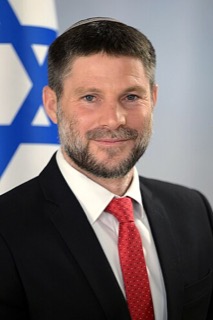 BS
BSorder the IDF to immediately prepare for the full occupation of the Gaza Strip and the central camps, to establish Israeli control over the entire territory of the Strip, and to establish Israeli settlements there.
Justice Minister Yariv Levin's position, as reported by NPR correspondents Itay Stern and Aya Batrawy:
Itay Stern (NPR): Israel's Justice Minister Yariv Levin says security can only be achieved where there's Jewish settlements.
Settlements Minister Orit Strook went further:
Orit Strook (Israeli Minister of Settlements and National Missions): If our prime minister doesn't know how to tell Trump and the world that Gaza is ours, we will be stuck with a plan that says Gaza belongs to the Palestinians.
These are not fringe positions held by backbenchers. Smotrich controls the budget that funds the PA's clearance revenues. Levin runs the justice ministry. Strook holds a cabinet seat. The institutional weight behind the annexation agenda is not marginal.
Yariv Levin himself, when pressed on whether Netanyahu shared these views, deflected:
Yariv Levin (Israeli Justice Minister): in the final reckoning, the prime minister is exposed to things I am not exposed to.
That is coalition management as epistemology: cabinet solidarity without policy clarity.
Stern and Batrawy also reported that Strook, in her own assessment, believes Israel will hold full sovereignty over Gaza within 10 years. [11][17] That timeline is not government policy. It shapes the ceiling of what Netanyahu's partners will accept.
'Voluntary Emigration': Legal Fiction or Policy Tool?
Defence Minister Israel Katz gave the clearest public statement of the post-war population plan:
Israel Katz (Israeli Defence Minister): We pledged that Hamas will not rule Gaza civilly or militarily, and so it shall be. The voluntary migration plan will also be implemented, all at the proper time and in the proper manner.
The Association for Civil Rights in Israel drew the legal boundary:
Association for Civil Rights in Israel: Creating living conditions that do not allow for survival, freedom and dignity, and subjecting civilians to them until they say they want to leave is not a plan for 'encouraging voluntary emigration' but a plan for forced evacuation and expulsion.
Jordon Scott and Joe Connor, writing for The Daily Britain, stated the governing legal standard:
Jordon Scott; Joe Connor (The Daily Britain): The distinction between voluntary and forced migration under international law does not rest on whether individuals are physically compelled to move. It rests on whether the conditions created leave meaningful choice.
The conditions in Gaza by mid-2026 do not meet that standard. A confirmed famine [8], 371,888 housing units destroyed or damaged [Theme 5], and 64% of territory under IDF control [14] leave no meaningful choice.
Gideon Levy, the Haaretz columnist, named the sequencing of this strategy:
Gideon Levy (Haaretz): Israel's military campaign has been accompanied by a broader objective: the destruction of Gaza's social, civic and institutional fabric, creating conditions in which mass displacement becomes increasingly possible.
Levy went further in characterizing the endpoint:
Gideon Levy (Haaretz): making the entire population of Gaza permanently disabled, injured, sick, hungry, homeless and unemployed. Once Gaza's population is reduced to a disparate mass without an organised society, without basic services, essential institutions and, of course, without leadership, the complete disintegration of the social fabric will make it easier for Israel to move to the next phase, which it has never relinquished, the phase of expulsion.
Levy's framing draws a causal chain from military operation to demographic outcome.
The settler movement's most public face states the population goal without euphemism. Mustafa Barghouti, Palestinian politician, put the label on it:
Mustafa Barghouti (Palestinian politician): Nachala and other groups like it are advocating the wholesale ethnic cleansing of Palestinians.
What Does the 'Day After' Architecture Actually Look Like?
Three governance proposals circulate in the diplomatic literature. None has Israeli cabinet support.
Option 1: Indefinite Israeli security responsibility. Netanyahu stated this position in late 2023:
Benjamin Netanyahu (Prime Minister of Israel): Israel will, for an indefinite period, have the overall security responsibility, because we have seen what happens when we do not have it.
Harry Reis, writing for Lawfare, names the contradiction at the core of that position:
Harry Reis (Lawfare): In the eyes of Gaza's residents — an occupied population, brutalized, blockaded, and bombed — Israel is not and can never be a legitimate governing authority.
Option 2: Palestinian Authority return with international reconstruction. The Washington Institute's Gaza Interim Administration proposal calls for Palestinian-led civilian governance with Arab-state security management and an international reconstruction coalition. [20] The PA, as Theme 12 established, carries over $14 billion in debt, nine months of withheld clearance revenues, and a president whose mandate expired in 2009. Neville Teller, writing in East Journal, states the condition of the institution being asked to govern:
Neville Teller (East Journal): The PA is currently riddled with corruption and inefficiency. President Mahmoud Abbas, who is scarcely capable of controlling the situation in Areas A and B of the West Bank, areas nominally under its control, is profoundly unpopular with the Palestinian public.
Option 3: International trusteeship. Reis draws on the East Timor precedent and argues that an international transitional administration with a clear political horizon toward statehood is the only architecture that can provide both security and legitimacy. [34] Daniel Levy, the former Israeli peace negotiator, is less sanguine about the existing institutional vehicle:
 DL
DLFor Israel, this is a nice model to see how far they can go, where the UN has divested itself of a role and outsources its legality to a nonexistent entity whose board is packed with Trump cronies.
As Theme 6 established, the Board of Peace exists on paper. The National Committee for the Administration of Gaza has not entered the territory.
Carol Daniel-Kasbari of the Quincy Institute identified the structural risk embedded in Resolution 2803:
Carol Daniel-Kasbari (Quincy Institute for Responsible Statecraft): The architecture created by Resolution 2803 risks turning Gaza into Oslo with helmets: a heavily securitized "interim" regime dominated by external powers that doesn't resolve the conflict, and in which Palestinian sovereignty is always coming but never arrives.
Carol Daniel-Kasbari (Quincy Institute for Responsible Statecraft): A model that sidelines Palestinians guarantees long-term resistance, instability, and blame, creating exactly the kind of open-ended security problem Washington has repeatedly said it does not want.
Does Netanyahu's Electoral Calculus Preclude Any Solution?
Dan Arbell's 2026 election analysis frames the campaign:
Dan Arbell (security analyst, Mondaq/Steptoe): The election is increasingly viewed as a referendum not only on Prime Minister Benjamin Netanyahu's leadership, but on the future shape of the Israeli state after October 7.
The desk's read is direct. Netanyahu needs his far-right coalition intact to survive the campaign. Smotrich and Strook will not accept a PA return to Gaza. They will not accept an international trusteeship that carries a statehood horizon. They have said so publicly, in cabinet-level language. Netanyahu's policy vacuum is therefore not an oversight or a negotiating posture. It is the predictable output of a coalition with incompatible demands and a prime minister who has chosen survival over resolution.
Susan Hattis Rolef states the political verdict from inside Israeli discourse:
Susan Hattis Rolef (Jerusalem Post, opinion): one cannot avoid suspecting that Smotrich is seeking to bring about the collapse of the Oslo Accords by indirect means.
On the question of Gaza annexation, the same pattern holds: a majority of the current government supports gradual full annexation, but Netanyahu resists superfluous declarations because of American opposition. [1] The policy exists. Its public statement is suppressed. That gap is how the coalition holds together.
Ramzy Baroud, the Palestinian-American journalist, names the mechanism as it operates in real time:
Ramzy Baroud (CounterPunch): With nearly the entire population of Gaza living in sub-standard tents and surviving on the meager rations permitted through Israeli checkpoints, it is the highest form of immorality to demand political concessions in exchange for basic sustenance.
Stéphane Dujarric, the UN Secretary-General's spokesman, gave the international baseline:
Stéphane Dujarric (UN Secretary-General's spokesman): One hundred percent of Gaza should be for the Palestinian people.
That position is the stated UN standard. Israel's trajectory runs in the opposite direction, at 10 percentage points per diplomatic cycle, and no actor with enforcement capacity has intervened to reverse it.
Pnina Sharvit Baruch's position on functional control versus physical presence, as Theme 2 established, leaves the accountability question open regardless of how Israel classifies the legal status of its Gaza operations. The desk's verdict: Netanyahu's coalition has produced a de facto annexation without a declared annexation, a displacement strategy without a declared population transfer, and a governance vacuum that serves every faction's interests except the 2.1 million people inside the shrinking territory. Whether that vacuum survives an Israeli election whose result no party is projected to win decisively is the question that 2026 has not yet answered.
Egypt as gatekeeper: Rafah, Sinai, and mediation leverage
Egypt controls the only border Gaza shares with the Arab world. That geographic fact gives Cairo leverage no other mediator holds. The desk's verdict: Egypt has used that leverage skillfully to block forced displacement and anchor the Rafah crossing as a two-way gate, but its power is structural rather than decisive. Cairo can slow the worst outcomes. It cannot impose a political settlement on parties that have rejected one.
Who Holds the Key? Rafah's Contested Sovereignty
The Rafah Border Crossing is Gaza's sole point of entry and exit to Egypt, distinct from every crossing into Israel [4]. Its governance history is a ledger of shifting control. Israel opened it in 1979. A 2005 Agreement on Movement and Access transferred operational authority to Egypt, the Palestinian Authority, and EU monitors. Hamas's 2007 seizure of Gaza broke that arrangement: the EU withdrew, Egypt largely sealed the gate, and Gaza's 2 million residents lost their primary international exit [4].
Israel never stopped holding a functional veto. Gisha, the Israeli legal rights organization, documented Israel's continued control over the Palestinian population registry, which determines who may cross at Rafah at all [4]. Israel also retained the power to close the crossing indefinitely and to veto the passage of foreigners even within permitted categories [4].
The May 2024 Israeli military seizure of the Gazan side of the crossing turned that latent veto into total closure. Ayman Al-Raqab, a Palestinian political analyst, said anyone who denies that the crossing was effectively shuttered by the Israeli occupation from that point on is deliberately misleading the public, because the facts are clear [1].
When the crossing reopened on a trial basis in early 2026, the terms of control had shifted again. Israel confirmed that exit and entry would be permitted in coordination with Egypt, following prior Israeli security clearance of individuals, and under EU supervision [10]. Remote Israeli officers using facial recognition software would supervise exits [10]. The crossing was not planned for aid or goods, only pedestrians [10].
Cairo managed daily operations. The EU inspected and identified. Israel decided who moved.
Kobi Michael, a senior research fellow at the Institute for National Security Studies, put the symbolism plainly:
Kobi Michael (Institute for National Security Studies): This is Gaza's exit to the world. From their perspective, it symbolizes sovereignty and Independence.
The crossing's reopening was therefore two things at once: a humanitarian release valve and a demonstration that Israel holds the architectural key to any governance arrangement in Gaza, as Theme 13: Israel's coalition politics and Gaza's 'day after' planning established with Netanyahu's coalition blocking every alternative.
Did Egypt Win the Battle of Rafah?
Diaa Rashwan, head of Egypt's State Information Service, said so directly:
Diaa Rashwan (Egypt State Information Service): Israel did not win the battle of the Rafah Crossing, but rather Egypt, international law, the mediators, and the Palestinian side won it.
The claim rests on a specific confrontation. Israel initially proposed reopening the crossing for outbound traffic only. Rashwan spelled out what that meant:
Diaa Rashwan (Egypt State Information Service): the Israeli side had insisted on opening the crossing only for Palestinians to leave Gaza, confirming the theory of displacement, but Egypt had rejected this proposal and insisted that the crossing must be opened from both sides.
Cairo got the two-way opening. The 2005 agreement framework, with the EU and the Palestinian Authority as partners, was formally restored [2]. Rashwan framed the reopening as proof that Netanyahu could not impose unilateral conditions [2].
The desk reads the outcome differently. Egypt won the framing battle. The operational reality is narrower. The crossing opened to 80-100 people per day [8]. Twenty thousand Gazans require urgent medical care abroad [8]. Hamza Chalan, a Palestinian journalist stranded in Egypt, described his situation:
Hamza Chalan (Palestinian journalist, Gaza): I am at the end of my savings, and because I don't have the right documents, I am unable to work here. So we are surviving month to month. In Gaza, I will be able to work as a journalist again.
Hamza Chalan (Palestinian journalist, Gaza): As a Palestinian, I have no right to self-determination. But we still put one foot in front of the other, still hold on to hope.
Khadija, a Gaza mother whose son required months of rehabilitation unavailable in Gaza, told France 24:
Khadija (Gaza resident): My son can't walk. He is currently in a hospital focused on rehabilitation. But because of a shortage of beds, he can only stay here for two or three months even though he needs six to seven months of care. That means that before his condition can improve, he will have to return to suffering in our tent.
A symbolic diplomatic win that delivers 80 crossings per day against a waiting list of 20,000 is not a humanitarian solution. It is a managed aperture.
Rashwan's own description of Cairo's method captures the gap between framing and outcome:
Diaa Rashwan (Egypt State Information Service): Egypt's approach in the negotiations combined patience with pressure, based on the understanding that fully implementing the Gaza agreement would take time.
Is Egypt a Reliable Security Partner or a Complicit One?
The Israeli and Egyptian framings of the Philadelphi Corridor, the narrow strip of land along the Gaza-Egypt border, diverge sharply. Benjamin Netanyahu warned that if Israel withdraws from the Philadelphi Corridor, "there will be enormous diplomatic pressure upon [Israel] from the whole world not to return" [9]. The JINSA Gemunder Center for Defense and Strategy, in its December 2024 analysis "Holding the Line," went further:
njudd (JINSA Gemunder Center for Defense and Strategy): Israeli officials' statements that an unsecured Philadelphi Corridor is tantamount to an "existential threat" to Israel should not be dismissed as hyperbole after the catastrophic events of October 7 and subsequent multifront, Iran-led, war.
The JINSA analysis also traced Egypt's shifting posture. From 2014 to 2017, Cairo cracked down on Hamas. Then, facing a growing Islamic State threat in the Sinai Peninsula, Egypt adopted what the report called a lesser-of-two-evils approach: it reconciled with Hamas, induced it to break from the Muslim Brotherhood, and persuaded it to refrain from aiding IS-SP [9]. The consequence was that Hamas's illicit smuggling of weapons and manufacturing materials into Gaza increased considerably during that period, likely with the involvement of some Egyptian officials but without Cairo's formal approval [26].
Amine Ayoub, writing in Ynet News, sharpened the accusation:
Amine Ayoub (Ynet News): Cairo has been, at best, a silent partner in the rearming of Gaza. While President Abdel Fattah El-Sisi claims to play a de-escalating role, Hamas could not have become a strategic threat without the implicit approval of elements within the Egyptian military and political leadership.
Amine Ayoub (Ynet News): Despite 15 months of intensive operations, the subterranean threat is far from neutralized. As of late 2025, Defense Minister Israel Katz revealed that more than 60 percent of Hamas' tunnel network remains undestroyed.
The desk places Ayoub's claim on the unclassified source pile. Its framing is analytically useful but not independently verifiable at high-rung standard. The JINSA paper's account of the 2017-2023 detente, a documented policy shift with named strategic logic, is the stronger evidentiary anchor.
Cairo's strategic paradox is real regardless of which framing one accepts. Egypt wants a stable Gaza border to contain IS-SP in Sinai. It wants to prevent a mass Palestinian refugee influx that would destabilize its domestic politics. It wants US aid, which is tied to regional cooperation. And it wants to maintain enough Hamas engagement to serve as a credible mediator. These four interests cannot all be maximized at once.
Ofir Winter, a researcher at the Institute for National Security Studies, described how Cairo manages this domestically. Egypt presents the Rafah reopening as a sovereign, tightly controlled move designed specifically to prevent the displacement of Gazans rather than enable it. Cairo's stated objective is to signal to its public that it has blocked any scenario of mass refugee influx and resisted external pressure on displacement [24].
What Does Egypt's Mediation Role Actually Buy?
Egypt's mediation position rests on three assets: physical control of the Sinai side of the Rafah crossing, long-running intelligence relationships with both Hamas and Israel, and US recognition of Cairo as indispensable to any post-war plan.
The US Charg\u00e9 d'Affaires in Cairo, Robert Silverman, visited the Rafah crossing to observe Egyptian aid operations. North Sinai Governor Khaled Megawer briefed Silverman's delegation, stating that 80 percent of aid entering Gaza originates from Egyptian institutions and entities [16]. Silverman praised Egypt's role in coordinating delivery and facilitating international relief organizations [16].
In May 2026, Egypt was simultaneously hosting Hamas's Gaza leader Khalil Al-Hayya and representatives from all Palestinian factions in Cairo, alongside Qatari and Turkish mediators, to advance the second phase of the Sharm El-Sheikh Peace Agreement [22]. Egypt was working to bridge the divide between UN envoy Mladenov's roadmap, which prioritizes weapons collection before continued negotiations, and Hamas's insistence on completing phase one before addressing any other issue [25].
Said Okasha, an Egyptian political analyst, described Cairo's core fear: Egypt sees the displacement of Palestinians as "a present and ongoing danger as long as there are no serious moves regarding the implementation of Trump's peace plan, the state of instability continues, and the reconstruction of the Gaza Strip does not begin" [25].
The Egypt-Qatar-Turkey triangle is the operational mediation architecture. Egypt hosts and manages the logistics of the Rafah crossing. Qatar holds financial relationships with Hamas leadership. Turkey provides diplomatic cover with the Muslim world. None of the three can deliver Israeli compliance with Phase 1 obligations already documented as unmet, as Theme 6: Ceasefire frameworks since 2025 established.
Egyptian Foreign Minister Badr Abdelatty told US Deputy Secretary of State Christopher Landau in January 2026 that implementing Trump's plan requires a national committee governing Gaza, a swift international stabilization force deployment, Israeli withdrawal, and Rafah's full reopening [27]. Cairo raised formal complaints to Washington about Israeli restrictions at the crossing, objecting to the slow return of Palestinians and their reported abuse by Israeli-backed militiamen [18].
A Cairo source quoted by The National described the bind:
Cairo source (Egyptian government, identity withheld): But we are telling all those involved not to provoke Israel into shutting down the crossing altogether or further hardening its measures on the Gaza side of the crossing.
That sentence is Egypt's leverage described in full. Cairo can complain. It cannot compel.
The Iran-linked conflict's escalation in spring 2026 pushed Gaza further off the international agenda. Saleh Salem's reporting for The New Arab captured Egypt's alarm: Cairo was racing to rescue the ceasefire as the Iran war pulled international attention away and aid delivery fell [15].
The Rafah 2 Architecture: Security Theater or Viable Checkpoint?
The new operational model at Rafah deserves its own accounting. Aritrika Ghosh, writing for Travel and Tour World, described the tripartite structure: Egypt manages daily operations, EUBAM provides on-site inspection and biometric identification, and Israel oversees security remotely using technology [23].
Aritrika Ghosh (Travel and Tour World): The new operating model for the Rafah crossing represents a significant shift in how borders are managed in high-conflict zones. It is a plan built on "remote trust" and international oversight, designed to address the humanitarian needs of Gazans while soothing the security concerns of Jerusalem.
Aritrika Ghosh (Travel and Tour World): This allows for "physical absence but total visibility," ensuring that unauthorized individuals or contraband do not pass through the gates.
Israel Hayom's analysis framed the same arrangement as an Israeli victory:
omrif (Israel Hayom): That era of total lawlessness is over. Yes, the Rafah Crossing has resumed operations, but this time in a completely different manner. Goods will not pass through it at this stage, only people, and that is a dramatic difference.
omrif (Israel Hayom): Israel will approve the identity of every individual entering or leaving the Strip and will also determine the permitted numbers in each direction. Everyone, in both directions, will be inspected by the European monitoring force that has returned to operate at the site.
Amine Ayoub at Ynet identified the system's failure point:
Amine Ayoub (Ynet News): If the "Rafah 2" mechanism is breached, or if the "Remote Control" cameras fail to detect the next shipment of Iranian-made components, the burden of preventing the next October 7 will fall solely on the IDF.
The desk's read: the Rafah 2 architecture is not security theater, but it is architecturally fragile. Over 60 percent of Hamas's tunnel network remained undestroyed as of late 2025 [5]. A checkpoint that screens pedestrians at the gate does not seal a subterranean supply chain. The model trades total Israeli physical presence for distributed oversight across Egypt, the EU, and Israeli remote surveillance. Each node in that chain is a pressure point.
Not every voice accepts the security framing as the primary lens. Abdel-Rahman Radwan, a Gaza City resident with a mother who is a cancer patient, put the human dimension without abstraction:
Abdel-Rahman Radwan (Gaza City resident): "We hope this will close off Israel's pretexts and open the crossing."
Benjamin Netanyahu, speaking about ceasefire sequencing, drew his own line:
Benjamin Netanyahu (Prime Minister of Israel): "We are at the start of the next (ceasefire) phase. What is the next phase? The next phase is disarming Hamas and demilitarizing the Gaza Strip. The next phase is not reconstruction."
That statement, taken with Netanyahu's coalition dynamics from Theme 13, sets the ceiling on what Egypt's mediation can deliver. Cairo can open the gate. It cannot force Israel to step back from the corridor or accept a governance framework its far-right coalition blocks.
The Displacement Red Line: Egypt's Actual Leverage
The most durable Egyptian constraint is not military. It is demographic. Cairo has calculated that a mass Palestinian displacement into Sinai would destabilize an Egyptian state already managing IS-SP and a domestic economy under IMF pressure. That calculation gives Egypt a genuine red line, one it has defended with consistent diplomatic pressure.
Al Jazeera reported Egypt's May 2026 warning directly: Cairo sent a warning to the Israeli government, rejecting any measures designed to push Gaza's residents towards voluntary emigration or direct Palestinians towards the Rafah crossing with Egypt [21]. Israel's Defense Minister Yoav Gallant had asserted that a forced displacement scheme would be implemented "at the right time and in the right manner" [21].
Egypt's response was to engage Khalil Al-Hayya's Hamas delegation in Cairo, loop in Qatar and Turkey, and escalate complaints to Washington [21]. The displacement red line functions as leverage precisely because the US shares it. As the Times of Israel reported during the earlier crossing closure, maintaining the tenuous peace between Israel and Egypt was described as a top priority for the Biden administration, which saw Egypt as a key player in any plans for post-war Gaza [7]. The Trump administration preserved that calculus.
The desk's position: Egypt's gatekeeping role is real and load-bearing for the entire ceasefire architecture. Without Cairo's cooperation on Rafah and the Philadelphi Corridor, no Phase 2 of the Sharm El-Sheikh Agreement can proceed, no international stabilization force can deploy, and no reconstruction corridor can open. That gives Egypt more structural weight in this negotiation than any other Arab state. The question the source record cannot answer is what Cairo does if Israel expands to 70 percent territorial control of Gaza and the displacement pressure exceeds the threshold Cairo can manage through diplomatic complaint alone.
Qatar, Turkey, and hostage diplomacy
The desk's verdict up front
Qatar and Turkey are indispensable to every Gaza negotiation that has moved since October 7, 2023. That is the structural fact. The conflict of interest critique, that sponsors cannot be honest brokers, is also structurally correct. Both propositions are true at the same time, and the international community has decided to live with the contradiction because no substitute channel exists. The desk's position: Qatar's mediation has produced real hostage releases and a real ceasefire, but its enforcement tools stop at the door of the negotiating room. Turkey's role is more recent, more contested, and more operationally ambiguous. Neither power can compel either party. Both are being paid in diplomatic currency for services that keep the process alive without resolving it.
Is Qatar an honest broker or a captured intermediary?
Frank Gardner, the BBC security correspondent, frames Qatar's structural position plainly:
Frank Gardner (BBC Security Correspondent): Qatar is fulfilling a unique role as the principal mediator between Israel and its avowed enemy, Hamas.
That role rests on a single asset: Qatar hosts Hamas's political office in Doha, an arrangement that every Western government has found useful while publicly tolerating it with discomfort [10]. Israel has accepted Qatari mediation while denouncing Qatar; Washington has demanded results from Qatar while stationing its largest regional military base at Al Udeid, a 20-minute drive from Hamas's Doha offices.
R. Swaminathan, writing for The Print, identifies what Qatar extracted from Washington in exchange for corralling Hamas into the October 2025 deal:
R. Swaminathan (The Print, South Asian geopolitical analysis): Doha has corralled not only Hamas' political leadership but also its armed cadres on the ground—and parallel factions like Palestinian Islamic Jihad—into a unified position. Qatar has also extracted two rare concessions from Washington and Jerusalem: an executive order treating threats to Qatar's security as a US peace-and-security concern, and, remarkably, a public apology from Prime Minister Benjamin Netanyahu over last month's breach of Qatari sovereignty.
The Netanyahu apology followed an Israeli missile strike in Doha that killed a Qatari security officer and targeted Hamas leadership while hostage negotiations were active [30]. That episode crystallized the paradox of Qatari mediation: the mediating state was simultaneously the venue for Israeli targeted killing. Netanyahu's expression of regret, made in a trilateral call with Trump, was the price Qatar demanded to continue.
The Israel Hayom analysis, written under the byline omrif, concedes Qatar's gains while framing them as a strategic problem for Jerusalem:
omrif (Israel Hayom): Qatar has successfully rehabilitated its international image as a broker and has received an American security guarantee anchored in a presidential directive, along with upgraded military cooperation.
The Qatari Press Center director-general offered the Doha self-reading:
Qatari Press Center director-general (Qatari state communications): When doors are closed, Qatar holds the keys to the locks.
Qatari Press Center director-general (Qatari state communications): Qatar possesses a rich track record of bringing adversaries to the negotiating table, out of the belief that dialogue is the only path to a solution.
The track record is real but uneven. Gardner's second observation cuts through the official optimism:
Frank Gardner (BBC Security Correspondent): If Qatar's efforts going forward prove largely fruitless then its standing in the West will suffer and pressure on Qatar to close that office may ensue.
That is the structural vulnerability. Qatar's mediation brand requires results. Results require Hamas compliance. Hamas compliance requires a political horizon. Israel has ruled out the political horizon. Qatar is caught in that loop as much as any other actor.
Hezy Laing, writing at IDF Club, mounts the captured-intermediary case directly:
Hezy Laing (IDF Club): Both countries have spent more than a decade cultivating Hamas politically, financially, and ideologically, making them among the group's most important international sponsors.
Hezy Laing (IDF Club): Expecting these two governments to pressure Hamas into disarmament is equivalent to asking patrons to dismantle their own protégés.
The analogy is pointed but analytically partial. A sponsor state pressuring its client to take a deal is not structurally incoherent. The United States pressured South Vietnam. The Soviets pressured North Korea into armistice. Sponsor leverage is real leverage, precisely because the client depends on the sponsor. The failure mode is not that Qatar lacks the tool. The failure mode is that Qatar has not chosen to use it.
Khaled Abu Toameh, the Jerusalem Post correspondent quoted by Laing, reads the broader stalemate:
Khaled Abu Toameh (Jerusalem Post): nearly three years after the October 7 attacks, the fact that Hamas is still debating whether to hand over its weapons is itself a stark indictment of the international community's approach
What did Qatar's mediation actually deliver?
The January 15, 2025 ceasefire deal is the measurable output. Tom Bateman, Rushdi Abualouf, and Lucy Williamson, reporting for the BBC, reconstructed the final hours:
Literally, negotiations were up until 10 minutes before the press conference. So that's how things were stitched up at the last minute. [26]
That granular account describes a Doha process where Israeli and Hamas delegations occupied the same building on separate floors, where Qatari and Egyptian mediators carried proposals up and down a staircase substituting for direct communication, and where a US envoy reportedly applied decisive pressure on Netanyahu to close [26]. The deal's framework echoed the May 2024 Biden proposal almost verbatim, but the dynamics had shifted: Yahya Sinwar was dead, Hamas's regional allies were weakened, and the incoming Trump team brought a deadline [26].
Qatar's chief negotiator, Mohammed Al-Khulaifi, acknowledged the toll before the deal closed:
We're definitely frustrated by the slowness, sometimes, of the process in the negotiation. This is an urgent matter. There are lives at stake here if this military operation continues day by day. [21]
Shortly before that, Sheikh Mohammed bin Abdul Rahman Al Thani had gone further:
Unfortunately, I mean, we have seen that there has been an abuse of this mediation and an abuse of this mediation in favour of narrow political interests. This means that the state of Qatar has called for a comprehensive evaluation of this role. We are now at this stage to evaluate mediation and also evaluate how the parties engage in this mediation. [25]
The suspension threat was brief. Qatar returned to the table once political conditions shifted. But the episode documented something the official Qatari framing obscures: Doha cannot sustain indefinite mediation without reciprocal movement from parties who regard the process instrumentally.
Qatar's foreign ministry stated the core logic plainly when pressure mounted to close Hamas's Doha office:
Qatari foreign ministry (official statement): The main goal of the office in Qatar is to be a channel of communication... [which] has contributed to achieving a ceasefire in previous stages.
H. A. Hellyer, the Royal United Services Institute scholar, delivered the sharpest verdict on why the Biden-era pressure campaign failed to produce results:
H. A. Hellyer (Royal United Services Institute): By setting red lines and allowing Netanyahu to cross them without consequence, the Biden administration effectively encouraged further impunity. I don't think any of this will change in the next 10 weeks.
The 10-week window referenced Biden's lame-duck period. The prediction held. Nothing changed. The Trump team's arrival did shift the frame, but through coercion of Netanyahu, not Hamas, and through a presidential security guarantee to Qatar that locked Doha back into the process.
Majed bin Mohammed Al-Ansari, Qatar's Foreign Ministry spokesman, articulated Doha's post-deal posture:
Majed bin Mohammed Al-Ansari (Qatar Foreign Ministry): What we need now is to build a new reality based on rebuilding trust, reopening channels of communication and reaching a shared understanding of what the region should look like in the post-war phase.
Majed bin Mohammed Al-Ansari (Qatar Foreign Ministry): Contacts between the parties are still ongoing, and Qatar continues, within the framework of its support for the Pakistani mediation, to communicate with the various parties in order to ensure the agreement reaches a successful outcome.
Is Turkey a bridge or a spoiler?
Turkey's role is formally parallel to Qatar's and structurally different from it. Qatar holds the Hamas political office. Turkey holds the Hamas financial infrastructure, along with NATO membership and Erdogan's particular positioning inside the Western alliance.
İbrahim Kalın, director of Turkey's National Intelligence Organization (MİT), published the agency's own account in its 2025 activity report:
İbrahim Kalın (Director, Turkish National Intelligence Organization): the agency carried out "intensive intelligence diplomacy with all relevant actors" on a permanent ceasefire, delivery of humanitarian aid, hostage exchanges, internal Palestinian reconciliation and a two-state solution
İbrahim Kalın (Director, Turkish National Intelligence Organization): In overcoming problems experienced in ceasefire negotiations, [MİT] undertook a bridge role between all parties, making concrete contributions to achieving positive results
Trump publicly named Turkey as a ceasefire guarantor alongside the US, Qatar, and Egypt [1]. That formal designation came over Israeli objection. Hamas officials, per sources cited in the Turkish Minute reporting, accepted Turkish engagement. Israel rejected it, labeling Ankara an enemy [1].
Israeli Diaspora Affairs Minister Amichai Chikli read Turkey's positioning as a threat rather than an asset:
Amichai Chikli (Israeli Diaspora Affairs Minister): What we are witnessing is the rise of a new axis
Chikli was describing what he called a Turkey-Qatar-Pakistan axis shaping the US-Iran deal [9]. The framing carried Israeli domestic politics inside it, but the underlying concern is analytically separable from the political framing. Turkey's simultaneous NATO membership and Hamas-hosting creates a structural anomaly that Israel's government has declined to tolerate.
Sarah Havdala, writing for the Jewish Institute for National Security of America (JINSA), reconstructed the specific problem Turkey poses. Her research found that Istanbul functions as a de facto financial headquarters for Hamas, with Turkey hosting Hamas-owned enterprises, front charities, and fundraising operations that no other NATO member tolerates [14]. Alan Makovsky, the Washington Middle East analyst cited in Havdala's work, put the contradiction plainly: Erdogan cannot accept credit for backing a plan that calls for an end to Hamas's resistance while simultaneously supporting Hamas's resistance [14].
Turkish Foreign Minister Hakan Fidan offered the Ankara frame on the US-Iran deal's regional implications:
Hakan Fidan (Turkish Foreign Minister): As our President Recep Tayyip Erdogan has also emphasised, our greatest hope is that this step, which has given our region and the entire world some breathing room, will evolve into a structural and lasting security architecture rather than a temporary period of calm.
President Erdogan framed Turkey's own security stake:
Recep Tayyip Erdogan (President of Turkey): The attacks by (Israeli Prime Minister Benjamin) Netanyahu and his network of murder on Lebanon and Syria have brought the issue to a point where it also threatens Türkiye.
Turkey's Gaza engagement is inseparable from Erdogan's domestic positioning. Vocal pro-Palestinian rhetoric carries electoral value inside Turkey. But Ankara also needs Washington, which gives Turkey an incentive to be useful to the US in Gaza negotiations regardless of its stated ideological alignment with Hamas.
Murat Yetkin, the Ankara-based security analyst, identified Turkey's most ambitious play:
Murat Yetkin (YetkinReport, Ankara security analysis): The idea of Hamas first achieving a ceasefire with Israel, then reconciling with the PLO in Ramallah, and eventually disarming to continue as a political party parallels Türkiye's project (since October 2024) to disarm the PKK and integrate it into parliamentary politics.
Murat Yetkin (YetkinReport, Ankara security analysis): Türkiye's ability to persuade Hamas to a ceasefire, and possibly disarmament, appears to be a significant factor in shaping the new Middle East.
The PKK analogy is either the most operationally serious template on the table or a category error. The PKK operates inside Turkish territory and depends on Turkish political arrangements for its survival. Hamas operates across a population of 2 million people under active bombardment, with a military identity the movement traces to 1987. R. Swaminathan captured the organizational logic:
R. Swaminathan (The Print): Its identity since 1987, following the first Intifada, rests on armed resistance. Full disarmament would mean organisational extinction.
Israel's position on Turkey's physical presence in Gaza is categorical. The omrif analysis at Israel Hayom drew the line:
omrif (Israel Hayom): Turkey cannot be allowed to station troops in Gaza, nor should any activists from the Turkish IHH Humanitarian Relief Foundation, known for organizing the infamous Mavi Marmara flotilla and, more recently, the flotilla thwarted by the IDF, be permitted to operate in the Strip.
What enforcement tools do middle-power mediators actually hold?
The mediation architecture running through Qatar and Turkey sits inside a larger framework: the US as political guarantor, Egypt as the physical gatekeeper (as Theme 14: Egypt as gatekeeper established), and the UN as the legitimating frame for UNSCR 2803. Qatar and Turkey operate in the gap between these institutional actors and Hamas's military command.
The enforcement gap is structural. Qatar can suspend its mediation, as it did in late 2024. Turkey can threaten to withdraw its diplomatic cover. Neither can compel Israeli compliance with Phase 1 withdrawal obligations, and neither can compel Hamas's military wing to accept any disarmament timeline. As Theme 7: Disarmament-for-governance tradeoffs established, Hamas's private position on warehouse storage of heavy weapons under third-party supervision signals negotiating room. That room only opens if the mediating powers are willing to apply real pressure.
Khalil al-Hayya, Hamas's chief negotiator, stated the group's core demand at the Sharm el-Sheikh talks:
Khalil al-Hayya (Hamas chief negotiator): We don't trust Israel
The demand for guarantees from third parties rather than from Israel directly is the engine of Qatar's and Turkey's leverage. Hamas will take a deal only if it believes the guarantors will enforce Israeli compliance. Khalil al-Hayya specified the mechanism at the Egypt talks:
Khalil al-Hayya (Hamas chief negotiator): the group wants "guarantees from President Trump and the sponsor countries that the war will end once and for all"
Egyptian Foreign Minister Badr Abdelatty named the only actor with sufficient coercive weight:
Badr Abdelatty (Egyptian Foreign Minister): The primary guarantee of success at this stage is US President Trump himself... even if it comes to a point to require him imposing a vision
Qatar and Turkey are transmission belts in this architecture. Trump is the only actor with enough coercive weight to bind both Hamas and Netanyahu. Qatar's value is access to Hamas. Turkey's value is the financial pressure it could apply if it chose to. Neither has applied that pressure fully. The publisher at Republican Point, writing in the medium-rung partisan press, put the consequentialist formulation succinctly:
publisher (Republican Point): the United States must add consequences that make agreement compliance more attractive than defection, or the process risks repeating partial deals that unravel under fire
The former Qatari prime minister, in remarks published by the Jerusalem Post:
former Qatari prime minister (Qatari government): The current agreement is what could be achieved under the current international and regional circumstances, and it requires continuous and thorough work to build a solid foundation for permanent agreements.
Bassem Naim, a Hamas official, stated Hamas's own reading of the remaining gap:
Bassem Naim (Hamas official): I think it is not a big challenge to reach a deal if there are intentions on the other side.
The symmetry of that framing is the problem. Both sides say the other lacks intention. Qatar and Turkey are being asked to certify intention that neither party will demonstrate on its own. The hostage file closed partially in January 2025. Phase 2, which requires Hamas disarmament and verified Israeli withdrawal, has produced no documented progress by mid-2026. The desk's verdict: Qatar is the irreplaceable channel, Turkey is the indispensable financial pressure point that has not yet been applied, and the question neither mediator has answered is what they are prepared to sacrifice if the party they sponsor refuses the deal they are guaranteeing.
Iran, Hezbollah, and 'Connected Fronts' with Gaza
Gaza did not ignite a regional war by accident. It ignited one by design. Iran's doctrine of wihdat al-sahat, Arabic for "unity of fields," treats Gaza, Lebanon, Yemen, Iraq, and Iran itself as a single battlefield. Pressure on one front triggers responses across all others. The desk's verdict: that doctrine has functionally transformed every ceasefire negotiation since October 7, 2023, into a cross-theater problem that no single mediator can solve, and the 2026 direct US-Israeli strikes on Iran have not dismantled the network so much as decentralized it into something harder to target and harder to deter.
Was 'Unity of Fields' a Doctrine or a Rationalization?
Ali Mamouri, a researcher covering Iranian regional strategy for MENANuances, traces the doctrinal shift with precision.
For years, Iran's regional strategy rested on establishing a wide regional network consisting mostly of non-state actors that contain Israel from all fronts, but with two principles: strategic patience and the separation of fronts.
In its place, a new doctrine appears to be emerging — one based on the unity of fronts, where pressure on any member of the alliance can trigger responses from the wider network.
The distinction matters. A doctrine implies prior planning, allocated resources, and coordinated red lines. A rationalization implies Tehran announcing a strategy after proxies acted on local incentives. The sources support the former reading more than the latter.
Mamouri's evidence is the October 7 aftermath itself.
The recent war appears to have convinced Tehran that such an approach leaves individual allies vulnerable to being defeated one by one. The emerging alternative is a doctrine of collective deterrence, in which the security of each front becomes tied to the security of all.
The International Wire's editor, writing in a June 2026 strategic assessment, put the architecture in operational terms [3]:
Editor (The International Wire): Iran's axis of resistance — the strategic architecture linking the IRGC, Hezbollah, Hamas, the Houthis, and Iraqi Shia militias — was explicitly designed to create a multi-front deterrence posture in which no single adversary could address any one component without triggering responses from the others.
That sentence describes something built, not improvised. The Axis of Resistance, asymmetric deterrence achieved through distributed proxy forces rather than matched conventional capacity, took four decades of IRGC Quds Force investment to construct [28]. The question is what October 7 revealed about its load-bearing capacity.
Did October 7 Expose the Architecture or Break It?
Radwan, writing in a March 2026 intelligence assessment published by Command Eleven, draws the sharpest line between what the Axis was and what it became [28]:
Iran's Islamic Revolutionary Guard Corps — principally through its Quds Force expeditionary arm — has spent four decades constructing the most sophisticated state-sponsored terrorist and insurgent network in the contemporary world.
What has changed is not the network's existence. What has changed is its degree of independence from Tehran — and that change cuts both ways.
Harder to target is not the same as harder to stop. But the distinction between those two things is where the strategic debate lives.
Hezbollah's degradation is the sharpest case. Hassan Nasrallah's death in 2024 removed the organization's most operationally experienced commander. Radwan's assessment is direct [28]:
It is Hezbollah's reduced capacity for complex, coordinated, multi-domain operations — the kind of operation that defined its strategic value to Iran in pre-war assessments.
Yet Abdaljawad Omar and Faris Giacaman, writing for Mondoweiss, document what Hezbollah retained even after those losses. The group's southern Lebanon operations deployed FPV drones, cheap first-person-view quadcopters costing a few hundred dollars each, against Israeli armored vehicles, D9 bulldozers, and troop concentrations in a systematic attack on Israel's mechanized warfare doctrine [1]. Cost asymmetry, not capability parity, is the operational logic.
Luiz H. S. Brandão, writing in a June 2026 strategic assessment for Intelligence Notes, captures the scope of what Iran lost in Syria [6]. The December 2024 collapse of the Assad regime severed what one analyst called "the logistical spinal cord of the Axis of Resistance" [24]. Without Syrian territory as a transit corridor, the overland supply chain from Iran to Hezbollah broke. Brandão's assessment describes the 2026 US-Israeli strikes as producing "the most fundamental restructuring of the Middle East strategic environment since the 1979 Iranian Revolution" [6].
That claim is plausible but premature. The 1979 revolution created a state. The 2026 strikes degraded one. Whether degradation produces restructuring depends on what fills the vacuum, and no source in the set provides a credible answer to that question.
How Does 'Unity of Fields' Recalibrate Cross-Theater Signaling?
Iran's Foreign Minister Abbas Araghchi made the doctrine's cross-theater logic explicit in a statement quoted by Mondoweiss [1]:
AAThe ceasefire between Iran and the U.S. is unequivocally a ceasefire on all fronts, including in Lebanon. Its violation on one front is a violation of the ceasefire on all fronts.
That statement is either a genuine doctrine or a coercive fiction. If genuine, it means Iran has bound Lebanon's ceasefire status to its own bilateral negotiations with Washington. If it is coercive fiction, it means Tehran is claiming leverage it cannot exercise. The ceasefire fragility documented across sources suggests Tehran believes it, and Israel does not.
The International Wire's editor put the fracture point plainly [3]:
Editor (The International Wire): The gap between Iran's determination to rebuild Hezbollah and Israel's determination to prevent it is the primary driver of ceasefire fragility.
As Theme 15 established, Qatar and Turkey cannot enforce the terms they broker. That limit applies equally here. No mediator can bridge a gap whose two sides are rebuilding the same weapons stockpile from opposite directions.
Amer Al Sabaileh, writing for EEC Press, names the US-Israel friction that the unity-of-fields doctrine exploits [15]:
Amer Al Sabaileh (EEC Press): This has created what could be described as an "alliance management crisis," in which the alliance remains formally intact while the priorities of both partners continue to diverge, increasing the risk of unilateral and poorly coordinated initiatives.
Wu Shaoyuan, in a May 2026 policy brief for Epinova, documents the cost of that divergence in operational terms [22]:
Wu Shaoyuan (Epinova Policy Brief): Phase I forced the United States to prioritize Israel in practical crisis-management terms, while Phase II exposes the costs of that prioritization across Ukraine support, European confidence, air-defense allocation, and Indo-Pacific deterrence signaling.
Iran's bet, visible in the Mondoweiss analysis by Omar and Giacaman, is that Israeli overextension and American exhaustion will do what direct confrontation cannot [1]. Wu's framework confirms the logic: every degree of US commitment to Israel's Iran campaign costs Washington in theaters from Kyiv to Taipei.
What Does the Strait of Hormuz Do to the Escalation Ladder?
The Strait of Hormuz, the 21-mile-wide chokepoint through which 20% of the world's traded oil passes, is the Axis of Resistance's economic leverage made geography [9]. Navroop Singh, founder of Niti Shastra, describes the Iranian doctrine this way [20]:
Navroop Singh (Niti Shastra): The strait is not merely a military trade chokepoint. It is a taxation mechanism, an economic lever of the first order, and Tehran has ably demonstrated that it could use it to extract payments, concessions, and immunities from the very states that had nominally supported the American campaign against it.
Navroop Singh (Niti Shastra): Iran brought the Strait of Hormuz, a doctrine of patient resistance, and a detailed understanding of its adversary's political and economic vulnerabilities. The Hormuz chokehold strategy was not improvised. Iranian military planners had spent decades developing the doctrine, the physical infrastructure of missiles, drones, fast boats, mining capabilities and the political understanding required to exploit the strait as a strategic lever.
The doctrine is decades old. The 2026 execution was not novel; it was the planned application of a pre-built instrument against a set of adversaries whose energy dependence Tehran had studied for years.
Larry Fink, quoted in Navroop Singh and Himja Parekh's broader 2026 analysis, put the economic floor in concrete terms [33]:
Larry Fink (BlackRock): the failure to secure the Strait of Hormuz could lead to "years of $100-$150 oil," triggering a severe global recession.
Wu Shaoyuan's Epinova brief extends the commodity list beyond crude oil [22]:
Wu Shaoyuan (Epinova Policy Brief): the conflict is no longer only an oil-market shock, but a wider resource-chain transmission problem involving sulfur, fertilizer, LNG, petrochemicals, metals, battery inputs, and food-system exposure.
That transmission problem is what converts a regional military escalation into a global deterrence argument. States whose food security depends on fertilizer supply chains routed through Hormuz have an independent incentive to restrain Israel that has nothing to do with Palestinian rights or Iranian legitimacy.
Can Decapitation End the Network?
The 2026 strikes killed Supreme Leader Ali Khamenei, a fact documented across sources [10][29]. The strategic premise was that leadership removal would produce regime fracture. The premise failed.
Mavia Fazal, writing for Frontier Affairs, names the failure mode directly [10]:
mavia fazal (Frontier Affairs): The killing of Khamenei has introduced profound unpredictability into Iranian decision-making. No established successor commands the institutional loyalty required to exercise restraint under extreme military pressure.
Unpredictability is not collapse. It is its own category of danger.
Luiz H. S. Brandão's Intelligence Notes assessment draws on Jenna Jordan's decapitation research to explain why [11]. Jordan's frameworks consistently show that strikes against highly bureaucratized organizations produce organizational hardening and radicalization rather than collapse. The IRGC, economically integrated and ideologically cohesive across its institutional layers, fits the Jordan model exactly. Brandão's conclusion: IRGC hardliners now directly control Iran's negotiating bottom lines, not a civilian-clerical consensus [11].
The NukeClock team, covering the escalation timeline from late 2025 through March 2026, draws the most direct line between the strikes and their unintended consequence [29]:
Iran's enrichment program was the original justification for military action — and the strikes may have paradoxically increased the nuclear risk rather than eliminating it.
The logic is structural. Strikes that destroy declared facilities without capturing the human capital, the engineers and the weapons design knowledge, leave a state with both the technical expertise and a hardened political incentive to disperse and accelerate what remains. The NukeClock assessment that breakout time was under two weeks before the strikes [29] does not tell us what it is after them.
Attrition Without Terminus: The Three-Axis Strategy
Omar and Giacaman identify three strategic axes the Axis of Resistance deployed to frustrate Israeli objectives after October 7 [1]. Geographic denial constrained Israeli military freedom in Lebanon and blocked buffer zone construction. Attrition without terminus used FPV drones and low-cost attacks to degrade mechanized warfare capacity and raise casualty counts. Direct clashes tested American restraint as Iran's bet that Washington would limit Israeli escalation.
Ella Rosenberg, writing for the Jerusalem Center for Foreign Affairs, frames the same three-axis structure from the Israeli strategic perspective [5]:
Ella Rosenberg (Jerusalem Center for Foreign Affairs): The new paradigm, called the new equation, is not defined solely by direct military exchanges or isolated proxy fights. Instead, it is marked by the IRGC's use of asymmetric military pressure and global economic coercion.
Ella Rosenberg (Jerusalem Center for Foreign Affairs): Its goal is not to achieve a quick military victory. Instead, it seeks to cause a slow paralysis that drains Israeli resources and political capital over time.
Rosenberg's prescription is financial: cut the IRGC's financing through international sanctions and the network degrades on its own timescale [5]. The desk finds this argument partially compelling. Financial pressure has historical precedent in constraining IRGC procurement. It does not address the decentralization problem Radwan identifies: proxy networks that have spent decades building local revenue streams are less dependent on Tehran's transfers than they were in 2015.
Al Sabaileh, writing from Amman, draws the political-military picture that Rosenberg's sanctions prescription leaves unaddressed [15]:
Amer Al Sabaileh (EEC Press): Israel has effectively transformed the confrontation from a cycle of periodic escalation into a struggle with existential dimensions, increasing Hezbollah's incentive to raise the cost of any future settlement for all parties involved.
Amer Al Sabaileh (EEC Press): Divisions within revolutionary security-oriented systems rarely produce political moderation. Instead, competing factions often seek to demonstrate greater resolve in order to avoid appearing weak, increasing the likelihood of calculated risk-taking rather than restraint.
That last sentence is the structural counterargument to every decapitation doctrine. Remove the moderating center and you get competing hardliners in a resolve auction, each refusing to be the one who blinked.
What Stable Configuration, If Any, Can Emerge?
The International Wire's editor named the system-level problem in terms that the desk accepts as the closing frame [3]:
Editor (The International Wire): The Middle East in 2026 is no longer experiencing a series of parallel crises — it is experiencing a single interconnected strategic deterioration in which each pressure point amplifies the others, and in which the mechanisms that historically prevented escalation to regional war are under unprecedented strain
Dr. Mohamed Chtatou, writing for Eurasia Review, places the 2026 conflict in historical typology [30]:
Dr. Mohamed Chtatou (Eurasia Review): The 2026 war conforms to this model while simultaneously transcending it: it has not merely intensified existing conflict but has structurally altered the distribution of power, the credibility of deterrence, and the economic architecture of an entire region.
Luiz H. S. Brandão's strategic assessment closes on the question the sources cannot answer [6]. The regional order has changed. Whether a stable configuration can emerge from the transition depends on four unresolved variables: Iranian nuclear breakout timing, Hezbollah's rebuilding pace under IRGC reconstitution doctrine, Saudi-Israeli normalization without a Palestinian settlement, and Syria's trajectory under a new government that controls neither the northern border with Turkey nor the eastern deserts where IS remnants operate.
Brandão's own framing from the Intelligence Notes assessment applies: "The question is not whether the regional order has changed — it has — but what stable configuration, if any, can emerge from the current transition" [6]. The desk adds one rider. The unity-of-fields doctrine was built to prevent Iran's allies from being defeated one by one. The 2026 strikes tested that doctrine by attacking the center directly. The test produced a decentralized network, a hardened Iranian negotiating position, a nuclear program whose post-strike status no public source has verified, and a Hezbollah rebuilding on a timeline Israel has sworn to prevent. Whether any of those four outcomes is reversible through the Pakistan-mediated JCPOA-Lite framework Brandão documents [11] is the question no actor with enforcement capacity has yet answered.
Jordan and Lebanon under strain: refugees, security, and fragile politics
The desk's verdict is this: Gaza's war has not created new crises in Jordan and Lebanon. It has pushed pre-existing fractures past the point of manageability. Both states entered 2026 already running refugee systems beyond design capacity. The 2026 escalation involving Iran, Israel, and Hezbollah added 218,000 new displacements in the Eastern Mediterranean since March alone [5]. Neither Amman nor Beirut has the fiscal room, the political cohesion, or the institutional support structure to absorb another shock. The question is not whether these states are under strain. The question is which breaks first and what that rupture produces regionally.
Jordan: An Alliance That No Longer Protects
Sean Yom, the political scientist at Temple University who tracks Hashemite regime security, frames Jordan's predicament in structural terms.
Sean Yom (Arab Reform Initiative): Jordan's greatest foreign policy asset, its US alliance, now paradoxically jeopardizes it. Since October 2023, the Gaza War has accelerated Israel's prospective annexation of the West Bank, which may displace millions more Palestinians onto the kingdom under the radical mantra that "Jordan is Palestine." Yet Jordan cannot resist this existential threat, given its US-brokered peace treaty with Israel and Washington's staunch support for Israeli militarism.
Sean Yom (Arab Reform Initiative): Squeezed between Israeli expansionism and Iranian attacks, the Hashemite Kingdom faces unprecedented threats to its sovereignty. Those challenges persist not despite, but because of, American hegemony.
The architecture is the problem. Jordan built its security on external patronage. That patronage now delivers threats from two directions simultaneously.
Curtis R. Ryan, the political scientist who has followed Jordanian politics for three decades, locates the structural knot precisely.
Curtis R. Ryan (POMEPS contributor): The kingdom has steadily increased its security dependence on the United States while trying to make itself indispensable to U.S. strategic planning in the region. But these efforts assumed that the U.S. would then, in turn, check Israel's most extreme impulses and curb any of its "Jordan Option" plans.
That assumption has not held. During the 2026 US-Israel strikes on Iran, Iranian missiles transited Jordanian airspace. Jordanian forces, operating alongside US assets, intercepted them [13]. Domestically, the intercept read as Amman defending Israeli skies. Ryan's earlier assessment of Jordan's historical fixation sharpens the picture.
Curtis R. Ryan (POMEPS contributor): It is hard to think of another country, in the Middle East or elsewhere, that has remained so laser-focused on fears over a neighboring territory.
Yom traces the direct line between treaty obligations and powerlessness.
Sean Yom (Arab Reform Initiative): Despite the 1994 peace treaty, King Abdullah's demands to Israel to halt such violations went nowhere. The carrot of cooperation, such as Jordan's agreement to purchase Israeli natural gas in 2016, did not proffer more leverage on this issue. Neither could it credibly threaten to end the peace treaty, its only meaningful stick.
Jordan's leveraging instruments have been spent. The gas deal produced dependency, not influence. The peace treaty is the cage, not the key.
Prerna BalaEddy, writing for POMEPS on Jordan's security amid the US-Iran confrontation, distills the dependency model in Ryan's words.
Curtis R. Ryan (POMEPS contributor): Jordan has tended to predicate its security on external alliances and ample aid flows to keep the aid-dependent state afloat, and to provide material support for its own ruling coalition, including a large state and security apparatus.
That model breaks when the patron's interests diverge from the client's survival. In 2026, they have diverged on three simultaneous axes: West Bank annexation pressure, Iranian missile transit, and Trump administration rhetoric around Palestinian displacement into Jordan as an "alternative homeland" [13].
Jordan's Refugee Burden: Numbers and Fiscal Reality
Jordan hosts one of the largest refugee populations per capita on earth. The fiscal stress is not theoretical. In April 2026, the World Food Programme suspended food assistance for an estimated 135,000 refugees living in host communities across Jordan [1]. The WFP faces a $7.6 million funding gap for 2026 and requires $66.1 million from April to September 2026 to sustain even minimal operations [1].
Osama Alkafri, reporting for the Jordan Times, states the classification gap plainly.
Osama Alkafri (Jordan Times): Jordan is among nine contexts where detailed classification of acute food insecurity levels is unavailable, with these areas collectively accounting for 27.9 million people facing high levels of acute food insecurity in 2025.
The absence of classification data is not a bureaucratic gap. It is a political signal. When a host state's refugee population falls outside IPC monitoring, donor pressure to fund that population drops accordingly.
Osama Alkafri (Jordan Times): without increased donor contributions, even the current minimal levels of assistance may not be sustainable.
UNHCR's June 2026 emergency update placed over 31 million people in forced displacement across the region [4]. Jordan sits at the center of that geography. UNHCR's assessment found that the majority of internally displaced persons across the region remain outside formal shelters, facing heightened protection risks and rising rental costs [4].
The WFP suspension lands at the worst possible moment. Donor budgets for the Eastern Mediterranean are being consumed by the new Lebanon emergency. Jordan's refugee caseload, mostly Syrian, is now the lower-profile crisis competing for a shrinking pool of contributions [5].
Lebanon: Displacement Inside Displacement
Lebanon entered 2026 carrying 174,422 registered Palestinian refugees from the 2017 census [7], plus an estimated 1.5 million Syrians, plus approximately 170,000 migrant workers largely invisible to the humanitarian system [23]. The March 2, 2026 escalation between Israel and Lebanon produced over 800,000 registered internally displaced persons by March 11 [7].
The Palestinian Association for Human Rights documented what this meant for Palestinians already in Lebanon. Palestinian families moved from camps in the south and Beirut to camps in the north or to UNRWA-run shelters or public buildings, a condition the association calls "displacement within displacement" [7]. By March 14, at least 1,567 displaced Palestinians were registered in UNRWA shelters, with many more seeking refuge outside official systems [7].
The risks the association identified are concrete: limited safe housing, high rents, overcrowding within camps, declining UNRWA health and education services in affected areas, and mounting pressure on water, sanitation, and hygiene infrastructure [7].
Michael Petro, a researcher tracking migrant labor in Lebanon, identified the population that fell entirely outside this already-strained system.
Michael Petro (PBS NewsHour): Migrants always fall through the cracks in the humanitarian system here in Lebanon. Part of that is that the -- is the -- exactly what you're talking about, is the way in which the legal structure here is designed to exploit and to make migrants invisible.
Michael Petro (PBS NewsHour): Their invisibility makes it such that people don't see them as anything more than people who serve, right, people -- they're not people to be served. They're people who serve.
The kafala sponsorship system, the restrictive framework binding migrant workers' legal status to their employer, does not pause during bombardment [23]. Workers who fled their employer's home lost legal status simultaneously with their shelter.
UNIFIL's Exit and the Security Vacuum
UN Secretary-General António Guterres presented three options for a successor peacekeeping presence in southern Lebanon in June 2026, ranging from 1,500 to over 5,500 uniformed personnel [2].
Antonio Guterres (UN Secretary-General): Under all proposed options, a uniformed United Nations presence working to facilitate de-escalation, dialogue, liaison and co-ordination and support for the Lebanese Armed Forces, would be necessary ... towards the overarching objective of a long-term solution to the conflict.
Guterres also called for international support to help the Lebanese army establish a state monopoly over weapons and disarm non-state groups including Hezbollah [2]. Ali Saad, a resident of southern Lebanon, delivered the civilian reading of what UNIFIL withdrawal means.
Ali Saad (southern Lebanon resident): What if UNIFIL pulls out? Who's going to make those? Who's going to believe us? I think if there are no multinational forces or another form of international forces in South Lebanon, I think we will be the second Gaza.
That fear is not irrational. As Theme 16: Iran, Hezbollah, and "Connected Fronts" with Gaza established, Hezbollah's network has been substantially degraded by the 2026 strikes and the killing of Khamenei, but the Lebanese army has never controlled the south without external scaffolding. Removing that scaffolding without a replacement is a documented mechanism for security collapse.
Israeli Prime Minister Netanyahu declared that Israeli troops will not withdraw from southern Lebanon, describing the occupation as a buffer zone despite the deal with Iran [10]. Hussein Barjawi, surveying the destruction in Nabatieh, put the physical scale in plain terms.
Hussein Barjawi (Al Jazeera): destruction in some neighbourhoods exceeds 70 percent, making rebuilding a daunting task.
Over a million displaced Lebanese moved toward the south after the Iran-US deal [10]. They returned to destroyed infrastructure and an Israeli military presence that Netanyahu has refused to end. Abu al-Hassan, one of the returnees, captured the tension between attachment and ruin.
Abu al-Hassan (southern Lebanon resident): the harsh experience of displacement only deepened people's connection to their villages, making the return "an indescribable feeling regardless of the damage sustained"
The Radicalization Architecture in Lebanon's Displacement Zones
Jack Schwartz, writing for War on the Rocks, identifies the security risk that humanitarian framing consistently misses.
Jack Schwartz (War on the Rocks): The very same conditions that led to the Nahr al-Bared clash are reassembling now, across a broader geography, with fewer safeguards in place.
The 2007 Nahr al-Bared conflict, in which Fatah al-Islam militants fought a three-month battle against the Lebanese army inside a Palestinian camp, killed over 400 people and displaced 30,000 [6]. Schwartz's thesis is that the 2026 convergence of Palestinian and Syrian displacement zones, the degradation of Hezbollah's policing function inside those camps, and the collapse of UNRWA service delivery is reproducing that environment at larger scale.
Jack Schwartz (War on the Rocks): The practical effect of securitization without service provision is not a reduction in Lebanon's displacement burden; it is a reduction in the visibility and manageability of that burden.
Dorothee Klaus, the UNRWA official cited in Schwartz's analysis, states the replacement problem without euphemism.
Dorothee Klaus (UNRWA): There is no other actor that has the resources and is capable to step in.
Philippe Lazzarini, UNRWA Commissioner-General, has placed the agency's viability in direct terms [15].
Philippe Lazzarini (UNRWA Commissioner-General): UNRWA is close to becoming unviable.
Philippe Lazzarini (UNRWA Commissioner-General): Its elimination has become a war objective.
Israel's 2024 legislation banning UNRWA from operating within Israel and occupied East Jerusalem is not a parallel development to the Gaza war. It is a component of it. The BBC documented that the ban prohibits contact between UNRWA staff and Israeli officials, severing the agency's access coordination mechanism for Gaza and the West Bank simultaneously [25].
Max Rodenbeck, the Economist's Middle East editor, delivered a one-line assessment of UNRWA's Gaza trajectory.
Max Rodenbeck (The Economist): UNRWA has been marginalised in Gaza.
The UN80 Strategic Assessment found that UNRWA has played an indispensable role in promoting regional stability and that it holds profound political resonance as the last institutional embodiment of the international community's commitment to Palestinian refugee rights in the absence of a political solution [26]. That assessment was written before the Israeli ban. The agency is now operationally constrained in its largest field of operation while facing a funding model that Raja Khalidi of the Palestine Economic Policy Research Institute describes as increasingly incapable of serving its constituency [17].
Michael Dumper, the British scholar of Palestinian refugee politics, places UNRWA's function in relief: despite the limitations on the agency's ability to advance a durable solution, it remains the only international body positioned to safeguard Palestinian refugee rights, and to embody them through the humanitarian services it provides to five million refugees across five fields of operation [17].
The Jewish Press editorial board represents the opposing camp's position, arguing in terms this desk classifies as ethnographic signal from the pro-Israel media constituency: UNRWA's generational refugee definition perpetuates the crisis rather than resolving it, and the agency should be dismantled rather than reformed [22]. The International Court of Justice reviewed the allegations of widespread Hamas infiltration that grounded the Israeli legislative campaign against UNRWA and found them unsubstantiated [29].
UNRWA's Structural Role in Jordan and Lebanon
In Jordan, UNRWA runs schools, health centers, and social assistance programs for over two million registered refugees [19]. In Lebanon, it provides the closest thing to a social contract that 174,422 registered Palestinian refugees have ever had in a country that denies them citizenship, property rights, and access to most professions [7]. The 2026 Flash Appeal for the occupied Palestinian territory alone seeks $1.26 billion [9]. UNRWA's 2023-2028 Strategic Plan covers nearly 5.9 million registered refugees across all five fields [19].
The UN General Assembly budget documentation for 2026 states the operational ground truth plainly.
Michael Horn (UN General Assembly): UNRWA is the backbone of the operations of the entire humanitarian community in Gaza and remains indispensable in the provision of basic services to Palestine refugees in Gaza.
That backbone is cracking at every joint simultaneously: funding suspended in Jordan, facilities destroyed in Gaza, operations constrained in the West Bank, and the agency's legal standing inside Israeli-controlled territory effectively terminated by the October 2024 legislation [25].
Safia Southey, in her SSRN analysis of UNRWA's mandate expansion, identifies the pressure that has forced the agency beyond humanitarian aid into protection, development, and quasi-governmental representation. Key stakeholders including Israel, the United States, and neighboring Arab states have placed pressure on UNRWA to shift its programs in light of their political goals [27]. The result, Southey finds, is that UNRWA now operates across programmatic areas consistently in tension with one another, weakening its core delivery capacity while satisfying none of the political actors pressing on it [27].
The Lebanon Security Endgame: Who Fills What
As Theme 16: Iran, Hezbollah, and "Connected Fronts" with Gaza established, Hezbollah's degradation after the 2026 strikes creates a political vacuum in southern Lebanon. The Lebanese army has never had the capacity to fill it unilaterally. Guterres placed this plainly.
Antonio Guterres (UN Secretary-General): These efforts continue to be vital in creating a conducive environment towards a permanent ceasefire and a long-term solution to the conflict.
Lebanon's primary diplomatic objective is Israeli withdrawal from the 20% of southern territory still occupied by the IDF [10]. Hezbollah's internal argument to the Lebanese government is that Israeli withdrawal is the deliverable that justifies any political concession [24]. Netanyahu has ruled withdrawal out.
The desk's reading of the buffer zone dynamic draws on the Caribbean Studies Online analysis, which identifies Israel's position as redefining who belongs where and under which rules a state claims the right to protect itself [12]. Displacing the civilian population of southern Lebanon as a strategic asset risks normalizing collective punishment as a security tool [12]. The UN Secretary-General stated it without diplomatic softening.
UN Secretary-General (UNHCR situation report): the Gaza model must not be replicated in Lebanon.
That warning lands against the documented reality that Israeli bombardment has exceeded 70% destruction in some Nabatieh neighborhoods [10], that 1,238 people have been killed in Lebanon including 51 first responders [20], and that the Lebanese civilian population is returning to rubble under an Israeli military presence its own prime minister says is permanent.
The EthioInsight analysis frames the structural diagnosis.
EthioInsight (EthioInsight): What began as a delicate containment strategy has evolved into a multi-front diplomatic and military crisis, as expanded Israeli military incursions into southern Lebanon have shattered the regional ceasefire framework and triggered a dangerous geopolitical stand-off involving the United States and Iran.
What Neither State Can Bear Alone
The Middle East Council's regional analysis finds that Lebanon and Jordan are already struggling to provide basic social services to their own populations, and have limited capacity to host additional displaced people [14]. The US-Israel-Iran war of 2026 risks worsening a displacement crisis that was already severe before the first strike landed [14].
UNHCR's position on the protection status of displaced Lebanese and Iranian nationals is explicit: those outside their countries of origin may have international protection needs on account of the armed hostilities [4]. Jordan and Lebanon are the primary receiving states. Neither has the fiscal architecture to carry that load without sustained external support.
The UNHCR-WHO joint emergency appeal issued in June 2026 sought $1.4 billion to address displacement and health-system collapse across the Eastern Mediterranean [5]. The appeal's lead official told MetaCurrents: "We are not at the edge anymore. We are past it" [5].
Lebanon-Israel talks, mediated by the US, were reported to be accelerating as of June 17, 2026, contingent on the broader Iran-US framework agreement [24]. Lebanon's stated goal is Israeli withdrawal and restoration of state authority in the south [24]. The IDF's continued presence makes that goal structurally incompatible with Israeli declared policy. No actor with enforcement capacity has moved to resolve the contradiction.
Jordan's question is less about ceasefire sequencing and more about demographic survival. The "Jordan is Palestine" pressure documented by Yom and Ryan does not require a single mass displacement event to destabilize the kingdom. It requires only that the West Bank annexation pressure continue while Amman's fiscal position deteriorates and donor attention migrates to the Lebanon emergency. The desk reads that combination as the kingdom's most immediate threat, and the question no regional compact has yet answered is what institutional guarantee prevents it from materializing before any Gaza stabilization deal closes.
Strait of Hormuz to Lebanon: systemic escalation scenarios
The desk's verdict up front: the 2026 Middle East crisis is not a series of parallel emergencies. It is one crisis with several addresses. The Strait of Hormuz, southern Lebanon, the Red Sea, and Gaza are not separate theatres. They are nodes in a single pressure architecture, and the failure of deterrence at any node propagates across the others within hours.
The International Wire editor put the structural case plainly:
Editor (The International Wire): The Middle East in 2026 is no longer experiencing a series of parallel crises — it is experiencing a single interconnected strategic deterioration in which each pressure point amplifies the others, and in which the mechanisms that historically prevented escalation to regional war are under unprecedented strain.
That single-deterioration framing is the analytic ground for everything that follows. Thirty-four source documents, spanning policy briefs, intelligence assessments, and market analyses, confirm the same structural reading.
Is the "Axis of Resistance" a coherent deterrence system or a liability Tehran cannot control?
As Theme 16: Iran, Hezbollah, and 'Connected Fronts' with Gaza established, Iran's doctrine of wihdat al-sahat treats all fronts as one battlefield. The same editor's framing makes the design logic explicit:
Editor (The International Wire): Iran's axis of resistance — the strategic architecture linking the IRGC, Hezbollah, Hamas, the Houthis, and Iraqi Shia militias — was explicitly designed to create a multi-front deterrence posture in which no single adversary could address any one component without triggering responses from the others.
Abdaljawad Omar and Faris Giacaman, writing in Mondoweiss, read the same architecture from the resistance side. In their account the fronts are not separate theaters but a single interconnected field of struggle, with pressure on one front calibrated to elicit responses across all others [5].
The counter-reading is also documented. Prof. Robert Pape, the University of Chicago political scientist who publishes the Escalation Trap analysis, identifies a structural liability in that same design:
From Tehran's perspective, Hezbollah is not simply another regional partner. It is the most important pillar of Iran's deterrent network outside its own borders.
Pape then names the trap this creates:
The problem is not simply disagreement. The problem is that the three objectives increasingly exclude one another. Washington cannot obtain a durable agreement if Hezbollah is dismantled. Tehran cannot accept a durable agreement if Hezbollah is dismantled. Yet Israel's military strategy increasingly depends on weakening Hezbollah permanently.
Three parties, three incompatible exit conditions. No solution space.
Iran's Foreign Minister Abbas Araghchi made the interdependence explicit, in a statement that re-linked the Lebanon file to the Hormuz negotiations:
AAThe ceasefire between Iran and the U.S. is unequivocally a ceasefire on all fronts, including in Lebanon. Its violation on one front is a violation of the ceasefire on all fronts.
Israel's position, documented across the source set, is the direct inverse: Lebanon and Gaza are separate files that Iran has no authority to condition.
The International Wire editor named the practical consequence:
Editor (The International Wire): The gap between Iran's determination to rebuild Hezbollah and Israel's determination to prevent it is the primary driver of ceasefire fragility.
What did the Hormuz closure actually cost, and did it change the strategic terrain permanently?
The February 28, 2026 US-Israeli strikes, the operation documented across sources as "Operation Epic Fury" or "Roaring Lion," killed Supreme Leader Khamenei and triggered Iran's closure of the Strait of Hormuz [13][34]. The Joint Chiefs of Staff had warned Trump that strikes could prompt exactly this response. Trump acknowledged the warnings but dismissed them, telling his team that Iran would capitulate rather than close the strait [34]. Iran closed it.
The market consequence was immediate and without modern precedent. Mia Chen, writing for InformedClearly, put the scale in numbers:
Mia Chen (InformedClearly): The global oil supply shock has no modern precedent in scale.
Brent crude averaged $86 per barrel across 2026, European gas futures surged 56%, fertilizer prices jumped 31%, and the World Bank projected global growth falling to 2.0% [33]. Up to 45 million people faced acute food insecurity linked to the fertilizer shock [33].
The Meridian Intelligence Desk, writing from a maritime law perspective, identified the structural shift that outlasts any ceasefire:
The Meridian Intelligence Desk (The Meridian): Before 28 February 2026, the vulnerability of the Strait of Hormuz was a theoretical concern debated in strategic studies journals and war-gaming exercises. After 96 days of this war, it is an empirical fact verified by the global shipping industry, every major navy, every energy market, and every government treasury that has watched oil prices behave accordingly.
The Meridian Intelligence Desk (The Meridian): A ceasefire that puts the IRGC assets back in their tunnels and the radar back on the hilltops of Qeshm does not erase the knowledge. Every shipping company that now pays a war risk premium for Hormuz transit will not immediately remove that premium on the day a settlement is signed.
Navroop Singh, founder of Niti Shastra, had analyzed Iran's Hormuz doctrine before the crisis reached its 2026 peak:
Navroop Singh (Niti Shastra): Iran brought the Strait of Hormuz, a doctrine of patient resistance, and a detailed understanding of its adversary's political and economic vulnerabilities. The Hormuz chokehold strategy was not improvised. Iranian military planners had spent decades developing the doctrine, the physical infrastructure of missiles, drones, fast boats, mining capabilities and the political understanding required to exploit the strait as a strategic lever.
That assessment, written before the February strikes, reads as a post-mortem on US planning failure.
The Mapshock briefing on maritime targeting doctrine supplies the operational mechanism. Iranian forces cut daily Hormuz traffic from 130 vessels to 8 during peak conflict periods, not by sinking ships wholesale but by making transit commercially unviable [32].
Mapshock (Mapshock Briefings): Rather than seeking to sink every vessel transiting the strait, Iranian operations focus on creating insurance market conditions that make passage commercially unviable.
Singh identified the economic logic Tehran was exploiting:
Navroop Singh (Niti Shastra): The strait is not merely a military trade chokepoint. It is a taxation mechanism, an economic lever of the first order, and Tehran has ably demonstrated that it could use it to extract payments, concessions, and immunities from the very states that had nominally supported the American campaign against it.
Does horizontal escalation at Bab el-Mandeb change the calculus at Hormuz?
Prof. Robert Pape identified the second chokepoint risk before it materialized:
The most important fact is not that a ceasefire was announced. The most important fact is that military operations continued anyway.
Pape's briefing warned that Iran's next move might involve horizontal escalation, defined as activating Houthi forces to disrupt Red Sea shipping through Bab el-Mandeb, creating pressure beyond the immediate Lebanon-Gaza theater [18].
That activation also reshaped commercial shipping: a system of paid safe passage took shape, with shipowners paying to avoid the Cape of Good Hope rerouting.
Evangelos Marinakis, the Greek shipping magnate, captured the commercial calculation that sustains the system:
Evangelos Marinakis (quoted shipowner): For me, it's better to pay $100-$200 thousand in fees depending on the cargo than to endure the inconvenience of the route around Africa.
When the largest commercial operators treat a payment to the IRGC Navy as a line item, the security architecture of the Red Sea has already changed.
Was the Lebanon front a separate war or a Hormuz pressure valve?
Benjamin Netanyahu's threat, documented in both EthioInsight accounts, was categorical:
Benjamin Netanyahu (Israeli Prime Minister): if Hezbollah doesn't cease its attacks, Israel will strike terror targets in Beirut.
Israel struck Beirut's Dahiyeh district in June 2026. Navroop Singh and Himja Parekh document that Iran's Foreign Minister had warned one week before the strike that the Islamic Republic would respond forcefully to any Israeli attack on the Dahiyeh district [11]. Israel struck anyway.
Iran's Foreign Ministry then suspended high-level talks with Washington, conditioning their resumption on an Israeli withdrawal from Lebanon and a halt to operations in both Lebanon and Gaza:
Iran's Tasnim News Agency (quoted): No dialogue will take place until Israel fully withdraws from occupied areas in Lebanon and stops all attacks in both Lebanon and Gaza.
This is the connectivity mechanism in practice. A strike in Beirut closes a negotiating track over the Strait of Hormuz.
Trump intervened directly. His public statement, posted after a call with Netanyahu, read:
Donald Trump (US President): I had a very productive call with Prime Minister Bibi Netanyahu, of Israel, and there will be no Troops going to Beirut, and any Troops that are on their way, have already been turned back.
James Whitfield, writing for Indoneo on the June 6 synchronous escalation, framed the two-front simultaneity as the argument's crux:
James Whitfield (Indoneo): Two theatres, hundreds of miles apart, moving in step. That synchronicity is the real story, and it is the part nobody can yet explain. Coordination would mean one thing. Coincidence, cascading from a shared logic of pressure, would mean something harder to manage.
James Whitfield (Indoneo): Whether June 6 was coordinated or merely cascading, the strait and the border are now reading from the same script — and that is the thing the old separation used to prevent.
The desk reads this as cascading rather than centrally coordinated. The architecture does not require coordination if the incentive structure is shared. Both Hezbollah and the Houthis face the same cost-benefit calculus: activate when Israel acts, rest when it doesn't.
Kaitlyn Hashem, a researcher at the Stimson Center in Washington, placed Lebanon at the weakest point in this architecture:
Kaitlyn Hashem (Stimson Center): Of all the stakeholders involved in this complex set of negotiations, the Lebanese government is the weakest. Lebanon was sidelined in the ceasefire negotiations between the U.S. and Iran and negotiations with Israel are unlikely to produce Israeli withdrawal in the short term.
Hashem added the framing regional capitals drew from watching the US-Iran deal take shape:
Kaitlyn Hashem (Stimson Center): One major takeaway in regional capitals is that neither the U.S. nor Israel are reliable, predictable allies. American protection is now seen as conditional and partial.
Can a ceasefire without enforcement mechanisms hold the system together?
Wu Shaoyuan, in a policy brief published by Epinova, identifies the Phase II shift with precision:
Wu, Shaoyuan (Epinova): June 3 is not a simple repeat of the February 28 opening phase. February 28 was defined by coercive initiation: U.S.-Israeli military action aimed at degrading Iranian capabilities and shaping settlement terms. June 3 reflects retaliatory reactivation, in which incomplete ceasefire arrangements, contested maritime rules, and weak enforcement mechanisms allow local incidents to propagate into broader escalation.
Wu's diagnosis of the near-term is not ambiguous:
Wu, Shaoyuan (Epinova): The most likely near-term outcome is no longer controlled diplomatic recompression, but partial conflict resumption under residual diplomatic ambiguity. This would involve continued strikes, weakened negotiations, and a narrowing boundary between diplomacy and coercion.
That reading tracks the desk's assessment of every prior ceasefire across Theme 6: Ceasefire frameworks since 2025 and Theme 7: Disarmament-for-governance tradeoffs. Agreements without enforcement are descriptions of the current pause, not commitments about the next one.
Wu specifies what concrete control mechanisms would require:
Wu, Shaoyuan (Epinova): Preventing this outcome requires moving beyond broad ceasefire language toward concrete control mechanisms: maritime incident management, short-cycle reciprocal restraint, force-posture freezes, threshold buffers around U.S. bases, Israeli constraint protocols, and sequencing nuclear negotiations after immediate crisis control.
None of those mechanisms are confirmed as operational in the June 2026 MoU. Jordan Glynn, writing for the Institute for the Study of War, documented the interpretive gap:
US and Iranian sources have expressed diverging interpretations of some key aspects of the recent US-Iran agreement. The full text of the agreement has not yet been published, which makes it difficult to ascertain which interpretations of the agreement are accurate.
The Strait of Hormuz governance question sits at the center of that gap. Iranian spokesman Esmail Baghaei stated:
Esmail Baghaei (Iranian Foreign Ministry spokesman): Iran and Oman will manage traffic through the strait, provide maritime "services," and collect related fees.
US Vice President JD Vance stated the opposite:
JD Vance (US Vice President): the United States expects the strait to be open "in a toll-free way for the long term."
Christopher Solomon, also writing for the Institute for the Study of War, assessed what Iran would do with the economic relief the MoU provides:
Iran would likely use immediate economic relief to try to reconstitute its military capabilities, the Axis of Resistance, and its nuclear program.
The Sean Hagarty Regionalert sitrep from June 9 put the trigger condition plainly:
Sean Hagarty (Regionalert): If Israel resumes strikes on Hezbollah targets in Lebanon, Iran has explicitly threatened to restart its missile campaign.
The MoU is a 60-day ceiling on temperature, not a structural solution. The enforcement gap Wu identified is not an implementation detail. It is the architecture's defining vulnerability.
What does systemic escalation look like, and where does it stop?
Dr. Mohamed Chtatou, writing in Eurasia Review, frames the structural shift the 2026 war produced:
Dr. Mohamed Chtatou (Eurasia Review): The 2026 war conforms to this model while simultaneously transcending it: it has not merely intensified existing conflict but has structurally altered the distribution of power, the credibility of deterrence, and the economic architecture of an entire region.
Wu Shaoyuan traces the cost of US prioritization of Israel beyond the Middle East:
Wu, Shaoyuan (Epinova): Phase I forced the United States to prioritize Israel in practical crisis-management terms, while Phase II exposes the costs of that prioritization across Ukraine support, European confidence, air-defense allocation, and Indo-Pacific deterrence signaling.
Wu's resource-chain diagnosis is equally pointed:
Wu, Shaoyuan (Epinova): the conflict is no longer only an oil-market shock, but a wider resource-chain transmission problem involving sulfur, fertilizer, LNG, petrochemicals, metals, battery inputs, and food-system exposure.
Navroop Singh draws the dollar-primacy conclusion:
Navroop Singh (Niti Shastra): The result is that the non-dollar trade architecture that Washington sought to dismantle not only survived the confrontation but has emerged arguably stronger. Countries that had been gradually building alternatives to dollar-denominated trade were given a powerful demonstration of why those alternatives mattered.
The RoninsGrips strategic assessment supplies the interceptor-cost arithmetic that shapes every Israeli calculus. A single Arrow interceptor costs upward of $3 million, while the Iranian Shahed loitering munitions it targets cost between $20,000 and $300,000 [30]. Saturation is Iran's cheapest option.
The Asymmetric Intelligence monitor, covering the May 30, 2026 period, identified the governance gap underneath all the kinetic activity:
Asymmetric Intelligence (Asymmetric Intelligence): The stability profile is not a matter of isolated battlefield movement alone; it reflects a widening gap between nominal ceasefire language and the operational reality of territorial expansion, aid interdiction, and an increasingly fragile diplomatic track.
The Daily Wire's conflict tracker, read here as ethnographic signal rather than analytic ground, captured the market's structural read on June 2026: commodities pricing not a temporary shock but a permanent regime shift in Middle East stability [19].
Pape's closing scenario for the Lebanon file cuts to the bone:
The next phase of this war may not begin in Beirut. It may begin at sea. And if it does, the question will no longer be whether Israel and Iran can be contained. The question will be whether the world can contain the instability they are creating.
Shahzad Ashraf Butt, writing for World at Net, delivered the hardest verdict on the strategic situation:
Shahzad Ashraf Butt (World at Net): What remains is the management of a war that achieved less than it promised, between parties that cannot afford to fully win or cleanly lose, over a geography that has run out of room for error.
The desk's position: the June 2026 MoU buys time but resolves nothing structural. The Strait of Hormuz's risk premium is repriced permanently [14]. The Lebanon ceasefire depends on Israel's operational choices, which Netanyahu's electoral calendar incentivizes toward escalation rather than restraint [11][13]. The Bab el-Mandeb tariff system has found commercial clients willing to pay [25]. Wu Shaoyuan's Phase II framing is the correct one: the question now is not whether the ceasefire holds but whether the consequences of its failure can still be contained across regional, Eurasian, and global systems, and that question has no answer yet [9].
U.S. policy: mediation models, arms and veto politics, and an 'equality' reframing
The Verdict Up Front: Fifty Years of Reversed Mediation
U.S. policy on Israel-Palestine has not merely failed to produce peace. It has actively reproduced the conditions for conflict. The desk's position is direct: Washington's consistent practice of pressuring the weaker party while shielding the stronger one inverted the standard mediation model and made American diplomatic capital an obstacle rather than a bridge. The 'equality' reframing now circulating in Brookings and Carnegie policy circles is the most significant doctrinal shift in a generation of American policy writing. Whether any sitting administration will operationalize it is a separate, and open, question.
Philip H. Gordon, the former White House coordinator for the Middle East under Obama, identifies the structural failure with precision.
Philip H. Gordon (Brookings Institution): "By alleviating pressure on the stronger party and increasing pressure on the weaker party, however, Washington effectively reversed the normal mediation model, helping to reinforce the status quo and often even exacerbating the conflict." [30]
This is not a procedural critique. It is a structural one. Mediation theory holds that the broker applies pressure where resistance is highest. For fifty years, U.S. administrations applied it in reverse.
Scott Lasensky, writing on the Biden pivot, framed the problem from the other direction.
Scott Lasensky (Carnegie Endowment for International Peace): "Trump traded the earlier advantages of partiality for a different construct: a partisan and ideological alignment with a relatively narrow segment of Israeli society and his political allies at home." [6]
The Trump 2.0 iteration has not corrected this alignment. It has deepened it.
Is the Board of Peace a Mediation Instrument or a Control Structure?
Six months after the October 10, 2025 ceasefire, the 20-point peace plan's institutional centerpiece, the Board of Peace, has delivered on three of its twenty points: a pause in bombardment, a hostage exchange, and a humanitarian aid surge [2]. The remaining seventeen are stalled.
Liam Hamama, writing for J Street, states the record plainly.
Liam Hamama (J Street): "the 20-point peace plan announced by President Trump has largely stalled on all its promises beyond the initial pause in fighting, hostage exchange, and surge in humanitarian aid." [2]
Nathan J. Brown, the political scientist at George Washington University who has tracked Gaza's governance collapse since 2007, goes further.
NBEven as its fulsome promises dissolve, it continues to shape the political field, foreclosing alternatives, deepening Palestinian decay, and hardening a reality that is less a transition to peace than the slow institutionalization of devastation.
Zaha Hassan and Charles H. Johnson, both Carnegie researchers who have tracked the Board of Peace's legal architecture, draw the sharpest conclusion on its governance design.
Zaha Hassan, Charles H. Johnson (Carnegie Endowment for International Peace): "What appears on offer is a wholly Trump-controlled body meant to rival (or oversee) the United Nations with complete discretion over how to spend the billions of dollars of donor contributions. Unlikely to last long and untethered to international law or standard financial oversight and accountability mechanisms, the Board of Peace lacks capacity to deliver early recovery and reconstruction for the benefit of Palestinians in Gaza, much less a just peace between Palestinians and Israelis." [7]
The Board's legal status shifted further in June 2026, when Secretary of State Marco Rubio announced its conversion from a public international organization into an international nongovernmental organization (INGO). Zaha Hassan, writing at Carnegie, identified the consequence.
Zaha Hassan (Carnegie Endowment for International Peace): "If converting the board's legal status aims to avoid U.S. congressional oversight and keep much of its activity opaque, then this alone should be enough to raise alarm bells among lawmakers and UN Security Council members about the Board of Peace and how it will execute its mandate." [21]
Robert Barron of the Baker Institute for Public Policy reads the architecture's ambiguity differently. He acknowledges the risks of stasis but does not write the Board off.
Robert Barron (Baker Institute for Public Policy): "This lack of clarity is understandable, as in negotiating a difficult ceasefire such as this, near-term progress necessarily took priority over difficult phase two and three issues, which could have disrupted phase one's implementation. But as the Board of Peace and its subcommittees move forward, it will be necessary to rapidly and credibly build on the emerging architecture, before bad actors exploit openings or stasis sets in, creating an untenable frozen conflict liable to ignite again." [16]
Barron's charitable reading is that deliberate ambiguity bought a ceasefire. Brown's harder reading is that the same ambiguity is now locking in devastation. Both are supported by the record.
Does Disarmament-First Produce Politics or Prevent It?
As Theme 7: Disarmament-for-governance tradeoffs established, every documented precedent of successful demilitarization treats disarmament as an outcome of political transition, not its entry price. The Trump plan inverts this. Samer Sinijlawi, the Palestinian political analyst, makes the point with uncommon directness.
Samer Sinijlawi (Palestinian political analyst): "The core strategic mistake in Gaza has been treating disarmament as a precondition for politics rather than the product of politics." [4]
Samer Sinijlawi (Palestinian political analyst): "Wars rarely end because armed groups simply disappear through declarations. Disarmament is usually the outcome of gradual political transformation tied to legitimacy, institutions, incentives, and alternative centers of authority." [4]
Frederic Wehrey and Charles H. Johnson, Carnegie security scholars, reach the same conclusion from a different angle.
Frederic Wehrey; Charles H. Johnson (Carnegie Endowment for International Peace): "Lasting peace in Gaza requires precisely what Trump's deal-centric foreign policy eschews: multilateral coalitional backing and deep institutional grounding." [19]
Amr Hamzawy, the Egyptian-American political scientist at Carnegie, acknowledged the plan's ambition while cataloguing its gaps.
Amr Hamzawy (Carnegie Endowment for International Peace): "The Trump plan for Gaza is comprehensive and ambitious, and it enjoys broad regional and international support. However, the expected implementation obstacles are numerous and substantial." [13]
The implementation obstacles Hamzawy lists are not procedural. They are structural. Hamas will not disarm without a statehood horizon. Netanyahu has publicly ruled one out. Israeli Prime Minister Netanyahu told his cabinet after the October 10 announcement that the moves to date are mostly "declarative," an important step not yet shaping realities on the ground [16]. The IDF has not conducted any further withdrawals and is building fortifications along the ceasefire line [2].
Anchal Vohra, reporting for Foreign Policy in June 2026, captured the operative dynamic.
Anchal Vohra (Foreign Policy): "Both sides are waiting for Trump's exit from the White House and a quiet death of the Board of Peace." [5]
The Veto and the Arms Transfer: What Leverage Actually Looks Like
The United States has exercised its UN Security Council veto to shield Israel from binding resolutions across five decades of the conflict [28]. Arms transfers have continued through periods of active civilian harm, including the post-October 7 bombardment that the ICC Pre-Trial Chamber I found produced reasonable grounds for war crimes charges against Netanyahu and Gallant, as Theme 8: International law fault lines established.
Yousef Munayyer and Zaha Hassan, in their Carnegie rights-based framework paper, put the structural consequence plainly.
Yousef Munayyer; Zaha Hassan (Carnegie Endowment for International Peace): "For thirty years, the United States has sent mixed messages to Israelis and Palestinians. While successive administrations have expressed support for a two-state solution and the establishment of a democratic state of Palestine, they have refrained from using the levers of U.S. power to stem the tide of Israel's illegal settlement expansion." [23]
Mort Halperin, the former senior U.S. national security official, delivered the clearest statement of leverage logic at the J Street symposium.
Mort Halperin (former U.S. National Security Council official): "The Israeli people have to understand that they can no longer in effect rely on our support regarding our money but especially on our veto at the UN when they simply ignore everything we ask them to do." [25]
Alexander Langlois, writing in The National Interest, frames the same gap as a political choice rather than a structural constraint.
Alexander Langlois (The National Interest): "That problem is clear: there is a refusal on the part of Western officials—specifically in Washington—to recognize the illegality of Israel's occupation, producing a lack of political will or interest in seriously shifting the status quo toward an equitable and sustainable solution steeped in justice, accountability, and international law." [12]
Sunny Peter's Diplopolis analysis identified what the desk calls the Gaza Template: American ceasefire announcements in this region carry a documented lifespan of roughly 60 days, contested throughout, collapsed when the harder questions arrive [11]. The pattern holds across Lebanon 2006, Gaza 2014, Gaza 2023, and the October 2025 framework. Far-right Israeli minister Itamar Ben Gvir supplied the mechanism directly.
Itamar Ben Gvir (Israeli National Security Minister): "Israel is 'not bound by agreements that put an end to its ability to defend itself.'" [11]
Washington has not contested this claim with any enforcement action. That silence is itself a policy.
Tania Hary, a Gaza access researcher, stated the Israeli policy goal with equal bluntness.
Tania Hary (Gaza access researcher): "Israel has been very forthcoming about its desire for Palestinians to leave Gaza, they are not even hiding it. [Defense Minister Israel] Katz has even said that he is looking for countries willing to take Palestinians from Gaza. The policy goal is very clear." [5]
The Association for Civil Rights in Israel, as Theme 13: Israel's coalition politics established, draws the line between voluntary emigration and forced expulsion at the point where conditions are made unlivable. U.S. arms transfers have continued throughout that process.
What the 'Equality' Reframing Actually Demands
The Brookings team led by Hady Amr, Scott R. Anderson, Dafna H. Rand, and Natan Sachs, among others, published the most direct challenge to Washington's operational assumptions in the current policy cycle. The reframing they propose is not rhetorical.
Hady Amr, Scott R. Anderson, Aslı Aydıntaşbaş, Kemal Kirişci, Suzanne Maloney, Itamar Rabinovich, Dafna H. Rand, Natan Sachs, Kevin Huggard, Robert Kagan (Brookings Institution): "Traditional U.S. policy has maintained a rhetorical commitment to the two-state solution while being unwilling to commit leverage to that goal. Absent such pressure, Washington's enormous diplomatic and financial investments in recent decades have failed to resolve, narrow, contain, or even manage this conflict, which has lurched in an increasingly zero-sum direction." [1]
The same group proposes what equality-as-policy requires in practice.
Hady Amr, Scott R. Anderson, Aslı Aydıntaşbaş, Kemal Kirişci, Suzanne Maloney, Itamar Rabinovich, Dafna H. Rand, Natan Sachs, Kevin Huggard, Robert Kagan (Brookings Institution): "The ongoing wave of violence and terror perpetrated by Israeli settlers in the West Bank against Palestinians is not just an unfortunate outcome of unavoidable friction. Specifically, for those perpetrating this violence, it appears to be a means to an end: the expulsion of Palestinian communities from their homes and villages into concentrated areas of the West Bank to allow for greater Israeli land seizure and settlement." [1]
The Brookings team stops short of specifying which U.S. laws it would invoke to impose costs. The Arms Export Control Act and the Leahy Law both exist as statutory tools. Neither has been applied to Israel's West Bank settlement apparatus.
Yousef Munayyer and Zaha Hassan put the rights-based alternative in concrete terms.
Yousef Munayyer; Zaha Hassan (Carnegie Endowment for International Peace): "If Israeli policies that violated rights and previous commitments came with costs attached to the U.S.-Israel relationship, it would force a recalculation and promote politics that are more amenable to political negotiation. On the Palestinian side, it would allow parties committed to negotiation to garner the faith of their publics." [23]
What Mediation History Actually Teaches
Sarah Yerkes, Amr Hamzawy, and Kathryn Selfe at Carnegie conducted the most systematic comparative analysis of U.S. mediation in the current literature. They examined the Egypt-Israel and Jordan-Israel successes against the Syria-Israel and Palestine-Israel failures across five decades.
Sarah Yerkes; Amr Hamzawy; Kathryn Selfe (Carnegie Endowment for International Peace): "For this effort to succeed, the United States should learn from the lessons of the past fifty years and employ mediation strategies that were successful in previous negotiations. These include sustained high-level U.S. leadership, incentives, and inducements to ensure the parties stay the course (and accountability to prevent spoilers), as well as intentional sequencing that entails conditional, yet tangible, benefits to prepare domestic and regional populations for long-term peace and stability." [15]
The Egypt-Israel case is their load-bearing example. The U.S. policy toolkit in 1978 combined intense presidential engagement, large deliverable incentives, threats of sanctions that altered the cost-benefit distribution for both parties, and security arrangements in the Sinai that made peace politically feasible for Begin's cabinet [22]. None of those four elements is present in the Trump 2.0 Gaza architecture. The incentives are opaque. The accountability mechanism for spoilers, on either the Israeli or Hamas side, does not exist. The sequencing is inverted. Presidential engagement is episodic.
Sarah Yerkes; Amr Hamzawy; Kathryn Selfe (Carnegie Endowment for International Peace): "However, a lack of political will by the parties, U.S. failure to provide meaningful incentives, and populations that were not adequately prepared to accept the agreement ultimately undermined the process." [15]
Philip H. Gordon, writing on the U.S. blind spot, identifies the mechanism by which this failure reproduces itself across administrations.
Philip H. Gordon (Brookings Institution): "successive U.S. administrations have tended to ignore or downplay the vast power disparity between two sides. After all, the relationship between Israelis and Palestinians is not only one of conflict; it is also an occupation in which Israel directly controls the lives of millions of Palestinians." [30]
The Sinai analogy has limits. Egypt in 1978 was a sovereign state with an army, a functioning economy, and a single demand: return of the Sinai. The Palestinian Authority in 2026 carries over $14 billion in debt, has not held an election since 2006, and controls no territory in Gaza. The gap between the cases is not procedural.
Domestic Politics in 2026: Who Shapes the Limits?
Kali Robinson at CFR places the domestic constraint in structural terms.
Kali Robinson (Council on Foreign Relations): "The United States has long tried to negotiate a resolution to the Israeli-Palestinian conflict, but several factors, including deep divisions between and within the parties and declining U.S. interest in carrying out its traditional honest-broker role, have hurt the chances of a peace deal." [28]
As Theme 13: Israel's coalition politics established, Netanyahu's 2026 coalition cannot accept Palestinian Authority return, international trusteeship with a statehood horizon, or any settlement freeze. His far-right flank, led by Smotrich and Ben Gvir, sets the operational red lines. Israeli Settlement Minister Smotrich has continued advancing housing units on the E1 West Bank plan, which he states would "bury" the idea of a Palestinian state [9].
Samer Sinijlawi, writing in the Jerusalem Post, sees a closing but real window.
Samer Sinijlawi (Palestinian political analyst): "For the first time in years, it is possible to imagine pragmatic political camps emerging simultaneously on both sides. That creates an opportunity Washington should not ignore." [4]
Zeid Ra'ad Al Hussein, the former UN High Commissioner for Human Rights, framed the sequencing logic at the J Street symposium.
Zeid Ra'ad Al Hussein (former UN High Commissioner for Human Rights): "hope lies in there being a sequence of events in Gaza, in the region, and across leading capitals that are coordinated and play off one another. Each step providing a positive energy and momentum to the next step." [25]
The coordinated sequence Zeid Ra'ad Al Hussein describes requires a U.S. administration willing to absorb domestic political cost for applying pressure on an ally. The 2026 electoral calendar, and the Republican coalition's dependence on evangelical and donor bases aligned with the Israeli right, makes that calculus unfavorable to any sitting president.
Yezid Sayigh, the senior Carnegie Middle East Center fellow who previously advised the Palestinian delegation in peace talks, draws the sharpest line on what the current architecture actually delivers.
Yezid Sayigh (Malcolm H. Kerr Carnegie Middle East Center): "The flaws of Trump's plan and his Board of Peace are many and dangerous, but for this very reason, the above four conditions form a necessary agenda for political action and leverage." [26]
His four conditions are: protection of civilian services from Israeli attacks; freedom for the NCAG to employ existing civil servants; unimpeded import of essential goods; and ISF deployment across Gaza. None of the four is currently met [26].
Nathan J. Brown's verdict from Theme 1: From Mandate to Oslo to October 7 applies with equal force here: Gaza by 2026 has no sovereign, no reconstruction, and no recognized legal status. The Board of Peace has not changed that. Brown's verdict on the plan's true significance deserves to close this section.
NBThe plan's most enduring effects may lie less in the institutions it builds than in the alternatives it helps close off, and the way it hardens temporary realities into new and pernicious forms.
The desk's position: the equality reframing is the first policy framework in a generation to name the structural inversion at the center of U.S. mediation practice. It has produced no enforcement mechanism, no arms conditionality, and no veto recalibration. The question the record does not answer is whether any U.S. administration facing a 2026 electoral calendar and a solidified Israeli right-wing coalition retains the domestic political capacity to deploy the leverage that every serious mediation analysis, from Camp David through Oslo through the current Carnegie and Brookings literature, identifies as the one variable that has always been missing.
Europe's divided center: recognition, conditionality, and aid machinery
Europe is the largest external financier of Palestinian survival and the most diplomatically fragmented actor in the Gaza file. That combination is the desk's thesis. The EU has committed up to €1.6 billion for 2025-2027, produced the most authoritative damage estimate in the conflict's history, and spoken the loudest words about two-state irreversibility. It has also failed to sanction a single violent Israeli settler, cannot agree on whether settlement-goods bans require unanimity, and has watched Germany shield Israel's settlement project under a Staatsräson doctrine that has quietly outlived its original mandate. The split is not superficial. It runs through the voting rules, the association agreement, the UNRWA funding line, and every conditionality clause attached to Palestinian Authority budget support. Europe's divided center is not a diplomatic inconvenience. It is the structural reason Brussels spends billions while Tel Aviv ignores its red lines.
Is the €71.4 Billion Assessment a Diplomatic Instrument or a Technical Document?
The World Bank-EU-UN Rapid Damage and Needs Assessment, published April 2026, is the most granular accounting of conflict destruction since the Kosovo reconstruction estimates of 1999 [10]. Its headline figure, $71.4 billion over a decade with $26.3 billion required in the first 18 months, has entered every donor conversation held since [1][2][3][4].
United Nations and European Union (joint assessment): "Recovery and reconstruction needs are estimated at around $71.4 billion"
United Nations and European Union (joint assessment): "Physical infrastructure damages are estimated at $35.2 billion, with economic and social losses amounting to $22.7 billion"
United Nations and European Union (joint assessment): "The scale and extent of deprivation across living conditions, livelihoods/income, food security, gender equality, and social inclusion, have pushed back human development in the Gaza Strip by 77 years"
The RDNA is technically impeccable. It is also politically inert. The document does not assess implementation arrangements [10]. It does not name liability. The Housing and Land Rights Network noted that Israel's conduct, Hamas, and the word "reparations" are absent from the text [9]. The assessment diagnoses the wound with precision and declines to name who inflicted it.
The EU-UN joint statement attached to the RDNA made a bolder claim than the technical document itself. It declared that recovery, UNSCR 2803 implementation, and the two-state solution are "not parallel tracks, but inherently interconnected" [1][2][4][9].
That formulation is the EU's core diplomatic wager: that financing reconstruction without a political horizon produces exactly the cycle Stephane Dujarric, the UN Secretary-General's spokesperson, named directly.
Stephane Dujarric (UN Secretary-General spokesperson): "What we wanted to see is reconstruction restart in a way that doesn't lead us to another cycle of build, destroy, rebuild, which the Gazans have seen all too often"
Six UN Special Rapporteurs, including Balakrishnan Rajagopal and Francesca Albanese, went further. Their collective statement rejected the RDNA's silence on political root causes.
Balakrishnan Rajagopal, Francesca Albanese, George Katrougalos, Tlaleng Mofokeng, Michael Fakhri, and Reem Alsalem (UN Special Rapporteurs): "The occupation must end, and the dispossession and discrimination against Palestinians must stop if rebuilding is to have any real chance of success"
Balakrishnan Rajagopal, Francesca Albanese, George Katrougalos, Tlaleng Mofokeng, Michael Fakhri, and Reem Alsalem (UN Special Rapporteurs): "The data confirms a pattern of structural discrimination that reconstruction efforts must urgently correct, rather than reproduce"
The Rapporteurs are telling the EU something it already knows but will not state in a joint document with the World Bank: a technically sound reconstruction plan that avoids naming the occupation as the structural constraint will reproduce the conditions it claims to address.
Does the EU Have the Tools, or Just the Rhetoric?
Kaja Kallas, the EU's High Representative for Foreign Affairs, spoke at the Ad Hoc Liaison Committee in Brussels and at the Paris Call for the Two-State Solution. Her language was unambiguous.
Kaja Kallas (EU High Representative for Foreign Affairs): "Europe is the biggest supporter of the Palestinian people. Europe is the largest donor and the main backer of the Palestinian Authority, European missions on the ground support Palestinian police, justice and governance and border management. You will not find a stronger supporter of the Palestinian people anywhere in the world."
Kaja Kallas (EU High Representative for Foreign Affairs): "After years of war, we have to be honest that the needle on the two-state solution has not moved much; yet it remains the most viable path to the Middle East without war."
Kaja Kallas (EU High Representative for Foreign Affairs): "The two-state solution remains the only viable way to bring lasting peace and stability to the Middle East."
The needle line is self-indicting. Kallas is the EU's chief diplomat. She controls the largest bilateral aid portfolio in the Palestinian territory. She is describing the outcome of her own institution's decade of work as a failure and then recommitting to the same strategy.
The EU's bilateral allocation ran to approximately €1.36 billion for 2021-2024 [8]. The new Comprehensive Support Programme proposes up to €1.6 billion for 2025-2027, structured across three pillars: €620 million in direct grants to the Palestinian Authority budget, conditional on fiscal and governance reforms; €576 million in project grants for the West Bank, East Jerusalem, and Gaza, including €82 million annually for UNRWA; and up to €400 million in European Investment Bank loans to the Palestinian private sector [20].
Dubravka Šuica, the EU Commissioner with responsibility for the Palestinian file, set out the governance rationale directly.
Dubravka Šuica (EU Commissioner): "A well-functioning and reformed Palestinian Authority must play a central role in post-conflict governance of Gaza."
Kaja Kallas (EU High Representative for Foreign Affairs): "The EU is determined to support the Palestinian Authority in its reform efforts. This will reinforce the PA's ability to meet the needs of the Palestinian people in the West Bank and prepare it to return to govern Gaza once conditions allow."
Both statements carry a conditional that Israel currently controls: "once conditions allow." Israel has not permitted the National Committee for the Administration of Gaza to enter the territory [18]. Netanyahu's position is that reconstruction cannot begin before Hamas is fully disarmed [18]. The EU's conditionality architecture is designed for a Gaza where the PA can govern. That Gaza does not exist in 2026.
As Theme 5 established, the $71.4 billion reconstruction bill sits behind an access blockade. Israel closed most border crossings into Gaza indefinitely from March 1, 2026, following US-Israeli strikes on Iran [25]. ACAPS assessed the consequences plainly: any disruption to aid flows would have "immediate and severe consequences, given the population's extreme dependence on humanitarian assistance" [25]. The EU's project grants and UNRWA allocations cannot reach a population whose crossings are shut.
The Palestinian Authority's fiscal collapse, documented in Theme 4 and confirmed by the Palestine Economic Authority's January 2026 update, makes the conditionality framework doubly abstract. Estephan Salameh of the Palestinian Economic Authority stated the position without qualification.
Estephan Salameh (Palestinian Economic Authority): "There is no prospect of resolving the clearance revenues file in the near future, and despite the PA's efforts and international pressure, no results have been achieved so far."
Israel has withheld clearance revenues for eight consecutive months [28]. The PA faces over $14 billion in public debt [28]. The EU is conditioning €620 million in budget support on fiscal reforms from an authority that cannot pay full salaries because a third party is withholding the taxes it legally collects on the PA's behalf. The conditionality design assumes a sovereignty the PA does not possess.
Why Can't the EU Sanction a Settler?
The settlements file strips the EU's posture to its operational core. Hugh Lovatt and Pia Jakobi, senior policy fellows at the European Council on Foreign Relations, set out the diagnosis in precise terms.
Hugh Lovatt; Pia Jakobi (European Council on Foreign Relations): "Europe possesses the necessary political and economic tools to act against Israel's settlement expansion. But it needs to deploy them fast, or risk the possibility of an independent and viable Palestinian state disappearing altogether."
Hugh Lovatt; Pia Jakobi (European Council on Foreign Relations): "It is a race against time—and Europe is still falling behind."
At the Ad Hoc Liaison Committee, Kallas acknowledged the blockage directly. A single dissenting EU member state prevented the bloc from sanctioning violent Israeli settlers [6]. That single vote, likely Hungary's, stopped an action that 26 member states supported. The unanimity rule for foreign policy is not a constitutional mystery. It is a design feature that every spoiler state in the EU exploits without cost.
Alberto Alemanno, a Jean Monnet Chair in EU law at HEC Paris, contests the unanimity framing directly. His argument is that the settlement-goods ban is a trade question, not a foreign policy one.
Alberto Alemanno (Jean Monnet Chair in EU Law, HEC Paris): "The proposal to ban goods from Israeli settlements is qualitatively different. It does not seek to punish a state or alter a geopolitical relationship. Its sole aim is to ensure that EU commerce does not infringe international law, a legal obligation the International Court of Justice (ICJ) spelled out with unusual clarity in its 2024 opinion."
Alberto Alemanno (Jean Monnet Chair in EU Law, HEC Paris): "If Budapest and Bratislava could not veto energy policy by invoking foreign policy grounds, others – such as the German or the Italian governments – cannot do so for West Bank trade either."
Alemanno's precedent is the Russian energy restrictions, passed under trade law over Hungarian objections. The legal mechanism exists. The political will to trigger it does not.
Lovatt and Jakobi named Germany's particular role.
Hugh Lovatt; Pia Jakobi (European Council on Foreign Relations): "Germany's unwavering support for Israel (its self-described Staatsräson) is extendeding beyond safeguarding Israel's security to include protecting its settlement project and shielding Israeli officials from accountability for violations of international law."
Germany is the EU's largest economy. Its veto weight in any qualified majority calculation is decisive. The Staatsräson, conceived after the Holocaust as an unconditional commitment to Israeli security, has been operationally extended into settlement protection. That extension was not debated publicly. It was absorbed into German diplomatic practice.
The author writing under the Mero byline, in a piece published for the Middle East Research and Information Project, made the consistency argument that Alemanno's legal framing implies.
John (Middle East Research and Information Project): "The EU cannot impose an import ban on products from Russian-occupied areas of Ukraine and shy away from imposing them on products from illegal settlements in the West Bank. Nor can the EU call on other states to honor the International Criminal Court's arrest warrant for Russian President Vladimir Putin and announce that it will not enforce the same body's warrant against Israeli Prime Minister Benjamin Netanyahu."
The Association Agreement: Suspended, Reviewed, or Functionally Intact?
The leaked EU foreign service document, reported by Andrew Rettman at EUobserver, found that Israel may be in breach of Article 2 of the EU-Israel Association Agreement, the human rights compliance clause [19]. The Association Agreement delivers roughly €1 billion per year in trade advantages to Israel [19]. The document corroborated UN findings of "indiscriminate attacks," "starvation," "torture," and "apartheid" in Gaza, the West Bank, and East Jerusalem [19].
Three voices responded to the document's publication with escalating urgency.
Claudio Francavilla (quoted in EUobserver): "The evidence was so overwhelming that they [EU institutions] had no choice but to acknowledge reality: Israel is in massive breach of Article 2 [on human rights compliance in its EU pact]. EU foreign ministers must act accordingly on Monday [23 June] and suspend the association agreement"
H.A. Hellyer (quoted in EUobserver): "If the EU doesn't act on the conclusions in this paper, then its credibility will be incredibly damaged"
Tom Gibson (quoted in EUobserver): "EU foreign ministers need to act and suspend it [the Israel agreement]. The message must be clear: Israel must be held to account. Anything less is a disgrace"
The Kallas-attributed findings in the leaked document went further than any prior EU official statement. She was attributed with the position that Israel's blockade of Gaza "amounts to collective punishment" and "may also amount to the use of starvation as a method of war" [19]. If that finding is accurate, the legal trigger for Article 2 suspension is already satisfied. The political trigger has not fired.
The gap between legal threshold and political action is where the EU's credibility problem lives. Quentin Weiler, representing the EU at the UN Security Council, offered the bloc's self-description.
Quentin Weiler (EU Representative to the UN Security Council): "The European Union, like the United Nations, was born from the devastation of war. It is at its very heart a peace project, where a continent once divided by brutal war chose cooperation over confrontation, human rights over human repression, and economic solidarity over economic inequality."
Weiler's framing invokes the EU's founding logic. That logic holds that external coercion from allied states is how human rights norms get enforced. The EU invented that model in its own accession process. It has declined to apply it to Israel.
Can Trade and Research Ties Do What Diplomacy Cannot?
The EU-Israel Association Agreement covers not only goods but research cooperation, including participation in Horizon Europe, the bloc's flagship science funding program [14][15]. The desk's position: research and trade ties are the only instruments the EU holds that Israel cannot dismiss as hostile, because Israeli universities and technology firms depend on them. The leverage is structural. It has not been deployed.
Lovatt and Jakobi's ECFR analysis noted that Qualified Majority Voting could govern trade measures without requiring the unanimity that blocks foreign policy action [5]. Alemanno's legal argument reinforces that route. The European Commission has pushed member states toward national trade bans rather than EU-level action, according to the ECFR analysis [5]. That preference for diffusion over coordination is itself a choice with consequences.
The European Joint Strategy 2021-2024, authored by Pierre Le Goff of the EEAS East Jerusalem delegation, acknowledged the limits of the previous decade's approach with unusual directness. European-funded interventions had "mixed success" and had not added up to "any transformative change," because interventions were "largely influenced by the limitations and obstacles imposed by the occupation" [22]. The EJS called for "a more intense trilateral cooperation on key confidence building measures" between the EU, Israelis, and Palestinians [22]. That trilateral frame has not materialized.
The performance-based model is not a European invention. It runs through the Board of Peace framework and the US-led reconstruction sequencing analyzed in Theme 7. But Europe has adopted its logic. The €620 million in PA budget support comes with reform conditions. The UNRWA allocation sits at €82 million annually inside a programme where the overall envelope is subject to political review [20]. Michael Horn, in the UN General Assembly budget document, stated the institutional reality directly.
Michael Horn (UN General Assembly): "UNRWA is the backbone of the operations of the entire humanitarian community in Gaza and remains indispensable in the provision of basic services to Palestine refugees in Gaza"
That sentence carries a political charge the UN budget document does not name. Several EU member states suspended UNRWA funding in early 2024 following Israeli allegations about staff conduct. The UNRWA 2026 Flash Appeal seeks $1.26 billion to cover 2.4 million people [12]. The EU's €82 million annual line inside the new programme is a fraction of that need and is conditioned on a reform trajectory that UNRWA cannot unilaterally deliver.
John, writing for Mero, located Europe's failure in its own historical record.
John (Middle East Research and Information Project): "Europeans bear significant responsibility for the conflicts currently roiling the Middle East. We are both the original perpetrators and historical accomplices, guilty by implication in the tragedy that has been unfolding for decades."
The desk's verdict: the EU-UN-World Bank assessment is analytically sound and politically incomplete. Europe's €1.6 billion programme is the largest single external commitment to Palestinian survival in 2026. The association agreement review has reached the threshold for suspension and not crossed it. The settlements trade ban is one qualified majority vote away from passage and has not been called. The question the accumulated record does not answer is whether the member states blocking coercive action are acting from genuine strategic disagreement or from the calculation that the cost of inaction will be paid by Gazans rather than by European governments.
The UN after UNSCR 2803: boards, envoys, and enforcement limits
The Desk's Verdict Up Front
UNSCR 2803, adopted November 17, 2025, is the most ambitious UN governance instrument deployed in the Israeli-Palestinian file in three decades. It is also, by May 2026, the most visibly stalled. The ceasefire held. The hostages came home. On those two points, the Board of Peace delivered. On every structural commitment after those two, the 15-point Roadmap has produced nothing finalized, the National Committee for the Administration of Gaza has not entered Gaza, the International Stabilization Force exists in troop-commitment letters rather than on the ground, and the IDF controls 64% of Gaza's territory while building fortifications rather than preparing withdrawal [1][16]. The resolution's legal architecture, as Ambassador Alan Baker, former Israeli Ambassador to Canada and treaty scholar at the Jerusalem Center for Public Affairs, writes, sits in a deliberate gray zone: politically endorsed by the Council but stripped of Chapter VII's coercive weight, leaving its obligations recommendatory rather than mandatory [10].
The desk's position is this: UNSCR 2803 created real institutions with no real enforcement spine. The Board of Peace is a gatekeeper without a gate to open. The High Representative has a podium and a Roadmap but no lever that moves the parties. That gap is not an accident of drafting. It is the price of Security Council consensus in a great-power-divided world, and it transfers the cost of non-implementation entirely onto Gaza's 2 million civilians.
What Did UNSCR 2803 Actually Build?
Resolution 2803, adopted at the Security Council's 10,046th meeting, endorsed two prior instruments: the Comprehensive Plan to End the Gaza Conflict of September 29, 2025, and the Trump Declaration for Enduring Peace and Prosperity of October 13, 2025 [8][26]. It created three institutional nodes.
First, the Board of Peace (BoP), a transitional administration chaired by U.S. President Donald Trump, tasked with overseeing Gaza's reconstruction, humanitarian aid, and the broader implementation of the Comprehensive Plan [8][12]. Second, the National Committee for the Administration of Gaza (NCAG), a Palestinian technocratic body for day-to-day governance, positioned below the BoP [4][13]. Third, the International Stabilization Force (ISF), a temporary multinational military presence authorized to secure borders, protect civilians, support Palestinian police, oversee demilitarization, and facilitate IDF withdrawal [29][30].
US Ambassador Mike Waltz framed the ISF's mandate at the adoption session in terms the resolution itself repeats:
Mike Waltz (US Ambassador to the United Nations): will stabilize the security environment, support the demilitarization of Gaza, dismantle terrorist infrastructure, decommission weapons and maintain the safety of Palestinian civilians
The mandate is categorical on paper. The ISF, six months after adoption, has not deployed.
The resolution's language on statehood was chosen with care. It states that after "the PA reform program is faithfully carried out and Gaza redevelopment has advanced, the conditions may finally be in place for a credible pathway to Palestinian self-determination and statehood" [29]. The conditional framing, "may finally be in place," is not diplomatic hedging. Baker reads it as deliberate legal insulation:
Amb. Alan Baker (Jerusalem Center for Public Affairs, former Israeli Ambassador): the resolution's obligations are largely recommendatory rather than mandatory. Legally, this carefully calibrated language creates a gray zone: It strengthens the political authority of the plan. It provides Security Council endorsement of it. Yet withholds the full coercive weight of Chapter VII
Is the Board of Peace a Governance Body or a Gatekeeper?
Safia Southey, writing in TRANSCEND Media Service's legal analysis of Resolution 2803, identifies the structural problem the BoP poses for Palestinian self-determination. According to Southey, the BoP is not an interim steward preparing a territory for inevitable independence. Rather, it is a gatekeeper empowered to determine if and when the population is ready for sovereignty [6][17]. Southey contends that by making statehood contingent on reform benchmarks defined by the BoP, the resolution transforms an inalienable right into a conditional privilege [6][17].
The ASIL Insights legal review published by the American Society of International Law reaches a parallel conclusion. The Security Council, that review finds, may have crossed from dispute settlement to the abrogation of inherent rights by placing the BoP as arbiter of Palestinian readiness for statehood [31]. Sierra Leone's Security Council representative stated the point directly at the adoption session:
Sierra Leone's representative (UN Security Council member): the Council cannot "extinguish, suspend or condition" a right that "exists independently of any peace plan."
China's representative at the same session registered a different objection, one about institutional design rather than rights:
China's representative (UN Security Council member): the resolution was "vague and unclear" on the Board's "structure, composition and terms of reference,"
Two abstentions, two different critiques. China wanted institutional clarity. Sierra Leone wanted the rights floor protected. The resolution satisfied neither.
Professor Eliav Lieblich's reading, cited in the Asian Voices legal analysis, carries the institutional critique furthest. Lieblich finds the choice of ambiguous words deliberate: it allows states to contest certain elements of the plan later, since Chapter VII was not explicitly invoked [9]. Lieblich further contends that the absence of a Chapter VII mandate, combined with the lack of consent from both the local authority and local population, would render the BoP an occupying entity, transferring control over Gaza from Israel to the BoP rather than to Palestinians [9].
Dr. Mohmad Maqbool Waggy, political theorist writing in CounterCurrents, grounds the critique in liberal peacebuilding scholarship:
Dr Mohmad Maqbool Waggy (CounterCurrents, political theorist): the tension between sovereignty and trusteeship, relief and justice, external management and self-determination
Dr Mohmad Maqbool Waggy (CounterCurrents, political theorist): humanitarianism without self-determination is not peace. True peace begins with sovereignty.
Waggy draws on Michael Barnett and Martha Finnemore's finding that institutions like the BoP claim legitimacy by presenting governance as technical and neutral, yet in practice reproduce existing power hierarchies [27].
UN Special Rapporteur Francesca Albanese, in her formal response to the resolution's adoption, did not soften her assessment:
Francesca Albanese (UN Special Rapporteur on the situation of human rights in the Palestinian territories occupied since 1967): Despite the horrors of the last two years and the ICJ's clear jurisprudence, the Council has chosen not to ground its response in the very body of law it is obliged to uphold: international human rights law, including the right of self-determination, the law governing the use of force, international humanitarian law, and the UN Charter.
Francesca Albanese (UN Special Rapporteur on the situation of human rights in the Palestinian territories occupied since 1967): The ICJ was clear: self-determination is an inalienable right of the Palestinian people and the UN and all States have an obligation to assist in its realization. This can only begin with the immediate and unconditional withdrawal of Israel's unlawful presence in the occupied Palestinian territory.
What Has Nickolay Mladenov's Office Actually Delivered?
Nickolay Mladenov, appointed High Representative for Gaza, has briefed the Security Council across three sessions since adoption. His briefings are the primary documentary record of what the Office of the High Representative can and cannot do [2][15][21].
On the humanitarian ledger, Mladenov's record is partial but real. The ceasefire held through most of the November 2025-May 2026 reporting period. All hostages returned. Humanitarian aid volumes increased [1][16]. The Board of Peace's own implementation report, filed as S/2026/418, states plainly that the maintenance of the ceasefire, the return of all hostages, and the restoration of humanitarian assistance brought enormous relief to civilian populations, and that institutions, resources, and plans are in place for next steps [1][16].
Mladenov himself, at the podium, refused to let the Council mistake those achievements for recovery:
Nickolay Mladenov (High Representative for Gaza, former UN Special Coordinator for the Middle East Peace Process): I will not stand before this Council and call this recovery, because there is no recovery. Around eighty-five per cent of the buildings in Gaza are damaged or destroyed. Some seventy million tons of rubble lie where homes and schools and hospitals used to stand, much of it mixed with unexploded ordnance.
The 15-point Roadmap Mladenov presented to the Council is built on two principles:
Nickolay Mladenov (High Representative for Gaza): The principle is reciprocity. Each step by one side triggers a step by the other. It is also built around a fact that none of us can wish away: the tragedy that trust between Israelis and Palestinians is below zero today.
The Roadmap's reciprocity mechanism is its analytical strength and its operational weakness at once. Reciprocity requires a functioning first step. No first step has been agreed.
On governance, Mladenov's position is that Hamas exclusion from governing structures is not an Israeli demand but a Palestinian principle:
Nickolay Mladenov (High Representative for Gaza): This is not an Israeli demand. It is a Palestinian principle. It is the formulation President Abbas himself has used, in public, for years.
Nickolay Mladenov (High Representative for Gaza): No society anywhere has ever recovered with armed structures operating in parallel to its governance. Not one.
Nickolay Mladenov (High Representative for Gaza): What ends is rule by the gun — not the livelihoods of public servants in Gaza.
The desk reads Mladenov's framing as tactically necessary. Grounding Hamas exclusion in Palestinian political tradition rather than Israeli security demands changes the political weight of the argument. It does not change Hamas's position.
The first Board of Peace report to the Security Council named the central bottleneck without diplomatic softening. Alan Shatter, former Irish Minister for Justice writing as a Board of Peace commentator, cited the report's own finding:
Alan Shatter (former Irish Minister for Justice, Board of Peace commentator): The first Board of Peace report to the UN Security Council depicts Hamas disarmament as the "single factor" needed to unlock reconstruction in Gaza, Israeli withdrawal and a pathway to Palestinian statehood.
The Board of Peace's own language on this is categorical:
Board of Peace (transitional governance body under UNSCR 2803): Demilitarizing Gaza is not optional if reconstruction, a phased Israeli withdrawal, and a path toward Palestinian statehood are to have any meaning.
Board of Peace (transitional governance body under UNSCR 2803): without a verifiable process for the disarmament of armed groups, especially Hamas, confidence in the stability of Gaza remains low and investment in reconstruction is correspondingly cautious.
Can the ISF Deploy Without Triggering the War It Is Meant to Prevent?
The International Stabilization Force is the resolution's enforcement mechanism. It is also the point where the resolution's ambitions meet its sharpest on-the-ground contradiction.
Dr. Igal Shiri, writing for Israel's Intelligence and Terrorism Information Center (ITIC), assessed the resolution's implementation prospects directly:
Dr. Igal Shiri (Israel Intelligence and Terrorism Information Center): In ITIC assessment, despite the importance of the Security Council resolution as an outline for a course for "the day after" in Gaza which includes full demilitarization and a stable, non-Hamas rule, it is a declarative step and it is unclear whether it can be implemented.
Hamas's formal response to the ISF mandate, delivered upon the resolution's adoption, leaves no procedural room:
Hamas (Gaza-based armed organization and governing authority): Assigning the international force with tasks and roles inside the Gaza Strip, including disarming the resistance, strips it of its neutrality, and turns it into a party to the conflict in favour of the occupation
Hamas also warned, as the Wikipedia summary of the resolution records, that any international force operating inside the Gaza Strip and engaging in disarmament would lose its neutrality and become a party on behalf of Israel [12][22]. The organization stated the resolution "imposes an international guardianship mechanism" [12].
The Wikipedia entry on Gaza under Resolution 2803 states the operational reality plainly:
Contributors to Wikimedia projects (Wikipedia, Gaza Strip under Resolution 2803): Continued Hamas control in Gaza is a significant obstacle to a de facto establishment of an international administration, with many countries reportedly fearing that their troops will end up having to fight Hamas forces.
The IUNWATCH analysis adds the coordination dimension: duplication of jurisdiction and incompatible priorities on security may be counterproductive especially where armed groups still exist [3][19]. No country has committed ISF troops under that condition.
The UK House of Commons Research Briefing, produced by the International Affairs and Defence Section, captures the European skepticism:
International Affairs And Defence Section (House of Commons Library): Hamas, which is proscribed in the UK as a terrorist group, has signalled it is willing to disarm if Israeli forces withdraw and progress is made on Palestinian statehood.
Hamas's conditional willingness matches exactly the sequencing the Roadmap cannot deliver: Israel conditions withdrawal on disarmament, Hamas conditions disarmament on withdrawal. As Theme 7 established, this is the same deadlock that has trapped every disarmament-for-governance proposal since Oslo.
The Great-Power Abstentions and the Limits They Imposed
Resolution 2803 passed with Chinese and Russian abstentions [8][28][33]. Those abstentions are not a procedural footnote. They define the resolution's enforcement ceiling.
Russian Ambassador Vasily Nebenzya expressed concern at the adoption session about giving control to entities with unknown modalities [28]. China's abstention tracked its representative's stated concerns about institutional vagueness. Neither power vetoed. Neither power is committed to implementation. The practical effect: the resolution's political authority rests entirely on US will, and the US has produced three of twenty promised points since October 2025 [from Theme 6 and Theme 19].
Baker's closing assessment carries the desk's weight:
Amb. Alan Baker (Jerusalem Center for Public Affairs): the success of Res. 2803 will depend upon the political will of its guarantors, the coherence of its newly created institutions, and the ability of all parties to navigate the legal ambiguities embedded within its structure.
Amb. Alan Baker (Jerusalem Center for Public Affairs): the UN in and of itself, due to its inherent deficiencies and politicization, cannot be relied upon to provide the framework for ascertaining a peaceful arrangement in Gaza.
What Alakbarov's Briefings Reveal About the Gap Between Resolution and Reality
UN Deputy Special Coordinator Ramiz Alakbarov briefed the Security Council on January 28, 2026, and again on May 21, 2026. The two briefings track the distance between the resolution's promise and its performance.
On January 28, Alakbarov's framing was cautiously optimistic:
Ramiz Alakbarov (UN Deputy Special Coordinator for the Middle East Peace Process): I brief you today at a moment of both profound opportunity and considerable risk. In front of us we see a potential turning point for Gaza, a genuine chance for a better future. But many uncertainties remain.
By April 28, the Security Council heard a different register:
UN Special Coordinator for the Middle East Peace Process (UNSCO, April 28, 2026 briefing): The tensions and hostilities that have upended the Middle East over the past weeks have shifted attention from the situation in the Occupied Palestinian Territory. Away from the spotlight, the situation in Gaza and the West Bank, including East Jerusalem, is steadily worsening.
UN Special Coordinator for the Middle East Peace Process (UNSCO, April 28, 2026 briefing): In Gaza, the ceasefire is increasingly fragile as Israeli strikes and armed activities by Hamas and other groups continue. While diplomatic efforts are ongoing with the goal of consolidating the ceasefire and implementing Phase II of the Comprehensive Plan endorsed by the UN Security Council in Resolution 2803 (2025), talks on the disarmament of Hamas and other armed groups have thus far not resulted in an agreement, raising concerns over the potential return to widespread hostilities.
The April briefing also recorded that the Palestinian Authority faces an existential fiscal crisis, with nine months of withheld clearance revenues and public debt exceeding US$14 billion [7]. As Themes 4 and 5 established, this leaves the PA without the fiscal base to absorb governance of Gaza even if Israel permitted the NCAG to function.
By May 21, Alakbarov's formulation was unambiguous:
Ramiz Alakbarov (UN Deputy Special Coordinator for the Middle East Peace Process): the people of Gaza cannot take more war. This scenario must be avoided at all costs.
Ramiz Alakbarov (UN Deputy Special Coordinator for the Middle East Peace Process): All elements of the Comprehensive Plan are interconnected and must be implemented in full. These include the disarmament of Hamas and other armed groups, Israeli withdrawal, and deployment of the International Stabilization Force.
Ramiz Alakbarov (UN Deputy Special Coordinator for the Middle East Peace Process): recovery in Gaza must advance the underlying political objectives: the reunification of the Gaza Strip and the West Bank under a single, legitimate, sovereign Palestinian government, and a restored political process that will end the unlawful occupation and realize a two-State solution in line with relevant Security Council resolutions, international law, and previous agreements.
The May 21 formulation is the resolution's political theory stated at its highest: reunification, sovereignty, statehood, two states. The gap between that formulation and the April 28 ground report is 23 days and the entire distance between aspiration and implementation.
The Human Rights Challenge: Is the Resolution Ultra Vires?
The Lawyers for Palestinian Human Rights (LPHR) legal briefing of November 21, 2025, released three days after adoption, frames the rights challenge in terms that go beyond political critique [32]. The LPHR analysis finds that UNSCR 2803 regresses from UNSC Resolution 1860 (2009) in at least three ways: it removes prior language affirming Gaza as an integral part of a Palestinian state, it makes Palestinian statehood conditional on PA reform performance, and it uses terminology that avoids clear reference to international humanitarian law obligations [32].
The LPHR briefing states:
gavan (Lawyers for Palestinian Human Rights): The substance of UN Security Council resolution 2803, which endorses the 'peace plan' accompanying the often-violated ceasefire in Gaza, appears concerningly disconnected from securing fundamental human rights for Palestinians and ultimately achieving sustainable peace.
gavan (Lawyers for Palestinian Human Rights): The first sentence has the twin effect of placing conditions on and – even should conditions be fulfilled – making indeterminate the full realisation of Palestinian self-determination and statehood.
gavan (Lawyers for Palestinian Human Rights): UN Security Council terminology of 'use all necessary measures' is tantamount to authorising the use of force. UNSC resolution 2803 thereby permits ongoing military use of force in Gaza that is virtually certain to endanger Palestinian civilians.
The TRANSCEND legal analysis raises the sharpest jurisdictional question: if the Council mandates a transition that effectively prevents the exercise of self-determination for an indefinite period, is the resolution ultra vires? [6][17] That is not a rhetorical question. It is a live legal claim that no court has yet adjudicated.
Mladenov's response to this charge, though not directed at the legal critics specifically, carries the architecture's most honest self-defense:
Nickolay Mladenov (High Representative for Gaza): The horror of the seventh of October does not lessen the suffering of the Palestinian people, and the suffering of the Palestinian people does not lessen the horror of the seventh of October.
The sentence holds two truths that the resolution's critics and defenders each selectively deploy. Mladenov's insistence on holding both at once is the closest the High Representative's Office has come to a political philosophy for the role.
Where the Architecture Fails: Spoilers, Sequencing, and the Reconstruction Blockade
The Board of Peace's own S/2026/418 report names the principal obstacle with no diplomatic softening: Hamas's refusal to accept verified decommissioning, relinquish coercive control, and permit a genuine civilian transition in Gaza [1][16].
Benjamin Netanyahu added the mirror constraint: reconstruction should not begin before Hamas is disarmed [13][23]. The two positions, Hamas refusing disarmament without withdrawal, Israel refusing reconstruction without disarmament, reproduce the sequencing deadlock that Theme 7 documented in detail.
Dr. Igal Shiri's ITIC assessment closes on a prediction that the six-month record has not falsified:
Dr. Igal Shiri (Israel Intelligence and Terrorism Information Center): In all probability, the refusal of Hamas and the other terrorist organizations to disarm, and the threat that they will regard the international force as an "occupying force," will increase friction between them and the foreign forces arriving in the Strip and lead to violent clashes which might also affect IDF forces.
The IUNWATCH composite framing of skeptic positions captures the political critique that had currency across 2026:
Independent UNWatch (IUNWATCH, independent analysis platform): skeptics contend that the resolution serves as a lawful sham that entrenches the outside power and water downs Palestinian agency
Independent UNWatch (IUNWATCH, independent analysis platform): Human rights groups caution that the Board of Peace initiative poses the threat of legitimizing some version of international trusteeship which circumvents historical UN obligations to Palestinian sovereignty founded on the 1967 territorial model
The desk does not fully adopt the "lawful sham" reading. The BoP and the High Representative's Office delivered two real deliverables: the ceasefire and the hostage resolution. But the desk adopts the trusteeship warning as descriptive of the architecture's default trajectory if the Roadmap remains unfinalized past the December 31, 2027 mandate expiration.
Nickolay Mladenov's final formulation before the Council carries the question the architecture cannot answer:
Nickolay Mladenov (High Representative for Gaza): there can be no credible path to Palestinian self-determination and statehood if Gaza remains under the control of Hamas and other armed groups.
The desk agrees with that claim. The question the resolution does not answer is what replaces Hamas control if decommissioning fails, the ISF cannot deploy, the NCAG cannot enter, and the mandate clock runs to December 2027.
Energy and the battlefield: Gaza Marine, Leviathan/Tamar, and Europe's diversification
Offshore Gas Has Become a War Aim, Not a Peace Dividend
Israel's Leviathan and Tamar fields supply 70% of the country's electricity and funnel gas through Egyptian liquefaction terminals to European buyers [3]. The desk's verdict: those platforms are now military targets, and every ceasefire calculation in Gaza, Lebanon, and Tehran factors that in. Energy interdependence was supposed to bind the region together. Three wartime shutdowns in 30 months have inverted the logic. Gas has become a vulnerability to exploit, not a stabilizer to protect.
Umud Shokri, an energy security analyst writing for the Middle East Forum, frames the exposure without equivocation:
Umud Shokri (Middle East Forum): Israel's offshore natural gas platforms are now among the most exposed energy assets in the Eastern Mediterranean. Israel's March 7, 2026, strikes on Iranian oil facilities have heightened the risk that energy infrastructure could become a central target in regional escalation.
Umud Shokri (Middle East Forum): Yet the offshore location that makes these gas resources commercially valuable also creates security risks. Platforms, pipelines, and export routes operate far from Israel's coastline and remain vulnerable to missile strikes, drones, naval infiltration, and underwater sabotage.
The commercial logic that produced Leviathan is precisely the logic that makes it a prize target. Distance from shore is not a defensive asset when the adversary holds precision missiles.
The 32-day shutdown of Leviathan and Karish during the Hormuz war was, per Dr. Elai Rettig of Bar-Ilan University, the third major disruption of Israeli gas exports since October 7, 2023 [15]. Chen Herzog, Israel's chief economist, put the direct cost of a single platform shutdown at 1.5 billion shekels: a 22% monthly increase in electricity bills from coal and diesel substitution, 400 million shekels in lost royalty and tax revenue, and 500 million shekels in GDP damage from reduced gas company profits [27].
Is the 'Security Umbrella' Real, or a Budget Fiction?
Israel's security establishment insists the navy preserved energy-sector continuity throughout the Hormuz war. A security official cited by Israel Hayom put it directly: the Israeli Navy succeeded in preserving continuity in the energy sector despite the threat, especially compared with other critical systems [27]. Ben Gurion Airport nearly ceased functioning. The gas platforms did not.
Skeptics within Israel read the same record differently. The platforms were shut down, not defended in place. The Israel Hayom analysis poses the question directly:
omrif (Israel Hayom): other facilities, from the oil refineries in Haifa to desalination plants, continued operating as usual even though the threat to some of them was greater. The refineries in Haifa were even hit during the war.
If the refineries absorbed direct hits and kept running, the decision to shut the offshore platforms looks less like prudent defense and more like institutional risk-aversion, or worse, a negotiating signal.
Shokri frames the threat architecture:
Umud Shokri (Middle East Forum): Hezbollah presents the most immediate operational threat to Israel's offshore energy infrastructure. The group possesses precision missiles, drones, and naval capabilities that could target fixed offshore platforms such as Tamar or Leviathan.
The June 3, 2026 Israel-Lebanon ceasefire created nominal space for resumed gas exploration in disputed Levantine waters [30]. The ceasefire's structural flaw is visible in a single sentence from Manuel Rapalo, a conflict analyst quoted by based.geopolitics:
Manuel Rapalo (conflict analyst): The fact that Hezbollah, as a group, has not been part of this negotiation makes them kind of a wild card and leaves questions unanswered as to how any sort of framework that could result from these negotiations would be implemented.
Israeli Ambassador Yechiel Leiter answered that framing with a threat, not a guarantee:
Yechiel Leiter (Israeli Ambassador): if Hezbollah is intent on disrupting the ceasefire, the result is going to be on them.
Threat attribution is not deterrence. Leiter's formulation assigns blame in advance. It does not prevent the strike.
Lebanon's Gas, Israel's Buffer Zone, and a Maritime Law Collision
Israel's unilateral imposition of a security buffer zone in southern Lebanon extends into Lebanese territorial waters and its exclusive economic zone [33]. Aref Fakhry, an international law specialist, described the maritime dimension with precision:
Aref Fakhry (international law specialist): The area Israel has placed in the "buffer zone" includes waters within 12 nautical miles (22.2km) of Lebanon's coast. Under international law, those waters are the territorial sea of a country, where it has full sovereign control. "As we move further out into the EEZ, it becomes a resource grab, where sovereign rights and resources are being infringed," Fakhry said, referring to a zone where, under the United Nations Convention on the Law of the Sea, a country has exclusive rights to explore, exploit, and manage natural resources.
Laury Haytayan, a natural resources governance expert, named the commercial consequence that Fakhry's legal point implies:
Laury Haytayan (natural resources governance expert): Any kind of activity that Israel, Israeli companies, or international companies do in the Lebanese EEZ will be considered illegal under the UN Convention of the Law of the Sea, so international oil companies [which Israel depends upon] are not going to work in an occupied EEZ as they would face legal problems they wouldn't want.
based.geopolitics frames what Lebanon stands to lose:
based.geopolitics (energy analysis): Energy revenue represents Lebanon's most credible pathway to reconstruction financing, yet the investment climate remains hostile.
Lebanon's fiscal collapse means gas revenue is the reconstruction budget. Israel's buffer zone blocks both the security and the revenue simultaneously. The two are not separable.
Ahmed Baydoun, a Lebanese environmental researcher, set the humanitarian register:
Ahmed Baydoun (Lebanese environmental researcher): Israeli attacks in Lebanon are "beyond ecocide or urbicide or all of these terms. It's literally poisoning the soil, poisoning the land, poisoning the air. It's beyond scorched earth policy. It's weaponising the environment in itself."
Azerbaijan as the Region's Gas Buffer: Resilience Engineering Around Leviathan
The political economy of the Leviathan disruptions produced a workaround that neither Israel nor its neighbors planned for. Azerbaijan's state oil company SOCAR has acquired a 10% stake in Tamar, taken exploration positions elsewhere in the East Mediterranean, and moved LNG cargoes to Egypt and Jordan during the 32-day Israeli shutdown [14]. Jacob Wirtschafter of The Media Line captured the mechanism:
JACOB WIRTSCHAFTER (The Media Line): They provide backup supply when Israeli gas goes offline, as it did for 32 days during the Hormuz war. They also allow gas produced in Israeli waters to reach customers who refuse to buy directly from Israel.
JACOB WIRTSCHAFTER (The Media Line): By marketing the gas as Azerbaijani, SOCAR can help it reach buyers who would refuse to buy directly from Israel.
Mohamed Fouad, an energy markets analyst, named the structural relationship between SOCAR and Leviathan:
Mohamed Fouad (energy markets analyst): SOCAR is the short- and medium-term backup, providing cargoes when Israeli supply drops.
Egypt's December 2025 agreement with Israel for 130 billion cubic meters of pipeline gas over 15 years, worth roughly $35 billion, remains structurally irreplaceable in Cairo's calculus. SOCAR provides what Fouad calls "resilience engineering around Leviathan dependence" [15]. It is a band-aid on a structural wound.
Dr. Elai Rettig of Bar-Ilan University names the pattern Jordan, Egypt, and Syria are drawing from those 32 days:
Dr. Elai Rettig (Bar-Ilan University): From the perspective of Israel's neighbors, the problem is no longer a one-off technical interruption but a recurring pattern of conflict-driven unreliability.
Dr. Elai Rettig (Bar-Ilan University): Israel remains attractive as a gas supplier because it is geographically close and is already integrated into regional infrastructure, and its gas is often significantly cheaper than liquified alternatives. But repeated wartime interruptions make overdependence increasingly difficult to justify.
Rettig's conclusion on the limits of interdependence cuts to the core of the security-energy thesis:
Dr. Elai Rettig (Bar-Ilan University): If such corridor projects continue to be presented mainly as infrastructure meant to serve Israeli regional interests and European energy needs, they risk appearing politically detached from the immediate needs of neighboring Arab states.
Does Europe's Diversification Strategy Survive the Leviathan Shutdown?
Europe's REPowerEU strategy rested on a specific substitution logic: replace Russian pipeline gas with LNG and Eastern Mediterranean supplies. The Leviathan shutdown tested that logic under live-fire conditions. based.energy posed the question that Brussels has not answered:
based.energy (energy analysis): if the solution to dependence on Russian pipelines is LNG and Mediterranean gas, but both are now constrained by conflict and infrastructure vulnerabilities, what remains of the REPowerEU diversification strategy?
based.energy (energy analysis): The shutdown reverses that dynamic, turning energy from stabilizer to vulnerability.
The answer is: the strategy survives, but only marginally, and only because European demand is falling faster than supply is disrupting.
Martin Vladimirov and Borbala Toth, researchers at REKK and CSD respectively, ran the modeling. Their joint finding, reported by Reuters and DevDiscourse, is that Europe's gas system proved remarkably resilient, especially considering the scale of the supply shock, and appears capable of absorbing more [8][9]. The bigger risk, in their assessment, lies on the demand side, where the outlook is far bleaker.
Sana Khan, writing for Modern Diplomacy, drew the same distinction:
Sana Khan (Modern Diplomacy): Europe's gas system is far more resilient than during previous energy shocks. Investments in LNG terminals, pipelines, and market integration have significantly improved energy security.
Sana Khan (Modern Diplomacy): The long term challenge may therefore be economic rather than physical. High and volatile gas prices could accelerate electrification, renewable energy adoption, and industrial efficiency improvements, reducing gas demand faster than many producers expect.
Clark Savage, writing for Energy News Beat, documents the Leviathan expansion that was approved despite all of this:
 CS
CSIn January 2026, the partners reached a Final Investment Decision (FID) on a $2.36 billion Phase 1B expansion. This includes drilling three additional offshore wells, installing new subsea infrastructure, and upgrading the production platform. The project aims to boost annual delivery capacity to approximately 21 BCM by the end of the decade (target online around 2029).
CSEurope's ongoing quest for energy security—diversifying away from Russian supplies amid geopolitical tensions—has spotlighted the Eastern Mediterranean as a promising alternative source of natural gas.
Europe's Structural Exposure: Geographic Diversification Is Not Energy Security
Kevin Villacis, writing for the Middle East International Group, named the category error in Europe's post-2022 energy strategy. Villacis contends that the Hormuz crisis did not create Europe's energy vulnerability. It revealed that the diversification achieved after 2022 was largely geographic rather than structural [11]. Europe traded Russian pipeline gas for Qatari LNG transiting the Strait of Hormuz. The chokepoint moved. The dependency did not.
Irina Patrahau and Lucia van Geuns, analysts at HCSS, put the operational frame on the same observation: resilience is about access, not just production, and vulnerability is not determined by the global volume of energy products but by who controls the chokepoints between producers and consumers, and which countries have the financial and logistical depth to absorb a sudden stop [1][4].
The Oxford Institute for Energy Studies framed the systemic shock. Bassam Fattouh and Andreas Economou concluded that the 2026 crisis forced a reconsideration of core assumptions: that spare capacity, stocks, and rerouting can reliably absorb large shocks; that maritime chokepoints will remain open under US-backed security arrangements; and that firms and governments will prioritize market efficiency over intervention, redundancy, and strategic control in a crisis [36].
The EastMed pipeline, which would have delivered Israeli gas directly to Greece and Italy, remains stalled. Savage put the cost plainly:
CSHigh costs (estimated €6–7 billion), technical challenges in ultra-deep water, and regional politics (including Turkish objections) have stalled progress.
Rauf Mammadov, an energy geopolitics analyst, offered the most precise vision of what the regional architecture could become:
Rauf Mammadov (energy geopolitics analyst): Turkey's hub ambitions, Israel's production base, and Egypt's LNG infrastructure "could just as easily form parts of a broader regional system as compete in a winner-takes-all struggle."
John, writing for MERO, set the outer limit on what Eastern Mediterranean gas can deliver for Europe:
John (MERO): The Eastern Mediterranean's role will be material but limited. It cannot replace Russian gas at scale, but it does not need to. Its value lies in flexibility, diversification, and responsiveness during market stress.
John (MERO): Europe's access to Eastern Mediterranean gas ultimately hinges on Egypt's ability to balance domestic demand with export capacity.
Egypt's ability to play that role has deteriorated.
based.energy added the institutional picture:
based.energy (energy analysis): Egypt's ambitions to be a regional gas hub have reversed over the past couple of years, turning it into a net importer due to declining production at major fields like Zohr coupled with surging domestic demand.
Egypt is simultaneously Israel's most important export customer, the Eastern Mediterranean's only LNG liquefaction hub, and a country that can no longer guarantee surplus capacity for export. Europe's Eastern Mediterranean strategy rests on a foundation that is sinking.
Gaza Marine and the Palestinian Fiscal Equation
Gaza Marine sits beneath waters Israel effectively controls. It holds an estimated 1 trillion cubic feet of gas, enough to finance Palestinian reconstruction if developed. As Theme 5 established, the total Gaza recovery bill runs to $71.4 billion over ten years. Gaza Marine revenue, at realistic development timelines, would cover a fraction of that figure. The Palestinian Authority, carrying over $14 billion in public debt and nine months of withheld clearance revenues, has no capital base to fund field development [5].
The security question is not academic. Shokri frames it:
Umud Shokri (Middle East Forum): Energy infrastructure sits at the center of regional confrontation.
Israel has no documented plan to permit Palestinian development of Gaza Marine under current military control. The Board of Peace's governance framework, as Theme 21 established, has not produced a finalized roadmap, and the NCAG has not entered Gaza. Without a governing authority, Gaza Marine has no licensee, no development agreement, and no revenue.
Andre Chelhot, a research analyst writing at Macro Anchor, set the political economy frame that applies here:
Andre Chelhot (Macro Anchor): Wars are ultimately judged by the political arrangements that emerge afterward. Military operations shape the environment. Negotiations reveal the balance of power.
The desk's position: Gaza Marine is not a reconstruction instrument under any realistic near-term scenario. It is a prize that whoever controls Gaza's political future will inherit. The question the source record does not answer is whether any actor with authority over Gaza's governance will permit Palestinian fiscal benefit from that inheritance before the 2027 Board of Peace mandate expires.
Humanitarian Access and Aid as Coercive Leverage
The Desk's Verdict: Access Is the Weapon
Gaza's humanitarian crisis is not a logistics failure. It is a policy outcome. Since October 2023, food, fuel, medicine, and construction materials have been rationed, blocked, and conditioned on political compliance by the party controlling every crossing into the territory. The ICC Pre-Trial Chamber I found reasonable grounds to issue arrest warrants against Benjamin Netanyahu and Yoav Gallant for the war crime of starvation as a method of warfare. As Theme 8: International law fault lines established, this is the first prosecution in history centered on that charge. The desk's position: the documented record, famine classifications, truck-count deceptions, crossing closures, and destroyed civil infrastructure, establishes that humanitarian access has been instrumentalized as coercive pressure. The debate is no longer whether this happened. The debate is whether the international architecture designed to reverse it has the will to do so.
Did Israel Turn Food Into a Weapon by Design?
Shmuel Lederman, an Israeli scholar whose study "Data for Denial: The Smokescreen Behind the Starvation of Gaza" examined COGAT's own internal warnings, concluded that starvation in Gaza resulted from deliberate planning, experimentation, and manoeuvring around the humanitarian red line, aimed in part at managing international pressure on Israel during the war [9]. Lederman's analysis rests on a principle well-established in famine studies: starvation is determined not simply by food availability, but by people's access to it [9].
K\u00fcbra Akta\u015f, a researcher at TRT World Research Centre, locates the mechanism in the architecture of access itself:
K\u00fcbra Akta\u015f (TRT World Research Centre): "The central question is no longer simply how much food enters Gaza, but who controls entry, who obstructs distribution, who drives up the cost of survival, and who decides whether the systems that keep civilians alive are allowed to function at all."
K\u00fcbra Akta\u015f (TRT World Research Centre): "In this sense, the crisis is not merely one of insufficient food availability, but of the progressive contraction of the systems that make survival materially possible. Hunger in Gaza is increasingly shaped not only by what exists, but by who can access it, move it, distribute it, afford it, and sustain the infrastructure upon which it depends."
The two sentences together form the prosecution's theory of the case. Starvation as a method of warfare does not require a food desert. It requires a controlled chokepoint.
Mohammed Abu Jayyab, an economist cited in reporting on the crisis, placed the purchasing-power dimension in precise terms:
Mohammed Abu Jayyab (Gaza economic analyst): "With unemployment soaring to 80 percent and the destruction of more than 160,000 jobs across industrial, agricultural, and commercial sectors, the population has entirely lost its purchasing power."
The historical baseline is documented. In 2006, Dov Weisglass, then chief of staff to Ariel Sharon, stated Israeli policy toward Gaza was designed "to put the Palestinians on a diet, but not to make them die of hunger" [5]. That formulation, brutal in its candor, described a calibrated deprivation architecture. By 2023, Hassan Abu Riyala, a Gaza-based official, stated that Israel was "engineering a policy of starvation" [6]. The distance between those two characterizations measures the trajectory of nineteen years.
Ismail al-Thawabta, Director-General of the Government Media Office in Gaza, stated the territory needs about 450 tonnes of flour per day, but that only 200 tonnes were coming in [10]. The UN estimates at least 500 trucks of aid are needed daily [27]. Tom Fletcher, the UN Under-Secretary-General for Humanitarian Affairs, called the deliveries that did arrive "a drop in the ocean" [27].
The Truck Deception: How Numbers Are Manufactured
Israel's Coordinator of Government Activities in the Territories stated "there is no famine in the Gaza Strip" [12]. That position depends on how trucks are counted.
Amal Abu Seif, a Palestinian journalist writing from inside Gaza, detailed the accounting problem directly:
Amal Abu Seif (journalist, Gaza): "To many of us, it is not clear how Israel counts the 'trucks of food', as there are indeed many commercial trucks allowed in that carry food of low nutritional value, like chocolate bars and biscuits, or food that is too expensive, like frozen chicken for $25 a kilo or a tray of eggs for $30."
Amal Abu Seif (journalist, Gaza): "According to the World Food Programme, only half of required food aid is entering Gaza. According to Palestinian relief agencies, only a quarter of necessary aid is actually allowed to go in."
Al Jazeera's reporting on the "truck deception" found that Israel inflated figures by counting re-loaded pallets as multiple trucks, banning mixed shipments, and closing entry points selectively [6]. The WFP figure and the Palestinian agency figure bracket the range. Neither supports COGAT's denial.
A US Agency for International Development internal analysis found no evidence of widespread aid diversion by Hamas [20]. Israel's primary justification for the GHF model, that UN-distributed aid was stolen by Hamas and required a replacement system, rested on a claim its own government's aid agency could not verify.
Stephane Dujarric, the UN spokesperson, reported that half of the 16 food distribution requests submitted to the Israeli military had been refused [12]. The refusals were not anomalies. Refugees International, after research in Egypt, Jordan, and Israel, concluded that Israel "consistently and groundlessly impeded aid operations within Gaza, blocked legitimate relief operations and resisted implementing measures that would genuinely enhance the flow of humanitarian aid into Gaza" [15]. The same report found Israel "demonstrably failing to comply" with legally binding provisional measures ordered by the International Court of Justice on January 26, 2024 [15].
Medical Access as a Separate Chokepoint
Food is one access dimension. Medical evacuation is another, and by mid-2026 it had become its own documented crisis.
Maher Shamia, head of Gaza's Health Ministry crossings department, stated:
Maher Shamia (Gaza Health Ministry): "The occupation bears full responsibility for this crisis due to its continued closure of the Rafah border crossing, the main gateway for patients to leave."
Over 16,500 Palestinians were prevented from leaving Gaza for medical treatment [2]. As Theme 14: Egypt as gatekeeper established, the Rafah crossing's 2026 operational model delivers roughly 80 to 100 crossings per day against a waiting list of 20,000 Gazans requiring urgent medical care abroad. The gap between those two numbers, 20,000 waiting and 80 to 100 processed per day, is the policy expressed as arithmetic.
UN Secretary-General Antonio Guterres stated:
Antonio Guterres (UN Secretary-General): "I'm also deeply concerned by Israel's decision to close crossings into Gaza and reiterate my call for the immediate reopening of all crossings to ensure the rapid, safe and unhindered passage of humanitarian assistance at scale throughout Gaza."
James Elder, UNICEF spokesperson, placed the aid worker death toll in its historical context:
James Elder (UNICEF): "More aid workers have been killed in this war than any war since the advent of the UN."
Al Jazeera's Sanad verification agency found that the three World Central Kitchen vehicles hit on April 1, 2024 were intentionally struck [8]. The killing of aid workers is not incidental to the access architecture. It is part of how the architecture functions.
Movement as the Instrument: The Maha al-Hussaini Framework
Maha al-Hussaini, an international human rights lawyer writing on Israel's movement control policy, supplied the legal taxonomy:
Maha al-Hussaini (international human rights lawyer): "a systematic policy through which Israel used control over movement to and from Gaza as a central tool of siege, collective punishment, and coercive management of the civilian population."
Maha al-Hussaini (international human rights lawyer): "Movement control was not incidental or administrative \u2013 it was used as a central tool to manage and pressure the civilian population."
Al-Hussaini places this within the occupying power's obligations: under international law, Israel is obligated to allow freedom of movement to guarantee "access to food, humanitarian aid, healthcare, education, and family reunification" [4].
By August 2025, the Integrated Food Security Phase Classification's Famine Review Committee determined that famine was occurring in parts of the Gaza governorate, with daily reports of children dying of malnutrition [14]. Liam Hamama, writing for J Street, placed 90 percent of homes as uninhabitable by that same period, with the medical triage system collapsing under shortages [14]. Fifty thousand children required urgent treatment for acute malnutrition by mid-2024 [24].
Dr. Omar Abdel-Mannan, a British-Egyptian paediatrician and neurologist who volunteered in Gaza, described the physiological progression:
Dr. Omar Abdel-Mannan (British-Egyptian paediatrician and neurologist): "Death through hunger occurs over three stages. The first starts as early as a skipped meal; the second comes with any prolonged period of fasting when the body relies on stored fats for energy. The third, and often fatal, stage is when all stored fats have been depleted and the body turns to bone and muscle as sources of energy. It is... 'a very cruel, slow death'."
Privatization of Aid: Did the GHF Model Collapse Under Its Own Design?
The Gaza Humanitarian Foundation, the Israeli- and US-backed entity that replaced UN operations with centralized "mega-sites" in militarized zones, generated its own documented failure. Joseph Belliveau, Executive Director of MedGlobal, stated:
Joseph Belliveau (MedGlobal): "The best thing that the US and Israeli authorities can do is to lift the restrictions and allow us to \u2026 work safely [and] protect medical sites [and] humanitarian workers."
Aid groups refused to participate in the GHF scheme, citing violations of "fundamental humanitarian principles" and breaches of international law [29]. Jake Wood, the GHF's founding director, resigned, stating he no longer believed the foundation could adhere to "the humanitarian principles of humanity, neutrality, impartiality, and independence" [11].
Ahmad Ibsais, writing in Al Jazeera, placed the GHF model within a longer structural critique:
Ahmad Ibsais (Al Jazeera): "An aid initiative to help an occupied and besieged population can never be neutral when it coordinates with the occupying army. It cannot be impartial when it excludes the occupied from decision-making. It cannot be independent when its security depends on the very military that engineered the famine it is trying to address."
Wood's resignation and Ibsais's framework converge on the same structural point. The GHF was constitutionally incapable of meeting the neutrality standard its own founding director required.
The US pushed the WFP to accept the hub model, and reporting in The Guardian found the Trump administration threatened to cut WFP's budget if it refused [29]. That is the coercive architecture operating at the institutional level, not just at the crossing.
Reconstruction Conditionality: Is Aid Now Political Blackmail?
The access question is not limited to emergency food and medicine. It extends to construction materials, governance authority, and the entire reconstruction architecture.
Nickolay Mladenov, the Board of Peace's lead representative, stated:
Nickolay Mladenov (Board of Peace): "Israeli restrictions at border crossings, especially those concerning goods classified as 'dual-use,' are the 'biggest obstacle'."
The "dual-use" category, goods that could theoretically serve military purposes, has been applied to cement, steel, and medical equipment [18]. Mamoun Besaiso, a Gaza reconstruction expert, reported that Israel continues to restrict the entry of cement, steel, and other materials, forcing residents and agencies to rely on debris from destroyed buildings [18]. Reconstruction using rubble is not reconstruction. It is managed stasis.
Said Arikat, a Washington-based journalist and former State Department correspondent, named the Mladenov framework's underlying logic:
Said Arikat (Al Jazeera): "The plan does not aim to rebuild Gaza. It aims to coerce it. Reconstruction has been transformed from a humanitarian obligation into a political weapon."
Said Arikat (Al Jazeera): "Gaza's destruction is treated not as a humanitarian emergency demanding immediate action but as leverage to engineer a new Palestinian political order aligned with the interests of Israel and the United States. Reconstruction, in effect, has been weaponised."
Arikat locates the architecture's tell in its sequencing: reconstruction, the territory's most urgent material need, is placed last in the 15-point framework, behind 14 prior conditions including Hamas disarmament and security restructuring [1]. The sequence is the argument. When the item the population most needs comes last, conditioned on compliance with prior items no party is positioned to deliver, the framework is not a reconstruction plan.
Nur Arafeh, a political economist at the Arab Center Washington DC, stated it plainly:
Nur Arafeh (Arab Center Washington DC): "In this framework, reconstruction is not a right but a reward for compliance. These reconstruction proposals have been developed and promoted by the US and Israel."
Nabil Abdo, speaking at the Bretton Woods Project panel, added the sovereignty dimension:
Nabil Abdo (Bretton Woods Project panelist): "any reconstruction process not rooted in national sovereignty is not legitimate."
Md Deluair Hossen, writing on Gaza's donor architecture, placed the bottleneck in structural terms:
Md Deluair Hossen (independent analyst): "The disbursement bottleneck is not the pledge envelope but the access architecture."
The Board of Peace faces a funding shortfall not because donors lack the money. Moath al-Amoudi, an expert in international aid to Palestinians, attributed the shortfall to the board's composition, which includes pro-Israel figures and a pay-for-influence model for permanent seats, and to the absence of any viable political horizon for a Palestinian state [19]. Al-Amoudi's position: linking humanitarian aid to disarmament without offering a Palestinian state transforms aid into a tool of political subjugation [25].
The Aid Distribution Gap: What Enters Versus What Reaches
Amal Abu Seif describes a parallel breakdown inside Gaza's distribution chain:
Amal Abu Seif (journalist, Gaza): "After two years of genocidal war, governance in Gaza has collapsed, its institutions systematically targeted by the Israeli army. There is no unified authority, and there is no force able to provide public order and security."
The collapse of governance is not incidental. As Theme 4: Bridging the Palestinian split established, the NCAG has not entered Gaza and no unified Palestinian authority has been permitted to function inside the territory. The absence of governance is partly a product of the access regime itself. Israel's documented practice of killing civil regulatory officials and economic administrators [6] removed the institutional layer that would have managed distribution.
Dr. Antonio Bhardwaj, writing for the Foreign Affairs Forum, characterized what the Board of Peace's first four months produced:
Dr. Antonio Bhardwaj (Foreign Affairs Forum): "Absent verifiable improvements in aid delivery and security, the initiative risks perpetuating a coercive stasis rather than genuine stabilization, eroding international legitimacy and fueling radicalization."
"Coercive stasis" is the desk's operating term for what the architecture has delivered. Not war, not peace, not reconstruction. A calibrated holding pattern in which the population cannot survive independently and cannot be rebuilt until it complies.
Hossein Cheaito, speaking at the Bretton Woods Project panel, drew the lesson from Lebanon:
Hossein Cheaito (Bretton Woods Project panelist): "any reconstruction that ignores the political economy and dynamics at play in Lebanon will undoubtedly fail."
Gaza's political economy is more constrained than Lebanon's. It has no sovereign, no reconstruction authority permitted inside its borders, and no legal framework that compels the crossing-controlling power to allow materials in. Cheaito's warning, stated for Lebanon, applies with greater force to Gaza.
The desk's verdict: the humanitarian access architecture in Gaza is a coercive instrument dressed as a relief operation. The famine documentation, the truck-count manipulation, the GHF's structural failure, the Lederman findings, the ICC arrest warrants, and Mladenov's own admission about dual-use restrictions all point to the same conclusion. What the Board of Peace has not answered, and what no actor with enforcement capacity has moved to answer, is what threshold of documented civilian harm converts stated donor concern into the access guarantees the territory's 2.2 million people require to survive.
Information battles and contested language: framing the conflict
The words chosen to describe Gaza do not describe reality. They construct it. Every editorial decision to write "operation" instead of "siege," "conflict" instead of "occupation," or "clashes" instead of "massacre" shifts the moral weight of events before a single fact is reported. The desk's verdict: language in the Gaza information space functions as policy. Journalistic framing, media access restrictions, and platform warfare have produced an information environment in which the dominant Western narrative has systematically obscured the legal and historical structure of the conflict, and named actors on multiple sides have pursued that obscuration as a deliberate strategy.
Is the War of Words a Sideshow, or the Main Front?
Isaac Chotiner, writing for the New Yorker, put the stakes plainly [34]:
Isaac Chotiner (The New Yorker): "In the campus protests over the war in Gaza, language and rhetoric are — as they have always been when it comes to Israel and Palestine — weapons of mass destruction."
The metaphor is not hyperbolic. Claudia Gohn and Shubhanjana Das, writing for The Polis Project, document how the Associated Press Stylebook introduced the framing "Israel-Hamas war" after October 7, 2023. [10] That label places a state military and a non-state armed group as grammatical equivalents, flattening an asymmetry that the same AP Stylebook treated very differently in its Ukraine coverage. The AP described Russia-Ukraine as a conflict between "one that has invaded to achieve its goals, and one that believes it is defending its homeland" [10], an explicit asymmetry it declined to reproduce for Gaza.
Aseel Albajeh, a Palestinian journalist, identified the perceptual consequence directly:
Aseel Albajeh (Palestinian journalist): "This is just an example of what language can do to the perception of the people. They [The audience] see Israel as the victim, they don't see the full perspective of what is happening to Palestinians."
Aseel Albajeh (Palestinian journalist): "If your premise is neutrality in situations where there's systemic racism and occupation, then you're not delivering the facts to your audience. And that is against the ethics of media standards that they should abide by."
"Occupation" Removed: The AP Stylebook as a Framing Instrument
Robin Anderson, in her book excerpted by French Intelligence Review, identifies a pattern across US establishment outlets including the New York Times and CNN [8]. Anderson finds that verbal restrictions were imposed internally, banning terms like "genocide," "massacre" (when applied to Palestinian deaths), "ethnic cleansing," and "occupied territories." A New York Times source, quoted anonymously, stated:
New York Times source (unnamed internal): "You are basically taking the occupation out of the coverage, which is the actual core of the conflict."
Anderson's position, presented through paraphrase in the source record, is that these constraints left US outlets unable to offer an accurate account of what was occurring in Gaza, and that the failure was a breach of basic journalistic standards [8]. The desk treats this as ethnographic signal about the state of US newsroom practice, not as a proven institutional conspiracy. Named leaks and internal style-guide documentation, not generalized assertion, carry the analytic weight here.
The critical discourse study by Mohammedwesam Amer, examining the Gaza War of 2008-2009 across The Guardian, The Times London, the New York Times, and the Washington Post, found that all four consistently foregrounded Israeli agency in pursuing ceasefires while portraying Hamas as refusing them or setting conditions [30]. The study concluded that political orientation and ideological stance shaped coverage, framing the conflict as "an Israeli War against Hamas." That framing carried forward to 2023 with minimal structural revision.
Adam Johnson's research, cited by Jeff Sparrow in The Conversation, produces a specific number [14]. CNN and MSNBC used the terms "war crime" and "genocide" 17.2 times more often in the context of Russia's invasion of Ukraine than in the context of Israel's operations in Gaza, despite what Sparrow calls the Gaza destruction being, by objective metrics, more deadly. Johnson also found that CNN used the "Hamas-run" label 277 times and MSNBC 146 times across a 100-day survey period, after neither network used the term once in the first ten days after October 7 [14]. That shift was not organic. It tracked the political pressure applied to how Hamas was to be characterized in coverage.
Who Controls the Camera?
André Liohn, a photojournalist writing for Medium, names the access problem without euphemism [15]:
André Liohn (photojournalist): "The problem is not only that journalism has failed to secure access to Gaza. The problem is that journalism has confronted a highly organized political and media infrastructure with little more than individual conscience, symbolic protest, and fragmented professional outrage. That asymmetry has consequences."
André Liohn (photojournalist): "It is an ecosystem. It is a communications structure with strategic intent, mass reach, distributed participation, message discipline, and the ability to move content, shape perception, activate reporting mechanisms, and extend influence through aligned outside voices."
Liohn names BrightMind, led by Ella Kenan, as a specific operation designed to shift Israel's public diplomacy "from defence to offence" and suppress opposing voices [15]. The institutional structure is not informal advocacy. It is funded, technologically equipped, and strategically coordinated. Against it, Liohn writes:
André Liohn (photojournalist): "Journalists without institutions willing to act are isolated workers with bylines. Prestigious names mean very little when editors, owners, platforms, and political interests define the limits of visibility and punishment."
A CNN journalist, quoted without name by Jeff Sparrow, described the internal verification asymmetry:
CNN source (internal, unnamed): "Whether it's in the newsroom or in the field, we couldn't credit anything to Israel unless we were held to this impossibly high bar of having to call it an 'explosion', until we geolocated the site of the explosion, sent the coordinates to the Israelis and asked them for comment."
That asymmetry in verification standards is documented, not asserted. One standard applied to Israeli-attributed events; a different standard applied to Palestinian-attributed events. Jay Rosen, press critic at NYU, named the editorial disposition producing it:
In politics, our journalists believe, it is better to be savvy than it is to be honest or correct on the facts. It's better to be savvy than it is to be just, good, fair, decent, strictly lawful, civilized, sincere, thoughtful or humane.
Does "Genocide" Do Analytical Work, or Only Rhetorical Work?
The most contested single term in the Gaza information war is "genocide." Two positions in the source record are irreconcilable, and the desk will not pretend otherwise.
Lisa Shatz, writing for the Times of Israel blogs, frames the legal threshold:
Lisa Shatz (Times of Israel): "Under international law, genocide requires specific intent to destroy a people as such."
Lisa Shatz (Times of Israel): "Sometimes the deepest disagreements arise not from what we see, but from how we see it."
Laala Bechetoula, writing for CounterCurrents, places the language question upstream of the killing:
Laala Bechetoula (CounterCurrents): "Mass atrocities do not begin with killing. They begin with linguistic preparation. Before populations are destroyed physically, they are progressively transformed into abstractions, biological threats, demographic dangers, or contaminating presences."
Laala Bechetoula (CounterCurrents): "The world did not fail to see. The world saw continuously. Weapons transfers continued during documentation. Diplomatic protection continued during documentation. Vetoes continued during documentation."
The desk's position: Bechetoula's framing on linguistic preparation is analytically supported by documented historical precedent and by the ICC Pre-Trial Chamber I's 2024 arrest warrants, as established in Theme 8. The legal threshold Shatz identifies is real: the ICJ provisional measures and ICC charges are based on specific evidence of intent, not on the casualty count alone. The word's power in public discourse, and its legal content in a courtroom, are different problems that the information war routinely conflates.
Matti Friedman, a former Associated Press journalist, takes the contrarian position with specific force. He names what he calls "Gazology," a Western literary genre that frames the conflict through what he reads as an antisemitic logic [29]:
Matti Friedman (former AP journalist): "Gazology is a literature of Jewish evil. Its origins lie not in journalism or academic inquiry but in the pseudosciences that have sprung up over the centuries to explain the problems of humanity with stories about the malevolence of this group of people."
Matti Friedman (former AP journalist): "The genre I've called Gazology makes three central claims. Firstly, that the war in Gaza is not a response to the attack of October 7, which was either unimportant or justified, and was in any case unrelated to the faith and ideology of the attackers or of the hundreds of millions who support them across the Islamic world. Secondly, that no firsthand experience, language skills, military knowledge, or even proximity are required for an author working in the genre, because all relevant facts are incontrovertible and available online. And lastly, and most importantly, Gazology rests on the idea that the Gaza war is not just Israel's fault, a bad decision, or even a crime, but the doorway to the dark workings of the world."
Friedman's critique of Western activist literature is sharpest on its third point: the conflation of a specific military campaign with a totalizing theory of Jewish malevolence. That conflation is a real phenomenon in some Western discourse. It does not, by its existence, invalidate the specific legal charges filed against named Israeli officials, or the documented evidence the ICC Pre-Trial Chamber relied upon. The two problems coexist. Acknowledging one does not require dismissing the other.
Framing Narrative vs. Reporting Facts: The Narrative Reframe Machine
Ramzy Baroud, editor of Palestine Chronicle, names what he calls the narrative flip applied to the disarmament demand [13]:
Ramzy Baroud (Palestine Chronicle): "Mladenov's insistence on Palestinian disarmament before the agreement can advance — without a single guarantee of Israeli compliance — conveniently flips the narrative. It cynically reframes systematic starvation and the blockade of medical and construction supplies as a Palestinian failure to honor commitments."
Ramzy Baroud (Palestine Chronicle): "With nearly the entire population of Gaza living in sub-standard tents and surviving on the meager rations permitted through Israeli checkpoints, it is the highest form of immorality to demand political concessions in exchange for basic sustenance."
Maha al-Hussaini, writing for Al Jazeera, places movement control inside the same framing architecture [26]:
Maha al-Hussaini (Al Jazeera): "Movement control was not incidental or administrative — it was used as a central tool to manage and pressure the civilian population."
When "movement control" appears in Israeli government statements, it describes security administration. When it appears in UN human rights documentation, it describes collective punishment. The same physical reality carries opposite moral and legal charges depending entirely on the vocabulary used to describe it. That is the information battle in concentrated form.
Cédric Debernard, writing for Geopolitical Monitor, places this vocabulary divergence inside international relations theory [7]:
Cédric Debernard (Geopolitical Monitor): "The argument is that the selective suspension of IHL enforcement transmits a signal: the constraint is, from now on, contingent, not universal. Rules apply to those without powerful patrons. For those with one, they are negotiable."
Cédric Debernard (Geopolitical Monitor): "These readings are not simply incompatible, they just proceed from entirely different frameworks of analysis. And it is precisely that divergence, more than any single event on the ground, that explains why the international system has been so comprehensively paralyzed in response."
Does "Deradicalisation" Mean What Netanyahu Says It Means?
Liz Loh-Taylor, writing on Substack, applies definitional pressure to one of the Netanyahu government's central framing terms [22]:
Liz Loh-Taylor (Substack): "In counter-terror policy, deradicalisation refers to the process of disengaging individuals from violent extremist ideology and reducing their willingness to use or support violence for political ends."
Liz Loh-Taylor (Substack): "When a state speaks of 'deradicalising' a society it occupies, what it is implying is that the society itself is ideologically diseased. But under the formal definition, deradicalisation is meant for individuals who choose extremist violence. Not populations resisting military domination."
Liz Loh-Taylor (Substack): "If radicalisation means the ideological normalisation of violence against civilians, then we must examine doctrine. Collective punishment. Siege. Starvation declared openly as policy. Hospitals flattened. Universities erased. Entire neighbourhoods reduced to rubble."
Loh-Taylor's move is definitional, not rhetorical: she applies the counter-terror profession's own language back to the occupying state. The desk finds this analytically sound as a method. The policy conclusion she draws from it sits outside the scope of this theme.
Mitchell Plitnick, writing for The Battleground, identifies the self-determination gap that no framing exercise resolves [21]:
Mitchell Plitnick (The Battleground): "no one is willing to recognise the Palestinians' basic right to self-determination. The United States, the European Union, and Arab states all profess support for peace. Yet even their nominal endorsement of a two-state solution avoids meaningful recognition of Palestinian self-determination."
Mitchell Plitnick (The Battleground): "Palestinians are not represented in any of the decision-making bodies. They only appear in the technocratic committee that is supposed to handle the day-to-day civil society administration of Gaza."
What the Framing Choices Produce on the Ground
Nooze.news stated its editorial position without hedging [1]:
nooze.news (editorial): "There is no neutral position on Israel and Gaza. Every sentence written about this conflict will be read by some as insufficient condemnation and by others as unfair accusation."
That observation is accurate. It does not follow that all framings are equally accurate. The nooze.news editorial also stated:
nooze.news (editorial): "Hamas, as an organisation, benefits from the continuation of the conflict. The worse conditions become in Gaza, the more its narrative of resistance is reinforced."
Bechetoula names the architecture of the information cover:
Laala Bechetoula (CounterCurrents): "Does the state apply equal legal value to all human beings living under its effective control? Across the territory extending from the Jordan River to the Mediterranean Sea, two populations continue to live under fundamentally different legal realities."
Hans-Peter Schulenberg, writing for Medium, cuts to what frames obscure most effectively [3]:
Hans-Peter Schulenberg (Medium): "That story is useful. It allows modern decision-makers to treat the outcome as fate rather than design — as something driven by history instead of maintained by systems that still operate today."
Hans-Peter Schulenberg (Medium): "The problem isn't that peace can't be imagined. It's that certain outcomes are never enforced. Not because enforcement is impossible — but because it remains optional."
The framing war serves that optionality. When "occupation" exits the coverage, the legal obligation that flows from occupation disappears with it. When "genocide" is withheld pending verification standards not applied to comparable cases, the accountability framework loses its public anchor. When "deradicalisation" is applied to an entire civilian population, collective punishment becomes administrative policy. Each term substituted is a policy consequence deferred.
The desk's closing verdict on Theme 24: Information battles and contested language: framing the conflict is that the information battle over Gaza is not symmetric. One side controls international newsroom style guides, press access credentials, platform moderation mechanisms, and state-funded communications infrastructure. The other side has social media, diaspora networks, and a growing body of documentation from Gaza-based journalists working at lethal personal cost. The question no actor in this battle has answered is whether the documentary record now accumulating, ICC warrants, satellite imagery, IPC famine classifications, COGAT's internal warnings, will eventually move a public that has been systematically under-informed, or whether the framing apparatus is durable enough to outlast the archive.
Transnational Civil Society: BDS, Campuses, and Diaspora Politics
The Desk's Verdict: Cumulative Pressure, Not Economic Collapse
The BDS movement has not bankrupted Israel. It has done something harder to reverse: it has changed the cost calculation for every institution, government, and corporation that partners with Israel in public view. Yedioth Ahronoth, Israel's largest-circulation daily, reported in June 2026 that Israel had become the country most exposed to boycotts worldwide, facing what it called "a tsunami of international sanctions targeting Israeli government officials, occupiers and official institutions" [11]. That is not a fringe assessment. It is an Israeli newspaper reading Israeli exposure.
Boaz Golany, writing in the Times of Israel, disputes the movement's economic impact directly. His position: Israel retained strong fundamentals, including a highly educated workforce, advanced infrastructure, and globally competitive innovation sectors, and those structural advantages proved more decisive than boycott activism [8]. The desk does not dismiss this. Israel's GDP did not collapse. Foreign investment did not exit en masse. But Golany's frame measures BDS by the wrong instrument. A movement built on cumulative reputational cost is not falsified by pointing at a quarter's GDP figures.
Nick Cull, a communications scholar at the University of Southern California, frames the mechanism precisely:
Nick Cull (University of Southern California): This training of people into a negative reflex is what makes boycotts so powerful. [7]
The boycott's power is pedagogical, not transactional. It trains a reflex across millions of low-stakes decisions, from a supermarket aisle in Dublin to a pension fund vote in Oslo, until the aggregate produces institutional inertia that quarterly financials cannot capture.
Itamar Eichner, writing for Ynet, put the pre/post-October 7 shift plainly:
Itamar Eichner (Ynet): Until October 7, Israel had managed to limit the impact of boycott, divestment and sanctions (BDS) campaigns. Economic sanctions had little effect because Israel's strong economy discouraged divestment, while academic and cultural boycotts were largely symbolic. Since the attacks, however, the phenomenon has intensified, with BDS achieving successes in multiple fields. [32]
Is BDS a Legal Movement or a Threat Dressed as One?
The anti-BDS legislative wave across U.S. states rests on a legal theory the Harvard Law Review dismantled in a 2015 analysis that has not lost its force. The review found:
Harvard Law Review (Harvard Law School): participation in political boycotts is protected First Amendment activity, and (2) governments cannot condition a contract for services on the relinquishing of First Amendment rights. [34]
Harvard Law Review (Harvard Law School): political boycotts involve a range of expressive activity and rely on the First Amendment freedoms of "speech, assembly, association, and petition." And because political boycotts are directed at issues of public concern, they are protected activities that "rest[] on the highest rung of the hierarchy of First Amendment values." [34]
Shir Hever, political economist and worldwide coordinator of the Palestinian BDS movement's military embargo campaign, made the constitutional point in starker terms:
Shir Hever (BDS National Committee): Every attempt to criminalize BDS always fails because BDS is anchored in the most basic tenets of the U.S. Constitution — freedom of speech, political organizing and democratic values. [5]
The contrarian case enters from Northwestern Law's Max M. Schanzenbach and Harvard Law's Robert H. Sitkoff, who contend that divestment campaigns singling out Israeli institutions could conflict with state and federal anti-discrimination statutes prohibiting discrimination based on national origin [35]. Their argument targets institutions, not individuals. It is a live legal question, not a resolved one. The desk's read: the constitutional protection for individual political boycott is settled; institutional divestment policy under procurement law is genuinely contested terrain.
Ariella Noveck, writing in the Washington Examiner, takes a different line entirely:
Ariella Noveck (Washington Examiner): In 2026, a meaningful boycott of Israel is virtually impossible. Israel is too deeply woven into the global economy, too integrated into the technology people use every day, and too essential to industries ranging from cybersecurity to medicine. [21]
Ariella Noveck (Washington Examiner): For all its rhetoric about justice and accountability, BDS increasingly resembles a symbolic campaign that generates headlines, social media engagement, and campus resolutions while offering little in the way of practical outcomes. [21]
Noveck's critique is ethnographically useful as a window into how the Israeli government's English-language media allies frame BDS domestically. The desk does not treat it as analytic ground. A movement that produces sanctions on Israeli ministers in France, vessel confiscations in Italian ports, and academic boycotts across 14 European countries [6] has crossed the threshold from symbolism into material consequence.
What Happened on U.S. Campuses: Protest or Hostile Environment?
The ADL's 2023-2024 annual report on U.S. campus anti-Israel activity recorded 2,637 incidents, a 628 percent increase year-on-year, across over 430 campuses in 47 states [28]. The ADL attributed primary responsibility to Students for Justice in Palestine and Jewish Voice for Peace.
ADL (Anti-Defamation League): The 2023-2024 ADL annual report on anti-Israel activism on U.S. campuses tallied 2,637 anti-Israel incidents of assault, vandalism, harassment, protests/actions and divestment resolutions between June 1, 2023, and May 31, 2024, a staggering 628% increase in those categories compared to the same period in 2022-2023. [28]
ADL (Anti-Defamation League): These incidents included both blatant acts of antisemitism, as well as anti-Israel activity, which is not always antisemitic. [28]
A.J. Caschetta, writing in Jewish News Syndicate, framed the encampments as coercive rather than expressive:
A.J. Caschetta (Jewish News Syndicate): the post-Oct. 7, anti-Israel protesters have created nothing but hostile environments. The encampment students, in particular, pilfered university resources and disrupted the education of their peers who want nothing to do with pro-Hamas demonstrations. [36]
The Fox News framing of campus activism as a coordinated network of "communist organizations and Muslim advocacy groups" organized across 39 countries with combined funding of approximately $1 billion [13] is an ethnographic signal, not an analytic claim. The desk records it as the dominant far-right media frame of the period, not as documented fact.
The congressional investigation framing carried by GlobalDisconnect, a Substack publication, describes a "sprawling web of U.S.-funded nonprofits, donor-advised funds, protest organizations, anti-Israel activist groups, and entities accused of maintaining ties to designated terrorist organizations" [12]. That framing treats funding flows between legal nonprofit organizations as guilt-by-association. The desk notes it as the dominant House Judiciary Committee posture toward civil society organizing in 2025-2026.
The more durable campus story is electoral, not disciplinary. A post-election survey by IMEU/YouGov in January 2025 confirmed that Gaza ranked among the top reasons why 2020 Biden voters did not support the Democratic ticket in 2024, second only to the economy nationally and the top issue in Arizona at 38 percent and tied for top in Michigan and Wisconsin at 32 percent each [30]. Young Democrats, in the formulation recorded by Mira Takahashi in her political analysis, do not see Israel through the lens of 1967 or 1973. They see it through TikTok videos from Gaza, university divestment campaigns, and the lived experiences of Palestinian-American classmates [29].
In Michigan, the Arab- and Muslim-American center of Dearborn swung hard. Trump carried the city for the first Republican win since 2000 [30]. That is not a campus resolution. That is a ballot.
How European Civil Society Outpaced American Institutions
Fiona Ben Chekroun, European co-coordinator of the BDS National Committee, described the post-October 2023 expansion across Europe as qualitatively different from prior cycles:
Fiona Ben Chekroun (BDS National Committee): It's been their reality for the last 78 years: how to find opportunities and how to find ways to fuel the resistance against this system and use what's happening for fueling popular resistance. [6]
The tangible wins Ben Chekroun cited are not symbolic. Italian energy giant ENI withdrew from an Israeli gas consortium [23]. MSC vessels transporting military-grade steel to Israel had their cargo confiscated in Italian ports [6]. Israeli military companies were expelled from weapons fairs [18]. These are supply chain consequences, not social media engagements.
Fiona Ben Chekroun (BDS National Committee): Palestine will free us all: because it's at the center of so many oppression systems, because it's connecting so many justice struggles. It's become the symbol of how to shut down fascism, how to shut down capitalism, patriarchy, and all of those systems that are oppressing everyone. [18]
Ben Chekroun's ideological framing is explicit. Palestine solidarity, in the BDS National Committee's strategic self-understanding, is the connective tissue of a broader anti-capitalist, anti-colonial coalition. That framing is analytically significant: it explains why the movement has attracted climate organizations, trade unions, and LGBTQ+ groups who have no direct stake in the Israeli-Palestinian territorial dispute [9].
The intersectional coalition model has a corresponding liability. Governments seeking to suppress BDS have used the breadth of the coalition to frame it as a security threat rather than a civil society movement. France banned ministers Bezalel Smotrich and Itamar Ben-Gvir from entry [32]. The UK, Canada, Australia, New Zealand, and Norway imposed financial restrictions on settlers and organizations promoting West Bank violence [11]. These governmental actions are distinct from BDS as a civil society campaign but run in parallel with it, producing a cumulative isolation effect that Yedioth Ahronoth characterized as unprecedented.
Jean-Yves Le Drian, France's former foreign minister, stated plainly that Smotrich's policies "cannot be accepted by the overwhelming majority of the international community, committed to a two-state solution" [32]. That sentence, from a senior French diplomat, carries more institutional weight than any number of campus divestment resolutions.
The Diaspora Split: Jewish Communities and the "Not in My Name" Turn
The Jewish diaspora fracture over Gaza is not a fringe development. Emily Hilton of Na'amod and Sonya Meyerson-Knox of Jewish Voice for Peace represent a generational break with institutional American Jewish support for Israeli government policy [14]. The sources attribute to Na'amod and JVP a shift most visible at the May 2026 Israel Day Parade in New York, where protesters challenged the claim that Israel speaks for global Jewry.
The DSA's 2025 convention passage of an explicitly anti-Zionist resolution captures the organized left's movement. The resolution passed after more than two years of organizing, with 54 DSA chapters representing over 30,000 members having passed local versions beforehand [31]. Anti-Zionism as an explicit organizational principle is now a documented position inside the largest socialist organization in the United States.
The Pew Research Center's Spring 2026 Global Attitudes Survey gives the diaspora shift its global context. A median of 67 percent of adults across 36 surveyed countries hold an unfavorable view of Israel, against 25 percent favorable [4]. The generational divide within that data is the sharpest: young adults in Western countries skew overwhelmingly unfavorable. That demographic pattern is the pipeline into diaspora politics, campus organizing, and eventual electoral behavior.
The Flotilla Episode: When Civil Society Produced a State Crisis
The April and May 2026 Israeli military operations against the Global Sumud Flotilla in international waters tested whether civil society action could generate a state-level response. It did. Dr. Margaret Connolly, a physician who treated flotilla participants after their detention, documented the injuries:
Dr. Margaret Connolly (flotilla medical team): 35 fractures, 5 head injuries, 15 sexual assaults, eye injuries, ear injuries, and a huge number of taser injuries. [15]
Violet Coco, a flotilla participant, described the detention:
Violet Coco (Global Sumud Flotilla): Every participant was stripped of our layers, pushed to a dark torture chamber where five Israeli soldiers waited to beat us. [15]
The Freedom Flotilla Coalition framed the episode as continuous with the documented pattern:
Freedom Flotilla Coalition (civil society): For decades, Palestinians have endured killing, arbitrary detention, torture, forced displacement, home demolitions, land theft, siege, military assaults, starvation policies, and the systematic denial of their fundamental rights. [15]
Vijay Prashad, writing in Breakthrough News, placed the flotilla response within Israel's governing logic:
Vijay Prashad (Tricontinental: Institute for Social Research): The politics of the Israeli far right is not merely about security; it is about pedagogy. The violence must be seen and the humiliation must circulate publicly. Domination must constantly reproduce itself through spectacle. [20]
Fathi Nimer, a communications analyst, identified the propaganda mechanism that the Ben-Gvir flotilla video broke:
Fathi Nimer (communications analyst): Hasbara is essentially state propaganda designed to "beautify the image of the occupation" by tailoring specific narratives to different global audiences. [27]
The Ben-Gvir video, posted by Israel's own National Security Minister, bypassed Hasbara's filtering function entirely. Several nations summoned Israeli envoys. The state response the flotilla sought, official diplomatic reaction, materialized not from the flotilla's humanitarian argument but from a minister's self-incriminating broadcast [27].
James Marc Leas, an attorney writing on the flotilla episode, put the trajectory in plain terms: Israel faces a future of deepening isolation not because its enemies are stronger, but because its own actions have made alliance with it unsustainable [15].
The ICJ Ruling and the Military Embargo Question
Shir Hever places the BDS military embargo on legal ground that most Western governments have declined to act on:
Shir Hever (BDS National Committee): The ICJ, the International Court of Justice, on July 19, ruled that the occupation is illegal and states are obligated to impose a military embargo to make sure that their weapons are not used to advance occupation. [5]
Hever also identified the financial structural risk Israel faces from prolonged military spending:
Shir Hever (BDS National Committee): A debt trap is when the interest payments are so high that you cannot meet them, and then you borrow in order just to pay the interest. The people who loan money to Israel will not accept to be paid in worthless shekels. [5]
Israel's new budget plan to invest heavily in domestic weapons production, designed to circumvent embargoes, may produce the outcome BDS could not: alienating U.S. military-industrial partners who benefit from Israeli procurement of American systems [5]. Civil society pressure and state-level credit risk converge at that point.
Philosopher Judith Butler called BDS "the only credible non-violent mode of resisting the injustices committed by the state of Israel" [10]. Adnan Ramadan, a Palestinian organizer who helped design BDS after the South African model, described the inspiration:
Adnan Ramadan (BDS founding organizer): We found the experience of South Africa very inspiring. [10]
Damian Quinn, an Irish trade union activist, drew the parallel explicitly:
Damian Quinn (Irish trade unionist): The same can be done against the apartheid, genocidal state of Israel today. [22]
Martina Anderson, a former member of the European Parliament, framed her own participation:
Martina Anderson (former MEP): I am proud to have been a thorn in the side of the Israeli state and its extensive lobbying machine, which works relentlessly to undermine Palestinian voices and to justify a brutal and oppressive rogue state. [22]
The South Africa analogy is contested. Critics point out that South Africa's apartheid government had no security rationale comparable to the Hamas attack of October 7, 2023, and that BDS's three demands include refugee return, which critics read as a demographic program for Israel's elimination rather than a civil rights framework. The BDS movement's answer, anchored in Shir Hever's constitutional and ICJ framing, is that the legality of the demands is determined by international law, not by the preferences of the state being boycotted.
The question the desk cannot answer is whether the cumulative reputational and financial pressure documented across these 35 sources will cross a threshold that alters Israeli government behavior, or whether, as Boaz Golany's structural argument predicts, Israel's economic integration with Western technology markets is deep enough to absorb the political cost indefinitely.
Accountability vs Diplomacy: UN Human Rights Processes and Criminal Courts
The desk's verdict comes first. The international legal architecture built to hold states accountable for atrocity crimes has produced, in the Gaza file, its most complete stress test and its most visible failure. The ICJ declared Israel's occupation unlawful in July 2024 [20]. The ICC issued arrest warrants against Netanyahu and Gallant [28]. The OHCHR documented apartheid, ethnic cleansing, and genocide-threshold conduct across six consecutive reporting periods [3]. None of it has stopped the killing, the settlement expansion, or the blockade. The accountability system is not broken. It is being actively dismantled by the states whose cooperation it requires to function.
Does the ICJ Advisory Opinion Change Anything?
The ICJ's July 19, 2024 advisory opinion was unambiguous. The court found that Israel's continued presence in the Occupied Palestinian Territory is unlawful under international law [20]. It concluded that Israel's settlement and annexation policies breach the Palestinian people's right to self-determination and the prohibition of acquiring territory by force [32]. The court further held that all states are obligated not to recognize the unlawful situation and not to render aid or assistance in maintaining it [27].
Philippe Sands, the international lawyer who argued before the court, left no procedural ambiguity about what the opinion demands:
Philippe Sands (international law): The right of self-determination... requires that UN member states bring Israel's occupation to an immediate end. "No aid, no assistance, no complicity, no contribution to forcible actions, no money, no arms, no trade. No nothing." [25]
The UN Independent International Commission of Inquiry translated the court's language into operational obligation. The Commission found Israel's continued presence unlawful and stated that the court's settlement findings replicated its 2004 advisory opinion on the Wall, meaning the same legal conclusions had now been reached twice without producing compliance [12].
The response from states with capacity to enforce the opinion has been paralysis. The OHCHR-affiliated UN experts named the gap directly:
UN experts (Francesca Albanese, Balakrishnan Rajagopal, Tlaleng Mofokeng, Farida Shaheed, and others): Despite these adamant directions, States remain paralysed in the face of the seismic shift represented by the Court's ruling and appear unwilling or unable to take the necessary steps to meet their obligations. [30]
UN experts (Francesca Albanese, Balakrishnan Rajagopal, Tlaleng Mofokeng, Farida Shaheed, and others): Failure to act now jeopardises the entire edifice of international law and rule of law in world affairs. [30]
The court spoke. States heard. Nothing moved.
Judges Tomka, Abraham, and Aurescu dissented from the opinion's core finding. They did not dispute that Israeli settlements breach Article 49 of the Fourth Geneva Convention. Their disagreement was structural: the occupation itself, they contended, does not become unlawful solely because of the policies conducted within it [16]. The dissent found the main opinion failed to distinguish adequately between jus ad bellum rules on use of force and the law of occupation [16]. The UN Commission of Inquiry rejected that reading, calling the court's finding "authoritative and unambiguous" [12].
How Far Does the ICJ Opinion Actually Reach?
The United States positioned itself squarely against the ICJ's direction of travel. The Biden administration rejected South Africa's genocide application, called the occupation's legal status a product of facts alone rather than violations, and treated the occupation's duration as legally irrelevant [26].
Joseph R. Biden, Jr. (President of the United States): there is no equivalence — none — between Israel and Hamas. We will always stand with Israel against threats to its security. [26]
Secretary Blinken framed the ICC's parallel warrant application as procedurally defective rather than politically inconvenient:
Antony J. Blinken (U.S. Secretary of State): rush[ed] to seek these arrest warrants rather than allowing the Israeli legal system a full and timely opportunity to proceed. [26]
The complementarity argument Blinken invoked is the ICC's own doctrinal test: the court defers to national proceedings if they genuinely investigate the same conduct. Megan Hirst and Nikila Kaushik, independent legal analysts commissioned by Lawyers for Palestinian Human Rights, examined whether Israel's military justice system could sustain that defense.
Megan Hirst and Nikila Kaushik (LPHR independent legal analysts): Israeli law does not contain domestic offences which address the conduct covered by many international crimes. Israeli law prohibits genocide and contains a small number of military offences comparable to some war crimes. However, many war crimes and crimes against humanity concern conduct which is simply not criminalised in Israel. [13]
The complementarity shield Blinken cited cannot cover conduct that Israel has not criminalized domestically. Hirst and Kaushik concluded that Israel's legal system would fail the ICC's "activity" test, the threshold question of whether national proceedings concern the same conduct as the ICC's potential cases [13]. Impunity, on this analysis, flows not from prosecutorial overreach but from a domestic legal gap Israel has chosen not to close.
The ICC Warrant Architecture and the Campaign Against It
As Theme 8 established, the ICC Pre-Trial Chamber I found reasonable grounds that Netanyahu and Gallant intentionally deprived Gaza's civilian population of food, water, and medicine from at least October 8, 2023. The warrant application covered war crimes and crimes against humanity [28]. Prosecutor Karim Khan, the ICC's chief prosecutor, placed the institutional stakes plainly:
Karim Khan (ICC Prosecutor): There is a concerted attempt in some quarters to erode confidence in these institutions because they may be viewed as an impediment to power. [4]
Craig Mokhiber, the former director of the OHCHR's New York office, documented what followed the warrant applications. Khan faced sexual misconduct allegations from a third party, not an alleged victim, timed to coincide with the warrant announcement preparation [10]. A judicial panel reviewed the allegations and unanimously found the facts did not establish misconduct or breach of duty [10]. The Bureau of the Assembly of States Parties, a political body dominated by Western governments, then disregarded the judicial panel's findings and proceeded with disciplinary suspension [10].
Craig Mokhiber (former OHCHR New York director): the political Bureau of states, led by Western governments, decided in April to disregard the results of the investigation and to proceed with a disciplinary process, further delaying the Prosecutor's return to his duties [10]
Mokhiber's conclusion is direct: the suspension sends a signal to future judges and prosecutors that challenging Israel or Western powers produces institutional retaliation [10]. The ICC's independence, its only durable asset, is the target.
UN mandate holders submitted an amicus brief to Pre-Trial Chamber I affirming the court's jurisdiction. Their legal position was categorical: Palestine's accession to the Rome Statute grants the ICC jurisdiction over all crimes committed on its territory, regardless of the perpetrator's nationality [15]. The Oslo Accords' jurisdictional limitations do not bind the court. The occupation itself, which prevents Palestinian enforcement, cannot be used as a reason to strip the court of the jurisdiction the occupation created [15].
What the OHCHR Record Actually Says
The UN High Commissioner for Human Rights documented the period from November 2024 to October 2025 in two parallel reports covering Gaza and the West Bank. The desk treats these as primary institutional record, not advocacy.
On settlements, the OHCHR found that the period saw acceleration across every vector: new outposts, legislative transfer of governance from military to civilian authorities, and increased settler violence often carried out with IDF assistance [1]. The cumulative effect, in the High Commissioner's framing, constitutes an institutionalized regime of systematic discrimination, oppression, and violence violating Article 3 of ICERD, the international convention prohibiting racial segregation and apartheid [2].
Israel's political leadership stated its position without procedural cover. The Israeli Prime Minister declared:
Israeli Prime Minister (quoted in OHCHR A/HRC/61/70): There will be no Palestinian state! This place is ours. [2]
Israel's Minister of Defense described the administrative transfer of settlement governance as:
Israeli Minister of Defense (quoted in OHCHR A/HRC/61/70): a revolutionary decision that does justice to the Jewish settlement enterprise in Judea and Samaria and will lead to its strengthening, consolidation and expansion [2]
Public statements by the two officials with command authority over Gaza and the West Bank. The ICC warrant application cited the same period.
On Gaza specifically, the OHCHR report A/HRC/61/26 found that the cumulative impact of Israel's conduct of hostilities and its long-standing blockade has been "the infliction of conditions of life increasingly incompatible with Palestinians' continued existence as a group in Gaza" [3]. The UN High Commissioner found a pervasive climate of impunity for gross violations of international human rights law and serious violations of international humanitarian law, some constituting war crimes and possibly other international crimes [3].
Special Rapporteur Amal Loubani, examining the systematic use of torture since October 7, 2023, concluded that both custodial and non-custodial practices meet the genocide threshold under the Genocide Convention [31].
Amal Loubani (UN Special Rapporteur): This is not incidental violence. It is the architecture of settler-colonialism, built on a foundation of dehumanization and maintained by a policy of cruelty and collective torture. [31]
Amal Loubani (UN Special Rapporteur): torture is a structural feature of the ongoing Israeli genocide and broader settler-colonial apartheid [31]
Special Rapporteur Khadija Buhadi, examining corporate complicity, placed the accountability gap at the governance level:
Khadija Buhadi (UN Special Rapporteur on the OPT): The asymmetry of immense power without sufficiently justiciable accountability exposes a fundamental global governance gap. [29]
Is Diplomacy-First a Strategy or a Shield?
The standard realpolitik argument against justice-first approaches runs as follows: criminal warrants poison negotiating atmospheres, force targets into corners, and remove the diplomatic exits that end wars. Blinken stated it at its sharpest:
Antony Blinken (U.S. Secretary of State): this decision does nothing to help, and could jeopardize, ongoing efforts to reach a ceasefire agreement that would get hostages out and surge humanitarian assistance in. [28]
The counter-position is structural, not rhetorical. The ICJ ruled the occupation unlawful in July 2024. As Theme 6 documented, the ceasefire framework adopted in October 2025 produced a pause in bombardment but left the IDF controlling 64% of Gaza's territory by mid-2026, with no reconstruction mechanism, no governance handover, and no statehood horizon. Diplomacy-first, in the Gaza record, has not produced diplomacy. It has produced a territorial consolidation that the ICJ explicitly found unlawful.
UN experts stated the structural problem directly:
UN experts (Francesca Albanese, Balakrishnan Rajagopal, Tlaleng Mofokeng, Farida Shaheed, and others): The Court has reaffirmed that the realisation of self-determination cannot be left to bilateral negotiations among two unequal and asymmetrical parties – the occupier and the occupied. [30]
The Human Rights Council draft resolution A/HRC/61/L.35, sponsored by Chile, Colombia, and Pakistan, documented in 2026 the continued expansion of Israel's administrative grip: imposition of Israeli land registration procedures in the West Bank for the first time since 1967, reclassification of Palestinian land as Israeli state land, and abolition of existing prohibitions on land transfer to settlers [22]. These are not ceasefire-phase developments. They are legal facts being created while diplomacy runs its course.
Volker Türk, the UN High Rights Commissioner, identified a parallel accountability problem in the proposed Israeli Special Military Tribunal for October 7 suspects:
Volker Türk (UN High Commissioner for Human Rights): The law allows further erosion of fair trial guarantees through its introduction of mass trials, which undermine the presumption of innocence by their premise of collective guilt rather than evidence of an individual's criminal acts. [14]
Volker Türk (UN High Commissioner for Human Rights): Its application to residents of the occupied Palestinian territory is in violation of the clear and unambiguous due process guarantees contained in international humanitarian law and would therefore constitute a war crime. [14]
Türk's objection is precise. A tribunal that applies a mandatory death penalty to occupied-territory residents violates IHL by definition. The accountability deficit runs in both directions: Israeli officials face ICC warrants, and Palestinian detainees face a tribunal the UN High Commissioner finds constitutes a war crime in its application.
UN Special Rapporteurs examining the underlying Knesset bill raised a linked concern: the bill allows political steering of prosecution policy and deviations from standard evidence rules, threatening the judicial independence essential to a fair trial under Article 14(1) of the ICCPR [24].
Special Rapporteurs on human rights (UN mandate holders): We are concerned that the Bill could result in criminal trials which are not consistent with international human rights law, including the rights to fair trial by an independent and impartial court, life, liberty, freedom from torture and other ill-treatment, and non discrimination and equality. [24]
The Compliance Gap and Its Architecture
The gap between legal obligation and state compliance is not accidental. It reflects a deliberate architecture built by states with enforcement capacity.
Khadija Buhadi identified corporate actors as a second-tier accountability target:
Khadija Buhadi (UN Special Rapporteur on the OPT): While political leaders and governments shirk their obligations, far too many corporate entities have profited from Israel's economy of illegal occupation, apartheid and now, genocide. [29]
Khadija Buhadi (UN Special Rapporteur on the OPT): Had proper human rights due diligence been undertaken, corporate entities would have long ago disengaged from Israeli occupation. Instead, post-October 2023, corporate actors have contributed to the acceleration of the displacement-replacement process throughout the military campaign that has pulverized Gaza and displaced the largest number of Palestinians in the West Bank since 1967. [29]
The UN experts' 14-point compliance framework, issued in September 2024, demanded: arms embargoes, sanctions on settlement entities, diplomatic review, and recognition of Palestinian statehood [9]. Not one of the 14 points has been adopted as binding policy by any P5 member.
UN experts (Francesca Albanese, Balakrishnan Rajagopal, Tlaleng Mofokeng, Farida Shaheed, and others): Devastating attacks on Palestinians across the occupied Palestinian territory show that by continuing to turn a blind eye to the horrific plight of the Palestinian people, the international community is furthering genocidal violence. [9]
The OHCHR's April 2026 statement on the Gaza damage assessment named the structural omission in reconstruction planning:
UN experts (OHCHR): The occupation must end, and the dispossession and discrimination against Palestinians must stop if rebuilding is to have any real chance of success [5]
UN experts (OHCHR): Without explicit safeguards, reconstruction processes may become a race for profits, driven by real estate interests associated with the Board of Peace, while excluding vulnerable groups [5]
As Theme 23 established, the Gaza Humanitarian Foundation collapsed when its founding director resigned over violations of humanitarian principles. The reconstruction architecture inherits the same structural problem: conditionality that rewards compliance over rights.
The ICJ's finding creates a legal trap for third states. The court held that all states must not render aid or assistance to Israel's unlawful presence [20]. The EU's €1.6 billion support package, documented in Theme 20, has not been conditioned on settlement cessation. The United States continues arms transfers. The UK abstained on enforcement resolutions. Each of these positions, post-July 2024, carries potential legal exposure under the ICJ's third-state obligation framework.
The desk's position: the tension between accountability and diplomacy is real but asymmetric. Accountability mechanisms have issued opinions, warrants, and compliance frameworks. Diplomacy has produced a territorial consolidation the court found unlawful. The legal architecture is plainly adequate. The open question is what threshold of institutional erosion, from the ICC prosecutor's suspension to the paralysis of P5-member states, transforms a functioning legal system into a monument to selective application, and who bears the institutional cost when that threshold is crossed.
Trusteeship and international administration ideas for Gaza's 'day after'
The Desk's Verdict Up Front
Every international administration proposal for Gaza shares one structural flaw: the population being administered has no seat at the table where the administration is designed. UNSCR 2803 created the Board of Peace, the National Committee for the Administration of Gaza, and the International Stabilization Force. By May 2026, the NCAG had not entered Gaza, the ISF existed only in troop-commitment letters, and the IDF controlled 64% of Gaza's territory [7]. The architecture is real on paper and absent on the ground. The desk's position: international trusteeship for Gaza, in any form proposed to date, delivers managed occupation under a different flag unless three conditions are met simultaneously. Palestinian representatives must hold binding authority at the governance tier, not just administrative functions. A sovereign statehood horizon must be written into the mandate, not deferred to a later phase. And the administering body must be insulated from Israeli veto over who enters Gaza and what materials cross its borders.
None of the proposals on the table meet all three conditions. The Board of Peace charter does not explicitly mention Gaza or Palestine [11]. The NCAG holds administrative functions but not sovereign political authority [31]. And Israel controls every crossing through which reconstruction materials must pass [13].
What Did UNSCR 2803 Actually Build?
As Theme 21: The UN after UNSCR 2803 established, Resolution 2803's three institutional nodes, the Board of Peace, the NCAG, and the ISF, were stripped of Chapter VII coercive weight before adoption. The resolution's obligations are recommendatory rather than mandatory [7]. The Wikipedia entry on Gaza under Resolution 2803 supplies the genealogy:
Contributors to Wikimedia projects (Wikipedia): The administration is modelled on earlier United Nations mandated transitional authorities such as those in West New Guinea (UNTEA), Cambodia (UNTAC), Eastern Slavonia (UNTAES), Kosovo (UNMIK) and East Timor (UNTAET).
The precedents are real. The differences are also real. UNTAET in East Timor governed a territory whose Indonesian occupier had withdrawn. UNMIK in Kosovo operated over a population whose primary demand, independence from Serbia, the administering body eventually accommodated. Gaza's situation inverts both conditions: Israel has not withdrawn, and no administering proposal to date carries a binding statehood commitment.
The same Wikipedia source records Hamas's response directly: the group stated that Resolution 2803 "imposes an international guardianship mechanism" [7]. That characterization is not simply spoiler rhetoric. Wei Heng Shih, writing for the Next Century Foundation, found a more specific problem in the charter's text itself:
Wei Heng Shih (Next Century Foundation): the draft charter does not explicitly mention Gaza or Palestine
Wei Heng Shih (Next Century Foundation): Palestinian interests and political authority appear largely absent from the highest levels of decision-making regarding Gaza's governance and reconstruction, while the Palestinian Authority has effectively been reduced to a limited administrative role.
Shih's reading is structural, not rhetorical. A governing board whose founding charter omits the name of the territory it governs is not a drafting oversight. It reflects a deliberate choice to frame the administration as a technical, security-focused operation rather than a political transition with a named beneficiary.
Major powers, Shih concludes, are "imposing solutions on Palestinians rather than negotiating with them" [11].
Is the Board of Peace Trusteeship or Occupation-by-Proxy?
Harry Reis, writing for Lawfare, draws the distinction the Board's architects prefer to avoid. Continued Israeli occupation is unsustainable, Reis writes, on grounds of legitimacy and political cost:
Harry Reis (Lawfare): Israel lacks both the legitimacy and the political will to adequately fulfill this role.
Harry Reis (Lawfare): In the eyes of Gaza's residents—an occupied population, brutalized, blockaded, and bombed—Israel is not and can never be a legitimate governing authority.
Reis advocates for a transitional trusteeship drawing on East Timor and proposes a robust international security force alongside Palestinian expertise integration. The argument is sincere. The structural problem it cannot resolve: every trusteeship model operates through the crossings Israel controls.
Professor Eliav Lieblich's finding, established in Theme 21: The UN after UNSCR 2803, extends this point. Without Chapter VII authority and without consent from the local population, the Board of Peace becomes an occupying entity rather than a transitional steward. Tom Warrick, the former senior Atlantic Council fellow whose postwar Gaza plan circulated widely before Resolution 2803, states the Palestinian Authority's incapacity plainly:
Tom Warrick (Atlantic Council): The Palestinian Authority (PA) is not ready to administer Gaza, nor does it have the requisite capacity to do so. The PA could not now address Israel's legitimate security requirements in Gaza.
Warrick's realism about the PA's limitations is accurate. The PA carries over $14 billion in public debt and nine months of withheld clearance revenues, as Theme 4 documented. But Warrick frames the problem as a PA deficit rather than a structural choice: Israel's blockade, documented since 2007, produced the PA's fiscal incapacity as much as any governance failure.
Dr. Mohmad Maqbool Waggy, writing in CounterCurrents, applies the political science literature most directly. Scholars Michael Barnett and Martha Finnemore found that international governance institutions claim legitimacy by presenting themselves as technical, neutral, and humanitarian, yet in practice reproduce existing power hierarchies [10]. Waggy draws the conclusion:
Dr. Mohmad Maqbool Waggy (CounterCurrents): humanitarianism without self-determination is not peace. True peace begins with sovereignty.
What Does the Trusteeship Literature Say About "Frozen Sovereignty"?
The trusteeship debate in Gaza draws on a contested body of post-conflict governance scholarship. Roland Paris and David Chandler identified the "frozen sovereignty" failure mode: an international administration that provides order without transferring authority, indefinitely deferring the political settlement it was installed to enable [10]. Kosovo is the canonical case. UNMIK governed for years; independence came in 2008 only after sustained political pressure outside the administration's own framework.
Waggy places Gaza directly in this lineage:
Dr. Mohmad Maqbool Waggy (CounterCurrents): the tension between sovereignty and trusteeship, relief and justice, external management and self-determination
That tension is not resolvable through better institutional design alone. It is a political tension between the parties whose consent the administration requires.
Mandy Turner, whose analysis appeared in Security in Context, names the Gaza version with more precision. Turner reads the Board of Peace's governance, security, and economic frameworks as reproducing three colonial-era instruments: administrative control, counterinsurgency pacification, and disaster capitalism. Turner's position: only Palestinians, particularly in Gaza, have the right to decide what happens to their land, resources, and future, and this requires Palestinian sovereignty and self-determination [12].
In Turner's reading, Gaza in the Board of Peace framework is not a society that endured a catastrophe but a problem space to be restructured and monetized, with Palestinians reduced to obstacles, risks, or future labor inputs [12]. The desk finds this reading excessive as a description of every actor in the framework, but accurate as a description of the framework's structural incentives.
The Reconstruction-as-Coercion Debate
Noa Shusterman Dvir of Mitvim states the pro-trusteeship case in its most candid form. The $70 billion reconstruction process, she writes, is not a purely humanitarian response:
Noa Shusterman Dvir (Mitvim): The reconstruction process of the Gaza Strip, whose cost is estimated at approximately $70 billion, is not limited to a purely humanitarian response but constitutes a strategic decision point for building a governing alternative to Hamas, which may reshape the entire Palestinian arena.
Noa Shusterman Dvir (Mitvim): The reconstruction process should serve as a tool to weaken Hamas's power centers by creating economic and diplomatic dependence of the population on the West and Gulf states, while attempting to transform Gaza from a "resistance enclave" that threatens Israel into a functioning political entity integrated into the vision of regional stability.
This is reconstruction as political engineering, stated without apology. The desk does not dispute Shusterman Dvir's strategic logic on its own terms. The question is whether a population informed of this framing consents to be governed by it. No polling instrument in 2026 has put that question to Gaza's 2 million residents.
Said Arikat, writing for Al Jazeera, reads the same framework from the receiving end:
Said Arikat (Al Jazeera): The plan does not aim to rebuild Gaza. It aims to coerce it. Reconstruction has been transformed from a humanitarian obligation into a political weapon.
Said Arikat (Al Jazeera): Gaza's destruction is treated not as a humanitarian emergency demanding immediate action but as leverage to engineer a new Palestinian political order aligned with the interests of Israel and the United States. Reconstruction, in effect, has been weaponised.
Nur Arafeh, quoted in the Bretton Woods Project panel discussion, states the governance logic:
Nur Arafeh (Bretton Woods Project panel): In this framework, reconstruction is not a right but a reward for compliance. These reconstruction proposals have been developed and promoted by the US and Israel.
Nabil Abdo, also on that panel, takes the sovereignty criterion further:
Nabil Abdo (Bretton Woods Project panel): any reconstruction process not rooted in national sovereignty is not legitimate.
As Theme 23 established, the ICC found reasonable grounds that Netanyahu and Gallant intentionally deprived Gaza's civilian population of food, water, and medicine as a method of warfare. The tiered reconstruction funding model extends the same logic into the post-ceasefire phase.
Who Actually Gets a Vote on the Plan?
The Tony Blair Institute draft that informed Resolution 2803 leaked in October 2025. John Na'em Snobar, a former Jordanian diplomat, read it and identified the consultation deficit immediately:
John Na'em Snobar (former diplomat, quoted in ABC News): No Palestinian leader I am aware of was consulted … in that sense the great lesson of the Abraham Accords was not learnt. You cannot have peace with Palestinians without Palestinians at the table.
Tony Blair offered the response:
Tony Blair (Tony Blair Institute, quoted in ABC News): President Trump has put down a bold and intelligent plan which, if agreed, can end the war, bring immediate relief to Gaza, the chance of a brighter and better future for its people, whilst ensuring Israel's absolute and enduring security and the release of all hostages.
Blair's framing treats Palestinian consultation as a procedural nicety rather than a legitimacy requirement. The Snobar critique is structural: a plan whose beneficiaries were not consulted will face a legitimacy deficit that no amount of reconstruction funding can purchase away.
Muhammad Shehada of the ECFR makes the same point with more precision about the power architecture:
Muhammad Shehada (ECFR): Trump's plan would obliterate Gaza's history and society by imposing a top-down economic and tourism model. Few Palestinians, if any, have been consulted in its development: in the absence of Palestinian agency, President Trump will "exercise all power and authorities" as chairman of the Board of Peace (BoP).
Muhammad Shehada (ECFR): Gaza was once Palestine's economic engine; Trump's plan transforms it into a free-market economy in which the local (and traumatised) population is relegated to cheap labour for foreign corporations.
Rima Najjar, writing for CounterCurrents, connects the consultation deficit to a documented legitimacy crisis:
Rima Najjar (CounterCurrents): This configuration generates an immediate legitimacy crisis and authority vacuum: the NCAG lacks a popular mandate, while the PA formally rejects its jurisdiction.
Shehada's prescription, speaking for ECFR, is that Europeans and Arab states should channel reconstruction funds through the World Bank rather than the Board of Peace, to preserve accountability and prevent profiteering [9].
Can a Hybrid Model Work? The Ground-Up Proposals
Not every proposal in this debate comes from the top down. Omar Shaban, a Gaza-based researcher quoted in the International Policy journal proposal, starts from the logistics of survival rather than the politics of governance:
Omar Shaban (International Policy journal): When the war on Gaza ends, the survivors will need immediate help and a government to administer that aid. Yet the debate on the post-war administration of the territory has continued throughout the invasion without reaching a concrete and comprehensive plan.
Omar Shaban (International Policy journal): The near-total devastation of the territory, enormous personal losses of loved ones, and the absence of a political horizon for ending the more than half a century of occupation that preceded October 7th create fertile ground for those seeking to foment more violence and extremism.
Shaban's practical proposal: a Gaza Reconstruction Council composed of vetted PA employees living in Gaza, working alongside civil servants from the Hamas administration. His conclusion on why Hamas civil servants cannot simply be excluded:
Omar Shaban (International Policy journal): It is not an option not to engage them to enhance public order and to reach results.
Shaban's pragmatism is the most grounded position in this debate. Gaza's civil administration did not cease to exist on October 7. Its employees, teachers, sanitation workers, hospital administrators, ran services for 2 million people. Replacing them requires an alternative bureaucracy that does not exist and could not be assembled in the timeframe reconstruction demands.
Gershon Baskin, writing in the Jerusalem Post, takes the incremental argument furthest:
Gershon Baskin (Jerusalem Post): But the people of Gaza cannot be held hostage to hesitation or endless negotiations. Even without a final Hamas agreement, the Board of Peace must begin now with concrete, visible, irreversible steps on the ground.
Gershon Baskin (Jerusalem Post): Law and order cannot be postponed until the end of the political process; it is the beginning of the process.
William Keenan, writing for the Times of Israel, supplies the operational framework Baskin gestures toward:
William Keenan (Times of Israel): A coercive campaign would likely trigger resistance and destabilize the transition. Instead, Gaza needs a phased, incentive-based approach that includes weapons buy-back programs, conditional amnesty for low-level fighters, and pathways into civilian employment.
William Keenan (Times of Israel): Local participation is not only a matter of dignity; it is a matter of effectiveness.
The Baskin-Keenan axis represents the most operationally serious version of the trusteeship argument: begin where you can, build outward, treat Palestinian civilian administration as the load-bearing structure rather than the product of a completed political negotiation. The fatal question their approach cannot answer is the Israeli veto. The NCAG has not entered Gaza not because its mandate lacks clarity but because Israel controls the crossings and has blocked entry.
Noa Shusterman Dvir identifies the trap that even a successful NCAG deployment faces:
Noa Shusterman Dvir (Mitvim): While the committee's potential success may positively affect the entire Palestinian arena and regional dynamics, at the geopolitical level the committee is expected to face a range of challenges, including: • Tension with the Palestinian Authority, which is in a "strategic trap" – the committee's success may highlight Ramallah's lack of relevance, while its failure will prevent the Authority's future return to Gaza
Shusterman Dvir's "strategic trap" is precise. A NCAG that succeeds at civil administration displaces the PA's claim to govern Gaza. A NCAG that fails discredits the PA by association. The only exit from the trap is a political settlement that gives the PA a credible mandate, which is exactly what Resolution 2803 defers.
The Hamas Question: Handover Theater or Real Transfer?
Hamas formed a committee in Cairo to prepare for the handover of Gaza's administration [6]. The factions demanded full ceasefire implementation by Israel, including military withdrawal, and limited the International Stabilization Force's role on weapons to supervision only, not executive action [6]. The UK Parliament briefing records Hamas's conditional signal:
International Affairs And Defence Section (House of Commons Library): Hamas, which is proscribed in the UK as a terrorist group, has signalled it is willing to disarm if Israeli forces withdraw and progress is made on Palestinian statehood.
The condition Hamas attaches to disarmament, a statehood horizon, is the same condition Netanyahu has publicly ruled out. As Theme 13 established, Netanyahu's coalition cannot accept a PA return, an international trusteeship with a statehood horizon, or any settlement freeze. The sequencing deadlock is not a negotiating gap; it is a structural incompatibility.
Said Arikat identifies what the weapons debate obscures:
Said Arikat (Al Jazeera): By isolating Palestinian weapons from the conditions that produced them, international discourse turns resistance into the central problem while rendering those conditions politically invisible.
Tom Warrick names the security design problem from the opposite direction:
Tom Warrick (Atlantic Council): Other plans have similar elements of international governance but have gaps in their design that could allow Hamas or other terrorist groups to re-take power in Gaza.
Both Arikat and Warrick are correct about different things. The conditions that produced Hamas's armed posture, documented across Themes 2, 3, and 7, are real. The security gap that allows rearmament is also real. Any trusteeship architecture that addresses only one of these two problems will fail on the one it ignores.
What the Historical Precedents Actually Show
The Resolution 2803 framework draws on five precedents: UNTEA in West New Guinea, UNTAC in Cambodia, UNTAES in Eastern Slavonia, UNMIK in Kosovo, and UNTAET in East Timor [7]. The precedents are not uniformly encouraging.
East Timor is the strongest case for trusteeship advocates. UNTAET governed from 1999 to 2002 with a clear statehood mandate and the departure of the Indonesian military as a precondition. Gaza in 2026 has neither: no departing occupier and no written statehood mandate.
Kosovo is the cautionary case. UNMIK governed for nearly a decade without resolving the final-status question. Independence came through a unilateral declaration in 2008, not through the administration's framework.
Hossein Cheaito, speaking at the Bretton Woods Project panel on Lebanon's reconstruction, delivers the principle that applies across all cases:
Hossein Cheaito (Bretton Woods Project panel): any reconstruction that ignores the political economy and dynamics at play in Lebanon will undoubtedly fail.
Replace "Lebanon" with "Gaza" and the sentence holds. The political economy dynamics in Gaza in 2026 include: Israeli control of all crossings, Hamas's continued armed presence across territories the ISF has not entered, a PA whose fiscal base collapsed under Israeli-withheld revenues, and a donor community conditioned on disarmament that has not occurred.
Dr. Antonio Bhardwaj, writing for the Foreign Affairs Forum, delivers the operational verdict:
Dr. Antonio Bhardwaj (Foreign Affairs Forum): Absent verifiable improvements in aid delivery and security, the initiative risks perpetuating a coercive stasis rather than genuine stabilization, eroding international legitimacy and fueling radicalization.
Rima Najjar draws the structural conclusion from the reconstruction literature:
Rima Najjar (CounterCurrents): Reconstruction frameworks that prioritize management over political resolution, and stability over rights, tend to generate persistent instability rather than durable peace.
What a Legitimate Trusteeship Would Require
The desk does not dismiss international administration as an instrument. UNTAET worked. UNTAES in Eastern Slavonia transferred territory from Croatian Serb control to Croatian sovereignty in two years. The instrument is not inherently colonial. Its application in Gaza to date is.
Three changes would convert the current framework from managed occupation into legitimate transitional governance. First, the Board of Peace charter must name Palestine explicitly as the sovereign entity toward which the transition points, with a binding date for statehood recognition by the administering states. Second, Palestinian representatives must hold binding votes at the Board tier, not merely administrative functions at the NCAG tier. Third, the ISF's mandate must include authority to open crossings independent of Israeli approval, or the administration administers nothing.
Baskin's operational instinct is right: begin where you can, build outward, do not wait for a completed political deal.
Gershon Baskin (Jerusalem Post): if Gaza is once again allowed to be under the bombardment of Israel and the terror of Hamas, if implementation is delayed until every political issue is resolved, then the ceasefire will officially come to an end, Hamas will try to control larger parts of the territory, Israel will remain inside Gaza, and the people of Gaza will continue to live without security, shelter, dignity, or hope.
The political preconditions Baskin's incrementalism requires, Israeli withdrawal from at least the areas the NCAG is meant to administer, remain unmet. Israel held 64% of Gaza's territory in May 2026 and was building fortifications, not withdrawing [7]. The question no actor with enforcement capacity has answered is whether any external power will pay the cost of holding Israel to the withdrawal schedule that any real trusteeship requires.
Normalization after Gaza: Saudi calculus and the Abraham Accords track
The Abraham Accords are not frozen. They are structurally broken, and the 2026 regional war finished what Gaza started. Saudi Arabia will not normalize with Israel under current conditions. The desk's verdict: no security guarantee, no civilian nuclear transfer, and no Palestinian statehood horizon can be packaged by Washington into a deal Riyadh will sign while Israeli forces hold 64% of Gaza's territory and Netanyahu has ruled out a Palestinian state. The path has lengthened past the point where transactional diplomacy can bridge it.
Did Gaza Kill Normalization, or Reveal Its Pre-existing Fractures?
The Abraham Accords, signed in 2020, never resolved the Palestinian question. They were designed to prove it could be bypassed. The Middle East Insider states the design flaw plainly:
The Middle East Insider (regional analysis outlet): "The Abraham Accords did not merely sideline the Palestinian question — they were explicitly designed to prove that it could be bypassed entirely."
Arab Barometer surveys conducted in late 2025 found opposition to normalization with Israel exceeding 85% in every surveyed Arab country, including the UAE and Bahrain [21]. A Washington Institute for Near East Policy survey published in August 2025 found that 99% of Saudi respondents viewed normalization with Israel as a negative step [1]. In 2020, 41% had considered the Abraham Accords a positive development for the region. By 2025, that figure had collapsed to 13% [1].
That is not marginal drift. It is a tectonic shift in public sentiment that redefines the political cost of any normalization move.
Konrad Wolfenstein, writing in a 2026 assessment of the Accords, frames the core structural weakness:
Konrad Wolfenstein (geopolitical analyst): "Any normalization based on the Abraham Accords remains a Sisyphean task—a constantly repeated and never-ending effort—as long as there is no credible commitment to the recognition of a Palestinian state."
Aaron David Miller, the former US peace negotiator, sharpens the logic:
 AM
AMWhat is the point for the Gulf states of normalizing with Israel now, as long as Israel makes no concessions on the Palestinian issue?
The Saudi Red Line: What "Irreversible" Actually Means
Riyadh's position has not shifted since 2002. It has hardened. Saudi Foreign Minister Prince Faisal bin Farhan stated the kingdom's terms without qualification:
Prince Faisal bin Farhan (Saudi Foreign Minister): "normalization 'can only come through the establishment of a Palestinian state' and that this position 'is based on a strong conviction that only through the establishment of a Palestinian state and only through addressing the legitimate rights of the Palestinian people to self-determination can we have sustainable peace and real integration in the region.'"
William Keenan, writing in the Times of Israel, identifies why the phrase "clear and irreversible pathway" is load-bearing:
William Keenan (Times of Israel contributor): "The phrase 'clear and irreversible pathway' is especially significant because it implies Saudi concern that symbolic gestures, temporary pauses, or vague diplomatic assurances would be politically insufficient."
William Keenan (Times of Israel contributor): "A common mistake in Western analysis is to assume that Gulf monarchies can absorb unlimited public anger simply because they are authoritarian systems. In reality, Saudi legitimacy rests on more than coercive authority alone."
Keenan draws a line that Western briefing papers consistently collapse: strategic convergence against Iran and full political normalization are not interchangeable.
William Keenan (Times of Israel contributor): "This distinction is analytically important because many outside observers continue to conflate strategic convergence with political normalization. They are not the same thing."
Abdul Mohammed, writing for House of Saud, captures how the 2026 war resolved Riyadh's dilemma without requiring a formal decision:
The war resolved this impasse by making it unnecessary for MBS to say no. He does not need to reject the deal — the deal has been made impossible by circumstances beyond his control.
MBS, Abdul Mohammed observes, operates within a political compact: economic modernization, social reform, and national security, in exchange for political quiescence from the Saudi population [2]. Normalization against the backdrop of a war widely described as genocide breaks that compact visibly and publicly.
Netanyahu's "War-to-Peace" Theory and Why It Failed
The theory, circulating in Israeli strategic circles before and during the 2025-2026 regional war, held that weakening Iran would automatically open the Saudi track. The Iraq analogy ran in reverse: remove the regional spoiler, and the deal space opens.
The war demolished the theory operationally. Iranian strikes reached GCC territory. Saudi soil absorbed conflict costs it had not consented to bear.
Aaron David Miller, the veteran US Middle East negotiator, delivered the sharpest verdict on the military campaign:
AM'Epic Fury' has been an epic disaster
AMWhat is about to be signed is not peace, but recognition: that the war's ambitions outran its achievements; that the battlefield produced a stalemate, and that Gulf states, which bore the heaviest costs, are recalibrating their security on shakier ground than at any point in time
Saher Ghazawi, writing for the Vision for Political Development, identifies the Israeli discourse shift that followed:
Saher Ghazawi (Vision for Political Development): "Normalization is no longer viewed as an inevitable outcome of converging security interests, but rather as a process conditioned by shifting regional and political contexts."
Does Trump's Abraham Accords Push Change the Calculus?
Trump's 2026 demand that Saudi Arabia, Qatar, Pakistan, Turkey, Egypt, and Jordan join the Abraham Accords as a condition for an Iran peace settlement was dismissed across regional capitals within days of its announcement [1]. Ausaf Sayeed, writing in West Asia Review, names the structural error:
Ausaf Sayeed (West Asia Review): "normalisation with Israel was recast from a voluntary incentive into a coercive condition, and the bilateral 2020 agreements transformed into a collective litmus test of alignment with Washington and Jerusalem"
Khawaja Muhammad Asif, Pakistan's Foreign Minister, made Islamabad's position public:
Khawaja Muhammad Asif (Pakistani Foreign Minister): "joining the Abraham Accords 'clashes with our fundamental ideologies,' and pointedly noted that Pakistani passports do not even carry Israel's name as a valid travel destination"
Michael Koplow, a US-based Middle East policy analyst, identified the strategic miscalculation in linking the Iran file to normalization:
Michael Koplow (Middle East policy analyst): "But I think they also understand that linking these things — the Iran issue to normalization — doesn't serve their interests as well."
Ahmad El Husseini, writing in Tomorrow's Affairs, put the Gulf perspective on what Washington was actually requesting:
Ahmad El Husseini (Tomorrow's Affairs): "Trump is asking the Gulf states to normalise relations with an Israel that may not be interested in the type of regional order that normalisation requires."
Ahmad El Husseini (Tomorrow's Affairs): "Many in the Gulf are now asking a more uncomfortable question: which Israel are they being asked to normalise with? An Israel seeking regional integration is one thing; an Israel pursuing annexationist and fragmentationist designs is another."
The Conversation, in an unclassified outlet assessment, supplied the arithmetic of US-Israeli leverage: both states entered these negotiations militarily, strategically, and economically weaker than they were before Operation Epic Fury [5]. Coercion requires capacity. The capacity was spent.
What the Existing Accords Actually Preserved
The Abraham Accords are not uniformly dead. The UAE-Israel track survived. Technology cooperation, financial ties, and intelligence sharing between Abu Dhabi and Tel Aviv continued through the Gaza war and the 2026 regional conflict [21, 26].
Mohammed Omar, writing for House of Saud, documents what the UAE did with that track under pressure:
Abu Dhabi has used the war — which it did not start and could not stop — to construct a parallel model of Gulf statehood anchored in the Abraham Accords defense axis, unilateral oil production sovereignty, and a bilateral security architecture with Israel and the United States that operates entirely outside the GCC framework Riyadh designed and controlled.
That divergence fractured the Gulf's internal architecture. Anwar Gargash, the UAE's senior diplomatic adviser, acknowledged the structural damage:
Anwar Gargash (UAE Diplomatic Adviser): "the GCC is the weakest in history, considering the nature of the attack and the threat it poses to everyone."
What the UAE secured is real. What it secured is also narrow: a bilateral defense axis, not a regional peace framework. Bahrain's participation in the Accords is largely dormant under domestic pressure [21]. Sudan's accession was suspended by civil war [21]. The Accords' expansion is finished at the UAE-Israel bilateral.
Arab normalizer states maintained their foundational ties to Tel Aviv throughout the Gaza war. The Middle East Monitor reported the structural mutation directly:
Middle East Monitor (outlet): "the core normalizers—including the Abraham Accords signatories, alongside Jordan and Egypt—have fiercely protected their foundational ties to Tel Aviv, ensuring that the machinery of state relations remains fundamentally uninterrupted."
Middle East Monitor (outlet): "While European governments like Spain and Norway formally recognised the State of Palestine, and Madrid officially intervened in the genocide case against Israel at the International Court of Justice, Arab capitals remained entirely absent from these legal mechanisms."
Can Tying Normalization to Palestinian Statehood Unlock or Foreclose the Two-State Track?
Brig. Gen. (res.) Dr. Sasoon Haddad, writing for the Jerusalem Institute for Strategy and Security, identifies how the war transformed the normalization question's meaning: before the war, Riyadh framed normalization as a possible strategic transaction. After the war, Riyadh frames it as a question about what regional order will emerge, what Saudi Arabia's place within that order will be, and to what extent closer ties with Israel can be justified domestically and across the Arab world [8, 20].
That reframing is consequential. A bilateral deal with Israel is one calculation. A decision about Saudi Arabia's position in a post-war regional order is an entirely different one.
Kayhan Valadbaygi, writing in The New Arab, identifies the US strategic interest driving the normalization push:
Kayhan Valadbaygi (The New Arab): "This lower-cost hegemonic model relies on two instruments working in tandem. The first is systemic economic coercion: sweeping sanctions and financial pressure designed to paralyse adversarial states without putting boots on the ground. The second is burden-shifting: transferring the frontline military risks of regional containment to local allies."
Abdulaziz Alghashian, a Saudi analyst, put Washington's dependence on the Accords track in one sentence:
Abdulaziz Alghashian (Saudi political analyst): "the relentless focus on normalisation suggests the Accords are effectively 'the only clear strategy the U.S. has in the region.'"
That dependence is the problem. A strategy that functions only if Riyadh signs leaves Washington with no fallback when Riyadh does not.
Anas Al Qaed, writing for the Gulf International Forum, puts the domestic risk plainly:
Anas Al Qaed (Gulf International Forum): "While political elites may see normalization as a pathway to improving their national interests—boosting regional security, deterring Iran, facilitating technology transfers, and promoting economic diversification—the people will only view Israel as an aggressor against the Palestinians' right to self-determination and a threat to regional stability as long as Palestinian aspirations for a free and independent state remain unanswered."
Shaun Davies, writing in a 2026 post-war assessment, delivers the desk's own closing frame:
Shaun Davies (DeKnight): "You cannot build a new Middle East on top of an old injustice. You cannot ask Arabs to celebrate peace with a nation that is conducting a war widely condemned as genocide."
Shaun Davies (DeKnight): "A meaningful normalization based on justice, equal rights and a real end to occupation is still possible. But it will require pain and honesty that most leaders today are not ready to provide."
The desk's position: tying normalization to concrete Palestinian statehood steps does not foreclose the two-state track. It is the only architecture that could ever give Riyadh a domestic argument for signing. Netanyahu has ruled out a Palestinian state [13]. That single fact closes every pathway simultaneously. No sequencing exercise, no security guarantee package, and no civilian nuclear transfer changes that arithmetic until the Israeli government changes its position on statehood. The question no source in this reading resolves is whether any successor Israeli coalition would move on statehood before Riyadh's domestic window closes entirely.
Looking to 2030: entrenchment, confederation, managed escalation, or breakthrough
The desk's verdict, stated at the front: the most likely path to 2030 is managed entrenchment, not breakthrough. The ceasefire architecture built around UNSCR 2803 is degrading in real time. The IDF controls 64% of Gaza's territory and builds fortifications rather than exits [23]. Hamas has refused disarmament without a political horizon [10]. The Board of Peace is, in Board of Peace Director General Nickolay Mladenov's own word, "paralyzed" [23]. None of that resolves before the mandate expires December 31, 2027. The most dangerous path runs through Iran's nuclear decision and the Strait of Hormuz governance gap left open by the June 2026 MoU, as Theme 18: Strait of Hormuz to Lebanon established. The breakthrough scenario requires leadership on both sides that Charles P. Ries at RAND identifies as simply absent [21].
Is the Ceasefire a Floor or a Ceiling?
Robert Barron of the Baker Institute, writing on the Board of Peace's institutional architecture, states the structural risk plainly.
Robert Barron (Baker Institute): This lack of clarity is understandable, as in negotiating a difficult ceasefire such as this, near-term progress necessarily took priority over difficult phase two and three issues, which could have disrupted phase one's implementation. But as the Board of Peace and its subcommittees move forward, it will be necessary to rapidly and credibly build on the emerging architecture, before bad actors exploit openings or stasis sets in, creating an untenable frozen conflict liable to ignite again.
The stasis has already set in. Six months after the October 2025 ceasefire, the NCAG had not entered Gaza and the ISF existed only in troop-commitment letters [7]. The ceasefire is not a floor toward reconstruction. It is a ceiling over continued occupation.
Asymmetric Intelligence's May 2026 conflict monitor documents the mechanism.
Asymmetric Intelligence (conflict monitoring service): The stability profile is not a matter of isolated battlefield movement alone; it reflects a widening gap between nominal ceasefire language and the operational reality of territorial expansion, aid interdiction, and an increasingly fragile diplomatic track.
Jaser Abu Mousa at the International Peace Institute puts the sequencing failure in terms no diplomatic communiqué will say directly.
Jaser Abu Mousa (International Peace Institute): sequencing cannot substitute for a credible and agreed upon political horizon, and disarmament is unlikely to be sustainable without it.
Annie Schmidt at IPI, writing independently on the same April 2026 data, reaches the identical conclusion. The convergence is not coincidence. It is the structural fact: Hamas will not disarm into a void, Israel will not provide a statehood horizon, and the distance between those two positions does not narrow without external cost imposed on the stronger party.
Entrenchment: The "Mowing the Grass" Scenario Through 2030
Raphael S. Cohen at RAND identifies the cycle Israel's own strategists named: Hamas attacks, Israel cuts the group down, the threat grows back [6]. Cohen's assessment of the post-ceasefire trajectory is unambiguous. Without a structural break, Hamas would likely rebuild, Gaza would remain in ruins, and a durable peace settlement would be all but impossible [6]. The IDF's retention of 64% of Gaza's territory as of May 2026 and its ongoing construction of the "yellow line" buffer corridor point directly at this scenario.
Yohanan Tzoreff (Institute for National Security Studies): Israel seeks to slow the pace of the transition to this phase. It insists on the return of the body of the last hostage, Ron Gvili, and on the establishment of a mechanism that will allow it to monitor the dismantling and collection of weapons from Hamas and the other factions.
Slowing the transition is not a negotiating posture. It is the strategy. Each week of delay consolidates IDF territorial control and degrades the NCAG's authority before it has exercised any.
Ehud Yaari, the Israeli analyst whose assessment appears in the MERO Phase 2 analysis, identifies Hamas's mirror calculation. Hamas factions fear any scenario in which the IDF remains deployed along the yellow line, cutting off more than half of Gaza's territory and slowing reconstruction, leaving the group straddling rubble indefinitely while facing two million impoverished, angry Palestinians [25]. The entrenchment scenario traps both parties: Israel holds the territory but cannot govern it, Hamas survives but cannot deliver.
Prof. Dr. Mohsen Mohammad Saleh at Al-Zaytouna Centre projected exactly this dynamic for 2026: the Trump plan would face significant implementation challenges and likely fail, Hamas would survive and adapt despite intensified pressure, and the Palestinian Authority would decline further in the West Bank under Israeli annexation pressure [16]. Six months of post-ceasefire data confirm the projection.
The Confederation Path: Architecturally Sound, Politically Weightless
As Theme 10: Two-state viability vs one-state or confederation established, confederation resolves what partition cannot. Settlers who accept Palestinian law could remain. Palestinian refugees could return under Israeli civil law. The single economic system between the Jordan and the Mediterranean would not need dismantling. Charles P. Ries and the RAND Israeli-Palestinian Initiative team put the cost-benefit arithmetic plainly: a two-state solution delivers $123 billion in gains for Israelis and $50 billion for Palestinians over a decade, against severe economic contractions under any violent-uprising scenario [11].
The RAND infrastructure team led by Shelly Culbertson, C. Ross Anthony, Kobi Ruthenberg, Robert Lane, and Shireen Shelleh went further, proposing nearly 200 projects across six sectors in the West Bank and Gaza, with quick-win projects that could begin at the local level even without a political solution [30]. The spatial vision is technically executable.
Ries identifies the binding constraint that makes it politically weightless.
Charles P. Ries et al. (RAND Corporation): Three characteristics have made this conflict especially difficult to resolve: (1) There are few credible Israeli or Palestinian partners to exert leadership for peace; (2) the territorial claims of both sides are incompatible; and (3) the conflict has attracted much international involvement, not always in support of compromise and peace.
This is not a solvable coordination problem. It is a leadership deficit combined with structural incompatibility. No institutional architecture repairs that gap. RAND's own infrastructure vision requires political will as its first precondition, and the same report acknowledges that will does not currently exist on either side [21].
James K. Sebenius, the negotiation scholar at Harvard's Belfer Center, proposes what he calls an Arab-Israeli-Palestinian Peace Initiative, a phased strategy integrating military, diplomatic, and political components.
James K. Sebenius (Harvard Belfer Center): The past Israeli approach to the Palestinians and the region has failed. On October 7, Hamas seized the strategic initiative and Israel remains in reactive mode.
James K. Sebenius (Harvard Belfer Center): The current war in Gaza has a primarily short- to medium-term focus that entails substantial risks, especially if fighting remains Israel's dominant effort without a longer-term political and diplomatic approach to the Palestinians.
Sebenius's initiative requires Israeli commitment to a sequential process, but Netanyahu's coalition cannot accept any sequence that ends in Palestinian statehood. That single veto closes the confederation and two-state tracks at once, as Theme 28: Normalization after Gaza established through Saudi Foreign Minister Prince Faisal bin Farhan's unambiguous statement.
Managed Escalation: The Hormuz-to-Gaza Transmission Belt
The CISS-Pakistan policy brief on the 2026 U.S.-Israel-Iran war lays out the three structural variables that determine the region's trajectory to 2030.
CISS-Pakistan (Centre for International Strategic Studies): The future regional order will be driven by three structural variables: Iran's nuclear decision (restraint vs. weaponization), the strategic status of the Strait of Hormuz, and evolving Middle East dynamics.
The managed escalation scenario does not require a new war. It requires the current configuration to persist: the Strait of Hormuz governance gap unresolved, Iran's nuclear breakout timeline unmonitored after the 2026 strikes killed Khamenei, and the Gaza ceasefire degrading toward renewed combat under nominal truce. Asymmetric Intelligence's monitor finds that escalation is becoming more coordinated across theatres rather than remaining compartmentalized [15]. That coordination is the transmission belt.
Dr. Mustafa Alani at the Gulf Research Center states Iran's strategic trap directly. Iran's own survival is so tied to its regional network that the collapse of one front could bring down the other [18]. Dr. Abdulaziz Sager at the same institution identifies the diplomatic contagion: Israel's strike on Doha signaled that states performing high-risk diplomatic functions could no longer rely on implicit protection [18]. Qatar's role as the irreplaceable channel, documented in Theme 15: Qatar, Turkey, and hostage diplomacy, becomes more precarious as that protection norm erodes.
The managed escalation scenario does not resolve the Gaza file. It freezes it inside a wider regional competition in which Gaza functions as a pressure valve, opened or closed by Tehran, Riyadh, and Washington based on calculations that have nothing to do with Palestinian governance.
The Breakthrough Scenario: What Decision Points Could Shift the Trajectory?
The Israel Policy Forum's 20-step analysis identifies the breakthrough's prerequisites: Hamas disarmament synchronized with reconstruction and legitimate governance, not sequenced one before the other [8]. Tamir Hayman at the Institute for National Security Studies names the plan's central problem.
Tamir Hayman (Institute for National Security Studies): The central problem lies in the absence of a clear mechanism for the complete dismantling of Hamas and for the demilitarization of the Strip, including addressing the tunnels and other armed groups.
Hayman also identifies the plan's structural logic.
Tamir Hayman (Institute for National Security Studies): the plan adopts Israel's core principles: the immediate release of all hostages, the complete exclusion of Hamas from governance, the demilitarization of the Strip, overriding Israeli security responsibility, and the continued presence of the IDF along the borders (the perimeter and the Philadelphi Corridor).
A plan built on Israel's core principles cannot simultaneously deliver Hamas's minimum requirement: a political horizon that makes disarmament rational. These are not bridgeable through procedure.
The breakthrough's three decision points are identifiable. First: the Board of Peace mandate expiration on December 31, 2027. If the 15-point roadmap remains unfinished, whoever inherits the transition file inherits the leverage. Second: the 2028 sunset of the U.S.-Israel security MOU. Rachel Brandenburg, Gabriel Epstein, Elisa Ewers, and Michael Koplow at the Israel Policy Forum propose shifting from Foreign Military Financing to joint technological investment, a restructuring that theoretically creates space for conditioning security cooperation on governance outcomes [33]. Third: Iranian nuclear decision. CISS-Pakistan identifies restraint versus weaponization as the variable that determines whether managed escalation stabilizes into cold-war competition or collapses into the most dangerous scenario.
Annie Schmidt at IPI identifies the only shift in the external environment that could force recalculation.
Annie Schmidt (International Peace Institute): these trends point to a gradual erosion of the bipartisan consensus regarding unconditional US support for Israel.
The erosion is real. As Theme 25: Transnational civil society documented, Gaza ranked second only to the economy among reasons 2020 Biden voters abandoned the Democratic ticket. A Pew Spring 2026 survey found 67% of adults across 36 countries hold an unfavorable view of Israel. The political cost of unconditional support is rising in measurable increments. The question is whether it rises fast enough, before December 31, 2027, to change the negotiating room.
The Psychological Dimension No Scenario Model Captures
Rita T. Karam at RAND places a variable outside every scenario framework. The psychological harm that Israeli blockades, periodic bombardment, and the latest Israel-Hamas war inflicted on an entire generation of Palestinians will determine the region's long-term stability and prospects for peace [28]. Karam's finding cuts across all four scenarios: entrenchment, confederation, managed escalation, or breakthrough. Each scenario inherits a generation shaped by what she calls the loss of safety, opportunity, and a sense of normalcy [28].
Scenario models run on institutions, incentives, and power distributions. They do not run on the political behavior of a generation whose emotional regulation was formed under famine conditions and algorithmic targeting. That is the variable none of the scenario models has adequately priced.
Safia Southey, writing on UNSCR 2803's legal architecture, names the rights claim that survives every scenario.
Safia Southey (legal analyst, Transcend Media): By making statehood contingent on reform benchmarks defined by the BoP, the resolution transforms an inalienable right into a conditional privilege.
The desk's closing position: entrenchment is the most likely path through 2030 because the institutional architecture designed to prevent it has no enforcement mechanism, no political champion with sufficient leverage, and a mandate clock running toward December 31, 2027. The breakthrough scenario exists as a technical possibility, but its prerequisites, a statehood commitment from Israel and a security guarantee Hamas will accept, are not approaching. The question no scenario model answers is what threshold of accumulated cost, in Israeli economic terms, in Arab diplomatic terms, in American electoral terms, converts Udi Dekel's warning that the drift toward one-state reality destroys the Zionist project into a negotiating room that did not exist the week before.
Theme Summaries
Theme 1: From Mandate to Oslo to October 7: Historical arcs and ruptures Khalil Shikaki calls October 7 a system-disrupting event, not another cycle of violence. The Oslo Accords of 1993 promised a Palestinian state within five years. That deadline passed in 1999 without resolution, and Daniel Kurtzer identifies the cause: asymmetric mutual recognition that hobbled Palestinian negotiating leverage for decades. Ariel Sharon's 2005 Gaza disengagement, framed by his chief of staff Dov Weissglas as formaldehyde for the peace process, produced a blockade rather than a peace dividend and the 2007 Hamas-Fatah split that left Palestinian politics without a unified address for diplomacy. Nathan J. Brown's verdict on the post-Oslo architecture is the desk's closing frame: Gaza by 2026 has no sovereign, no reconstruction, and no recognized legal status, a borderland where no political order has yet established itself.
Theme 2: Gaza’s political genealogy: disengagement, Hamas’s rise, blockade, and the legal status debate Israel's 2005 withdrawal removed 8,000 settlers and all military personnel from Gaza, but Col. (Ret.) Pnina Sharvit Baruch's position that the military government ended with them is contested by Benjamin Rubin, who draws the line between physical presence and functional control over borders, airspace, and population registry. Hamas won the 2006 legislative elections, seized Gaza in 2007 after the Fatah split, and Israel and Egypt responded with a blockade whose documented design, by Israeli officials' own words, targeted the civilian economy rather than weapons alone. The formal occupation-status debate is a genuine disagreement among international lawyers, but the accountability question does not depend on its resolution. Gaza by 2026 holds no sovereign, no reconstruction framework, and no recognized legal status, placing 2 million people in the gap between occupation law and sovereign law, governed by whoever holds the keys to the crossings.
Theme 3: Competing causal narratives of the Gaza conflict: occupation vs security paradigms The occupation frame and the security frame do not describe different conflicts. They describe the same conflict through incompatible moral grammars, and the frame chosen predetermines the policy prescription. Kuperwasser, Eiland, and Diker each argue that the 2005 Gaza withdrawal produced a weapons-building decade, not security. Historiographical Research counters that Hamas's military wing exists because diplomatic and legal avenues to end occupation were systematically blocked. Carol Daniel-Kasbari identifies the structural knot: a security-first architecture that indefinitely defers sovereignty reproduces the grievance engine, while a rights-first framing that ignores armed groups leaves the next October 7 unaddressed.
Theme 4: Bridging the Palestinian split: reunifying Gaza and the West Bank under legitimate governance UN Deputy Special Coordinator Ramiz Alakbarov told the Security Council in May 2026 that Gaza recovery must advance reunification of Gaza and the West Bank under a single, legitimate Palestinian government. Resolution 2803, adopted November 2025, created the National Committee for the Administration of Gaza and an International Stabilization Force, but Ambassador Alan Baker read its obligations as largely recommendatory rather than mandatory. Carol Daniel-Kasbari of the Quincy Institute warned the architecture risks replicating Oslo: sovereignty always coming but never arriving, with Palestinian agency sidelined by external powers. The Palestinian Authority faces a parallel fiscal collapse in the West Bank, including nine months of withheld clearance revenues and public debt exceeding USD 14 billion, leaving it too weak to govern Gaza even if permitted. Hamas's refusal to accept verified decommissioning and Israel's documented interest in keeping the two territories separated remain the documented bottlenecks blocking any reunification path.
Theme 5: Humanitarian devastation and the politics of reconstruction A joint World Bank-EU-UN assessment released April 2026 puts Gaza's total recovery bill at $71.4 billion over ten years, with 371,888 housing units destroyed or damaged, 84% economic contraction, and human development set back 77 years. Six UN Special Rapporteurs, including Balakrishnan Rajagopal and Francesca Albanese, reject donor sequencing that prioritizes financing over accountability, insisting occupation must end before rebuilding can succeed. Noa Shusterman Dvir of Mitvim frames reconstruction as a strategic instrument to build a governing alternative to Hamas through economic dependence on Western and Gulf states, while Israel's refusal to allow the National Committee for the Administration of Gaza to operate or permit construction material entry keeps $71.4 billion in assessed need behind an access blockade. The Palestinian Authority, carrying over $14 billion in debt and nine months of withheld clearance revenues, lacks the fiscal base to absorb governance handover even if Israel permitted it. The mechanism that could unlock reconstruction remains the one political question no actor with authority has answered.
Theme 6: Ceasefire frameworks since 2025: design, sequencing, and why they stalled The October 10, 2025 ceasefire produced a pause in bombardment, a hostage-for-prisoner exchange, and a surge of humanitarian aid. Beyond those three, UN Security Council Resolution 2803's 20-point framework delivered nothing it promised. The sequencing deadlock is structural: Hamas conditions disarmament on Israel halting military operations first; Israel conditions reconstruction on Hamas disarming first; and by mid-2026, the IDF controlled 64% of Gaza's territory while building fortifications rather than withdrawing. Carol Daniel-Kasbari of the Quincy Institute named the architectural risk plainly, warning that Resolution 2803 risks turning Gaza into 'Oslo with helmets,' a securitized interim regime in which Palestinian sovereignty is always coming but never arrives. The Board of Peace exists on paper; the NCAG has not entered Gaza; and no actor has answered what institution inherits the transition if the BoP mandate expires December 31, 2027, with the 15-point roadmap still unfinalized.
Theme 7: Disarmament‑for‑governance tradeoffs: can sovereignty be sequenced? The Board of Peace's eight-month plan makes Hamas decommissioning the single prerequisite for reconstruction, Israeli withdrawal, and Palestinian governance, a sequence that inverts every documented precedent of successful demilitarization. Alpaslan Özerdem finds that disarmament is "rarely the beginning of peace," and RAND Corporation research across 648 armed groups over six decades shows only 7% were defeated militarily, with 43% ending through political transition. Hamas's private position, warehouse storage of heavy weapons under third-party supervision, signals negotiating room, but the 12-point roadmap carries no statehood horizon and Netanyahu has ruled one out, leaving the group no political track to decommission into. Mediators from Egypt, Qatar, and Turkey cannot guarantee Israeli compliance with Phase 1 obligations already unmet, and without that guarantee Hamas will not move first. The only architecture with a documented track record treats decommissioning as an outcome of a political process, not its entry price.
Theme 8: International law fault lines: jus ad bellum/in bello, siege, and accountability Israel's argument that jus in bello displaces jus ad bellum once hostilities begin finds no support in state practice. Gal Cohen at UCL and Michael Schmitt at West Point both conclude the two bodies of law apply in tandem, and Stanford Law School's proportionality analysis found that Israel's war aim, while itself legitimate, required means that foreseeably caused excessive civilian harm. The ICC Pre-Trial Chamber I found reasonable grounds that Netanyahu and Gallant intentionally deprived Gaza's civilian population of food, water, and medicine from at least October 8, 2023, making this the first prosecution in history centered on the war crime of starvation as a method of warfare. The IDF's use of AI targeting systems including Lavender and Gospel raises unresolved questions about whether algorithm-driven kill chains can satisfy IHL's proportionality requirement, given that predetermined statistical ratios may substitute for case-by-case human judgment. The accountability gap is not doctrinal: the law is written, the charges are filed, and the proportionality violations are documented by satellite imagery, IPC famine classifications, and Israeli officials' own public statements. Enforcement remains a political question that states with capacity have declined to answer.
Theme 9: West Bank spillovers: settlements, settler violence, and dual legal regimes Srinivasan Muralidhar, Chair of the UN Independent International Commission of Inquiry, concluded that settler violence "is the direct outcome of Israeli policies that support, enable and protect their actions," making it a delivery mechanism for annexation rather than a policing failure. The UN Human Rights Commissioner documented 1,732 incidents of settler violence through October 2025, a 24-percent increase year-on-year, while OCHA recorded 925 movement obstacles by April 2026, the highest in 20 years. Israeli planning authorities advanced over 6,000 housing units in the West Bank during the reporting period, in direct defiance of UNSCR 2334, and the E1 corridor development threatens to permanently sever East Jerusalem from the rest of the West Bank. Palestinians in the occupied territory live under IDF military law while settlers in the same land operate under Israeli civil law, a dual legal regime the UN High Commissioner found constitutes "an institutionalized regime of systematic discrimination, oppression, and violence" violating the International Convention on the Elimination of All Forms of Racial Discrimination. Over 36,000 Palestinians were displaced in the West Bank in a single year, with the UN High Commissioner concluding that forcible transfers "appear to aim at a permanent displacement, raising concerns over ethnic cleansing."
Theme 10: Two‑state viability vs one‑state or confederation: re‑opening the endgame debate Khaled Elgindy calls the Israeli-Palestinian peace process 'plain dead,' and the arithmetic supports him: Oslo's West Bank settler population has tripled to 700,000 since 1993, the E1 corridor threatens to permanently sever East Jerusalem from the West Bank, and Netanyahu has publicly declared a Palestinian state will not be established west of the Jordan. RAND's cost-benefit modelling puts a two-state outcome at $123 billion in gains for Israelis and $50 billion for Palestinians over a decade, but Charles P. Ries identifies the binding constraint: there are no credible partners, the territorial claims are incompatible, and international involvement often works against compromise. Confederation, as Omar M. Dajani and Limor Yehuda frame it, resolves what partition cannot: settlers who accept Palestinian law could remain, Palestinian refugees could return under Israeli civil law, and the single economic system Emanuel Shahaf identifies between the Jordan and the Mediterranean would not need to be dismantled. Ed McNally and Karma Nabulsi mount the rights-first counter: no governance architecture imposed before the rights settlement will command Palestinian democratic legitimacy. The desk's verdict is that confederation is the most developed alternative available, but no Israeli government will enter that negotiation and no Palestinian government has the fiscal base to function as a credible partner, making the operative question what cost threshold converts Udi Dekel's warning, that the drift toward one-state reality destroys the Zionist project, into a negotiating room.
Theme 11: Final‑status files after Gaza: borders, Jerusalem, refugees The three permanent-status files Oslo deferred in 1993 are further from resolution in 2026 than in 1999. Seven hundred thousand Israeli settlers now live east of the Green Line, the E1 corridor threatens to permanently sever East Jerusalem from the West Bank, and UNRWA's 2026 Flash Appeal covers 2.4 million displaced people in Gaza alone. On borders, Dan Diker and Yaakov Amidror demand demilitarized buffer zones as the precondition for any territorial agreement, while the opposing position treats a statehood commitment as the precondition for security cooperation. These positions are not bridgeable procedurally. On refugees, Mahmoud Abbas acknowledged in 2008 that literal return of five million Palestinians is not feasible, but his formulation satisfies neither Lena El-Malak's restitution standard nor Alan Baker's position that Resolution 194 creates no binding right. As the International Wire's editor put it, legal and diplomatic frameworks are moving toward greater recognition of Palestinian rights while political and territorial conditions on the ground move in the opposite direction.
Theme 12: Palestinian Authority reform and succession: legitimacy, elections, and security coordination The Palestinian Authority enters 2026 with a mandate that expired in 2009 and a president who has not faced an election in two decades. Khalil Shikaki's PCPSR polling shows overwhelming Palestinian dissatisfaction with Abbas, with Marwan Barghouti leading presidential preference polls while sitting in an Israeli prison on murder convictions. Khaled Elgindy contends that Hamas's exclusion from Palestinian politics after 2006 generated the split that produced the governance crisis the international community is now trying to solve, while Gershon Baskin prescribes new elections within a year of the war's end under a 'one authority, one law, one gun' framework. Security coordination with Israel sits at the center of the PA's legitimacy deficit: PCPSR found Palestinians demanding its end as a precondition for any new political strategy, because the PA's security sector is perceived as protecting Israeli interests rather than Palestinian civilians. The sequencing question the international community has declined to answer, whether a statehood commitment precedes or follows security compliance, is the only question whose answer determines whether any governance arrangement over Gaza holds.
Theme 13: Israel’s coalition politics and Gaza’s ‘day after’ planning Netanyahu's governing coalition has produced no agreed governance plan for Gaza. The far-right flank, led by Smotrich, Levin, and Strook, sets the operational red lines: full IDF occupation, Israeli settlements in Gaza, and no Palestinian Authority return. Michael Ratney, former US Special Envoy, states the mechanism plainly: the coalition's most extreme elements, to some degree, define government policy. Israel's 'voluntary emigration' framing does not survive legal scrutiny. The Association for Civil Rights in Israel draws the line directly: creating conditions that do not allow survival until civilians say they want to leave is forced expulsion, not voluntary departure. Netanyahu's 2026 electoral calendar locks the vacuum in place. His coalition cannot accept a PA return, an international trusteeship with a statehood horizon, or any settlement freeze, and no actor with enforcement capacity has moved to reverse Israel's territorial advance from 53% to 64% of Gaza since October 2025.
Theme 14: Egypt as gatekeeper: Rafah, Sinai, and mediation leverage Egypt controls the only border Gaza shares with the Arab world, giving Cairo structural weight no other Arab state holds in the ceasefire architecture. Diaa Rashwan, head of Egypt's State Information Service, declared that Israel did not win the battle of the Rafah crossing, crediting Egypt, international law, and the Palestinian side with forcing a two-way reopening against Israeli pressure for outbound-only traffic. The crossing's 2026 operational model splits authority three ways: Egypt manages daily operations, EUBAM provides biometric inspection, and Israel approves every individual remotely using facial recognition. That arrangement delivers roughly 80 to 100 crossings per day against a waiting list of 20,000 Gazans requiring urgent medical care abroad. Cairo's deepest constraint is demographic: a mass Palestinian displacement into Sinai would destabilize an Egyptian state already managing Islamic State activity in the Sinai Peninsula and IMF-pressured finances, giving Egypt a genuine red line it has defended through diplomatic pressure on Washington and direct warnings to Israel against forced displacement.
Theme 15: Qatar, Turkey, and hostage diplomacy Qatar and Turkey are structurally indispensable to every Gaza negotiation that has moved since October 7, 2023, yet neither can compel the parties they sponsor. Qatar's hosting of Hamas's Doha political office produced the January 15, 2025 ceasefire and partial hostage releases, but Doha's enforcement tools stop at the negotiating room door. Turkey holds Hamas's financial infrastructure and NATO membership, creating an anomaly Israel rejects categorically, while Murat Yetkin identifies Ankara's PKK disarmament template as a possible Hamas model. The desk's verdict: Qatar is the irreplaceable channel, Turkey is the unused financial pressure point, and neither mediator has answered what it will sacrifice if the party it sponsors refuses the deal it is guaranteeing.
Theme 16: Iran, Hezbollah, and ‘Connected Fronts’ with Gaza Iran's doctrine of wihdat al-sahat, unity of fields, treats Gaza, Lebanon, Yemen, Iraq, and Iran as a single battlefield. Ali Mamouri traces Tehran's shift from strategic patience and separated fronts to collective deterrence, where pressure on any one ally triggers responses across the network. The 2026 US-Israeli strikes killed Supreme Leader Khamenei and severed the Syrian transit corridor linking Iran to Hezbollah, but Radwan's Command Eleven assessment finds the network harder to target after decentralization, not weaker. Navroop Singh places the Strait of Hormuz at the center of Iran's coercive architecture: a chokepoint through which 20% of the world's traded oil passes, built over decades as a taxation mechanism against adversaries whose energy dependence Tehran had studied in detail. The 2026 strikes produced four unresolved variables: Iranian nuclear breakout timing, Hezbollah's rebuilding pace, Saudi-Israeli normalization without a Palestinian settlement, and Syria's trajectory under a government controlling neither its northern border nor its eastern deserts.
Theme 17: Jordan and Lebanon under strain: refugees, security, and fragile politics Gaza's war has not created new crises in Jordan and Lebanon. It has pushed pre-existing fractures past the point of manageability. Sean Yom frames Jordan's trap precisely: the kingdom's US alliance, its core security asset, now delivers threats from two directions, as West Bank annexation pressure mounts and Iranian missiles transit Jordanian airspace during US-Israel strikes. The WFP suspended food assistance for 135,000 refugees in Jordan in April 2026, facing a $7.6 million funding gap, while Lebanon absorbed over 800,000 new internally displaced persons after the March 2026 escalation, on top of 174,422 registered Palestinian refugees already denied citizenship and property rights. Jack Schwartz warns that the convergence of Palestinian and Syrian displacement zones, degraded Hezbollah camp policing, and collapsing UNRWA service delivery is reproducing the conditions that produced the 2007 Nahr al-Bared conflict at larger scale, and Philippe Lazzarini states the institutional ground truth without qualification: UNRWA is close to becoming unviable.
Theme 18: Strait of Hormuz to Lebanon: systemic escalation scenarios The February 28, 2026 US-Israeli strikes killed Khamenei and triggered Iran's closure of the Strait of Hormuz, cutting daily traffic from 130 vessels to 8 and producing an oil shock the World Bank linked to global growth falling to 2.0%. Prof. Robert Pape identifies three incompatible exit conditions: Washington cannot obtain a durable agreement if Hezbollah is dismantled, Tehran cannot accept one if it is, and Israel's military strategy depends on weakening Hezbollah permanently. Iran's Foreign Minister Abbas Araghchi stated that a ceasefire on any front is a ceasefire on all fronts, while Israel treats Lebanon and Gaza as separate files Tehran has no authority to condition, a gap Wu Shaoyuan calls the architecture's defining vulnerability. The June 2026 MoU left the Strait of Hormuz governance unresolved, with Iran asserting a fee-collection right and the United States expecting toll-free passage, and a parallel Bab el-Mandeb tariff system emerged in which shipowners pay to avoid rerouting around Africa. Shahzad Ashraf Butt delivers the desk's closing verdict: what remains is the management of a war that achieved less than it promised, between parties that cannot afford to fully win or cleanly lose, over a geography that has run out of room for error.
Theme 19: U.S. policy: mediation models, arms and veto politics, and an ‘equality’ reframing Philip H. Gordon identifies the structural failure at the center of fifty years of U.S. mediation: Washington consistently applied pressure to the weaker party while shielding the stronger one, inverting the standard broker model and reproducing the conditions for conflict. The Trump administration's Board of Peace has delivered three of its twenty promised points since the October 2025 ceasefire. Nathan J. Brown contends the plan's primary effect is foreclosing alternatives and hardening devastation into permanent institutional form, not building toward peace. The Brookings team led by Hady Amr, Dafna H. Rand, and Natan Sachs proposes what they call an 'equality' reframing: committing U.S. diplomatic and financial leverage to the two-state goal rather than maintaining rhetorical support while absorbing Israeli settlement expansion without cost. No sitting administration has applied the Arms Export Control Act or the Leahy Law to Israel's West Bank apparatus, and the 2026 electoral calendar makes that recalculation politically unfavorable.
Theme 20: Europe’s divided center: recognition, conditionality, and aid machinery The EU is the largest external financier of Palestinian survival and the most diplomatically fragmented actor in the Gaza file. Its €1.6 billion Comprehensive Support Programme for 2025-2027 and the World Bank-EU-UN RDNA's $71.4 billion reconstruction estimate sit alongside a complete failure to sanction a single violent Israeli settler, a leaked foreign service document finding Israel in breach of Article 2 of the EU-Israel Association Agreement, and a Staatsräson doctrine that, as Hugh Lovatt and Pia Jakobi of the European Council on Foreign Relations write, has extended from protecting Israeli security to shielding its settlement project. Alberto Alemanno of HEC Paris contends that a settlement-goods ban requires only qualified majority voting under trade law, not the unanimity that Hungary can block, yet the Commission has pushed for diffuse national action rather than EU-level measures. The gap between legal threshold and political action is where the EU's credibility collapses: the association agreement review has reached suspension criteria without crossing them, and the €620 million in PA budget support is conditioned on fiscal reforms from an authority Israel has starved of clearance revenues for eight consecutive months.
Theme 21: The UN after UNSCR 2803: boards, envoys, and enforcement limits UNSCR 2803, adopted November 17, 2025, created three institutional nodes: the Board of Peace, the National Committee for the Administration of Gaza, and the International Stabilization Force. By May 2026, the ceasefire held and all hostages returned, but the 15-point Roadmap produced nothing finalized, the NCAG had not entered Gaza, the ISF existed only in troop-commitment letters, and the IDF held 64% of Gaza's territory. Ambassador Alan Baker reads the resolution's legal architecture as deliberately stripped of Chapter VII's coercive weight, leaving its obligations recommendatory rather than mandatory. Professor Eliav Lieblich goes further, finding that the absence of a Chapter VII mandate combined with no consent from the local population would render the Board of Peace an occupying entity rather than a transitional steward. Hamas refuses disarmament without Israeli withdrawal; Israel conditions reconstruction on disarmament first. That deadlock, documented across six months of Security Council briefings by Nickolay Mladenov and Ramiz Alakbarov, is what the resolution's architecture cannot resolve before its December 31, 2027 mandate expiration.
Theme 22: Energy and the battlefield: Gaza Marine, Leviathan/Tamar, and Europe’s diversification Israel's Leviathan and Tamar fields supply 70% of the country's electricity and export through Egyptian liquefaction terminals to European buyers, but three wartime shutdowns since October 7, 2023 have inverted the logic of energy interdependence: gas is now a military target, not a stabilizing asset. Dr. Elai Rettig of Bar-Ilan University calls this shift a recurring pattern of conflict-driven unreliability, costing Israel 1.5 billion shekels per shutdown in electricity, royalty, and GDP losses. Azerbaijan's SOCAR has emerged as the structural workaround, holding a 10% stake in Tamar and moving LNG cargoes to Egypt and Jordan during the 32-day Leviathan shutdown, while Egypt's own flagship Zohr field has declined from export surplus to net import dependence. Kevin Villacis contends that Europe's post-2022 REPowerEU diversification was geographic rather than structural, trading Russian pipeline dependency for Qatari LNG transiting the Strait of Hormuz. Gaza Marine holds an estimated 1 trillion cubic feet of gas beneath waters Israel controls, but with no licensed governing authority and the Palestinian Authority carrying over $14 billion in debt, the field remains a political prize rather than a reconstruction instrument.
Theme 23: Humanitarian access and aid as coercive leverage Gaza's humanitarian crisis is a policy outcome, not a logistics failure. The ICC Pre-Trial Chamber I issued arrest warrants against Netanyahu and Gallant for the war crime of starvation as a method of warfare, the first prosecution in history on that charge. Shmuel Lederman's analysis of COGAT's internal warnings concluded that starvation resulted from deliberate planning aimed partly at managing international pressure, while Kubra Aktaş places the mechanism in the architecture of access itself: the question is not how much food enters, but who controls entry and who decides whether survival systems function. The Gaza Humanitarian Foundation, the Israeli- and US-backed replacement for UN operations, collapsed when its own founding director Jake Wood resigned, stating the foundation could not adhere to the humanitarian principles of humanity, neutrality, impartiality, and independence. Nur Arafeh states the reconstruction conditionality plainly: in this framework, reconstruction is not a right but a reward for compliance, placing the population's most urgent material need last in a 15-point sequence conditioned on prior compliance no party is positioned to deliver.
Theme 24: Information battles and contested language: framing the conflict Language in the Gaza information space functions as policy. The AP Stylebook's post-October 7 framing of "Israel-Hamas war" placed a state military and a non-state armed group as grammatical equivalents, an asymmetry the same stylebook rejected in its Ukraine coverage. Adam Johnson's research found CNN and MSNBC used "war crime" and "genocide" 17.2 times more often for Russia-Ukraine than for Gaza, and CNN applied the "Hamas-run" label 277 times across a 100-day period after using it zero times in the first ten days after October 7. André Liohn identifies the structural imbalance: journalism confronted a funded, technologically equipped communications apparatus, including named operations like BrightMind, with little more than individual conscience and fragmented professional outrage. When "occupation" exits coverage, the legal obligation flowing from occupation disappears with it; each substituted term is a policy consequence deferred.
Theme 25: Transnational civil society: BDS, campuses, and diaspora politics BDS has not collapsed Israel's economy, but Itamar Eichner writes that October 7 accelerated the movement past symbolic into material consequence: Italian port confiscations, weapons fair expulsions, and governmental sanctions on Israeli ministers now run in parallel with civil society campaigns. Nick Cull places the mechanism precisely: boycotts train a negative reflex across millions of low-stakes decisions until aggregate institutional inertia accumulates beyond what quarterly GDP figures can capture. On U.S. campuses, the ADL recorded 2,637 anti-Israel incidents across 430 campuses in 2023-2024, a 628 percent year-on-year increase, while a post-election IMEU/YouGov survey confirmed Gaza ranked second only to the economy among reasons 2020 Biden voters abandoned the Democratic ticket, with Trump carrying Dearborn for the first time since 2000. The Jewish diaspora fracture deepened visibly: the DSA passed an explicitly anti-Zionist resolution backed by 54 chapters representing over 30,000 members, and a Pew Spring 2026 survey found 67 percent of adults across 36 countries hold an unfavorable view of Israel, with the sharpest divide among young adults. Shir Hever grounds the BDS military embargo demand in the ICJ's July 2024 ruling that occupation is illegal and states are obligated to halt weapons transfers, and James Marc Leas concludes that Israel faces deepening isolation not because its enemies are stronger but because its own actions have made alliance with it unsustainable.
Theme 26: Accountability vs diplomacy: UN human rights processes and criminal courts The ICJ ruled Israel's occupation unlawful in July 2024, the ICC issued arrest warrants against Netanyahu and Gallant for the war crime of starvation, and the OHCHR documented apartheid and genocide-threshold conduct across six consecutive reporting periods. None of it stopped the killing or the settlement expansion. Philippe Sands called the ICJ opinion's demand categorical: no aid, no arms, no trade, no complicity. UN experts Francesca Albanese, Balakrishnan Rajagopal, and others found states paralyzed and unwilling to meet their legal obligations. The accountability architecture is adequate. It is being actively dismantled by the states whose cooperation it requires to function, from the Bureau of States Parties suspending ICC Prosecutor Karim Khan after a judicial panel cleared him, to U.S. arms transfers continuing post-July 2024 despite third-state obligation exposure under the ICJ ruling.
Theme 27: Trusteeship and international administration ideas for Gaza’s ‘day after’ Every international administration proposal for Gaza shares one structural flaw: the population being administered holds no binding authority at the governance tier where the administration is designed. UNSCR 2803 created the Board of Peace, the NCAG, and the International Stabilization Force, yet by May 2026 the NCAG had not entered Gaza, the ISF existed only in troop-commitment letters, and Israel held 64% of Gaza's territory. Wei Heng Shih finds that the Board of Peace charter does not explicitly name Gaza or Palestine, and that Palestinian political authority has been reduced to a limited administrative role rather than sovereign decision-making power. The desk's position: international trusteeship delivers managed occupation under a different flag unless three conditions are met simultaneously: Palestinian representatives hold binding votes at the Board tier, a statehood horizon is written into the mandate with a binding date, and the ISF holds authority to open crossings independent of Israeli approval. No proposal on the table in 2026 meets all three conditions, and the question no actor with enforcement capacity has answered is whether any external power will pay the cost of holding Israel to the withdrawal schedule that any real trusteeship requires.
Theme 28: Normalization after Gaza: Saudi calculus and the Abraham Accords track The Abraham Accords were designed to bypass the Palestinian question. Gaza proved that bypass has a structural limit. Arab Barometer surveys in late 2025 found opposition to normalization exceeding 85% across every surveyed Arab country, including UAE and Bahrain; a Washington Institute poll found 99% of Saudi respondents opposed. Saudi Foreign Minister Prince Faisal bin Farhan stated the kingdom's position without qualification: normalization can only come through the establishment of a Palestinian state. Netanyahu has ruled out a Palestinian state, and that single fact closes every pathway simultaneously, no matter what security guarantees or civilian nuclear transfers Washington packages alongside the offer.
Theme 29: Looking to 2030: entrenchment, confederation, managed escalation, or breakthrough Managed entrenchment is the desk's verdict for the most likely path to 2030. The Board of Peace is paralyzed, the IDF controls 64% of Gaza's territory, and Hamas will not disarm without a political horizon Israel's coalition cannot offer. Jaser Abu Mousa at the International Peace Institute states the structural fact directly: sequencing cannot substitute for a credible political horizon, and disarmament is unlikely to be sustainable without it. The confederation path is architecturally sound but politically weightless. Charles P. Ries at RAND identifies the binding constraint: there are no credible Israeli or Palestinian partners to exert leadership for peace, and the territorial claims of both sides remain incompatible. Three decision points could shift the trajectory before December 31, 2027: the Board of Peace mandate expiration, the 2028 sunset of the U.S.-Israel security MOU, and Iran's nuclear decision between restraint and weaponization. Rita T. Karam at RAND places one variable outside every scenario model: the generation shaped by famine conditions and algorithmic targeting, whose political behavior no institutional framework has priced.
The voices behind the synthesis
The engine synthesis cites 557 sources and renders 19 canonical voices as full voice blocks. The list below is generated from the same pipeline run as the article.
Voices matched to the canonical Dediro voice database and rendered as full voice blocks.
- Avi Shlaim Quoted
University of Oxford (emeritus) → source - Nathan Brown Quoted
George Washington University → source - Alexandru Radu Quoted
operational analysis, War on the Rocks → source - Abbas Araghchi Quoted
Iranian Ministry of Foreign Affairs → source - Nadav Eyal Quoted
Yedioth Ahronoth → source - Muhammad Arshad Quoted
ThinkTank Pakistan → source - Bezalel Smotrich Quoted
Israeli Finance Minister → source - Daniel Levy Quoted
U.S./Middle East Project (USMEP) → source - Ali Mamouri Quoted
MENAnuances → source - Radwan Quoted
Command Eleven → source - NukeClock Team Quoted
NukeClock → source - Prof Robert Pape Quoted
University of Chicago, political scientist → source - Jordan Glynn Quoted
Institute for the Study of War → source - Christopher Solomon Quoted
Institute for the Study of War → source - Clark Savage Quoted
Energy News Beat → source - Jay Rosen Quoted
New York University → source - Aaron David Miller Quoted
Carnegie Endowment for International Peace → source - Abdul Mohammed Quoted
houseofsaud.com, ethnographic signal → source - Mohammed Omar Quoted
House of Saud, partisan Gulf outlet → source
Sources cited by the synthesis writer and classified by the pipeline's multi-role source assembler.
- http://www.pcpsr.org/sites/default/files/Brief%201_2026_Shikaki%20on%20Enduring%20Consequences%20and%20Palestinian%20Strategy_English.pdf
Unclassified-rung source open source - https://mecouncil.org/publication/rupture-and-representation-the-palestinian-national-movement-after-october-7/
Unclassified-rung source open source - https://theinternationalwire.com/palestine-what-has-happened-and-what-comes-next/
Unclassified-rung source open source - https://israelbehindthenews.com/2024/12/30/from-oslo-to-beeri-how-the-30-years-long-peace-delusion-led-to-hamass-10-7-massacres/
Unclassified-rung source open source - https://mergedinsight.com/2026/05/24/after-october-7-the-fall-of-the-palestinian-cause/
Unclassified-rung source open source - https://jcfa.org/how-the-trump-peace-plan-challenges-israels-strategic-position/
Unclassified-rung source open source - https://sayighyezid.substack.com/p/the-third-death-of-palestinian-politics
Unclassified-rung source open source - https://internationalpolicy.org/publications/why-we-must-learn-from-past-pitfalls-in-israeli-palestinian-peace/
Unclassified-rung source open source - https://theinternationalwire.com/palestine-what-has-happened-and-what-comes-next
Unclassified-rung source open source - https://jewishcurrents.org/the-anti-politics-of-disengagement
Unclassified-rung source open source - https://insighttoincite.substack.com/p/the-truth-about-oct-7-that-israel
Unclassified-rung source open source - https://en.wikipedia.org/wiki/Oslo_Accords
Unclassified-rung source open source - https://internationalpolicy.org/publications/why-we-must-learn-from-past-pitfalls-in-israeli-palestinian-peace
Unclassified-rung source open source - https://carnegieendowment.org/middle-east/diwan/2026/03/trumps-plan-for-gaza-is-not-irrelevant-its-worse
Unclassified-rung source open source - https://en.wikipedia.org/wiki/Oslo_II_Accord
Unclassified-rung source open source - https://deluair.com/consultancy/insights/gaza-reconstruction-2026
Unclassified-rung source open source - https://www.cambridge.org/core/journals/israel-law-review/article/abs/disengagement-from-the-gaza-strip-and-postoccupation-duties/0F6B0023A94F5DBB96CEC5300D927E99
Unclassified-rung source open source - https://www.inss.org.il/wp-content/uploads/2026/02/Memo-254_Digital-1.pdf
Unclassified-rung source open source - https://nooze.news/blog/the-impossible-conflict
Unclassified-rung source open source - https://andrezaaiman.com/wp-content/uploads/2026/06/israel-repositioning-final-az-june-20261.pdf
Unclassified-rung source open source - https://nesa-center.org/dev/wp-content/uploads/2024/08/2024-0820_Ceasefire-Part-1-%E2%80%93-Understanding-Threat-Perception.pdf
Unclassified-rung source open source - https://jcfa.org/the-changes-required-in-israels-security-concept-following-the-failures-of-october-7/
Unclassified-rung source open source - https://eng.alzaytouna.net/2026/06/06/political-analysis-netanyahus-strategy-toward-gaza/
Unclassified-rung source open source - https://saudijournals.com/media/articles/SJHSS_114_194-200.pdf
Unclassified-rung source open source - https://www.historiographicalresearch.com/2026/03/14/when-defense-is-called-attack-how-israel-rewrote-the-origins-of-hamas-and-hezbollah/
Unclassified-rung source open source - https://www.geopoliticalmonitor.com/three-frameworks-one-paralysis-what-ir-theory-reveals-about-gaza/
Unclassified-rung source open source - https://jcfa.org/an-updated-security-doctrine/
Unclassified-rung source open source - https://quincyinst.org/research/how-to-keep-resolution-2803-from-becoming-a-u-s-run-occupation
Unclassified-rung source open source - https://eng.alzaytouna.net/2026/06/06/political-analysis-netanyahus-strategy-toward-gaza
Unclassified-rung source open source - https://www.pcpsr.org/en/node/1008
Unclassified-rung source open source - https://www.inss.org.il/publication/de-hamasification/
Unclassified-rung source open source - https://cigacriticalvoices.com/index.php/2025/12/23/after-gaza-four-roads-one-destination
Unclassified-rung source open source - https://jcfa.org/defensible-borders-for-israel-from-historical-imperative-to-post-october-7-existential-necessity/
Unclassified-rung source open source - https://docslib.org/doc/3332343/conflict-economic-closure-and-conflict-in-gaza
Unclassified-rung source open source - https://unsco.unmissions.org/en/news/security-council-briefing-28-april-2026
Unclassified-rung source open source - https://una-oic.org/en/palestinians/2026/04/20/Palestinian-Prime-Minister-to-implement-the-New-York-Declaration/
Unclassified-rung source open source - https://www.thenationalnews.com/news/us/2026/05/21/gaza-roadmap-15-points-israel/
Unclassified-rung source open source - https://parstoday.ir/en/news/west_asia-i241722-unsc_stresses_stabilizing_peace_in_gaza_strip_and_containing_instability_in_west_bank
Unclassified-rung source open source - https://www.un.org/unispal/document/un-under-secretary-general-stresses-seizing-the-opportunity-to-restore-a-credible-political-horizon-in-the-middle-east/
Unclassified-rung source open source - https://www.jpost.com/opinion/article-898008
Unclassified-rung source open source - https://www.straitstimes.com/world/europe/Palestinian-Authority-plans-for-major-role-in-post-war-Gaza-despite-US-blueprint
Unclassified-rung source open source - https://www.bbc.com/news/articles/crgm147lzv1o
Unclassified-rung source open source - https://www.transcend.org/tms/2026/02/un-resolution-2803-the-board-of-peace-and-the-limits-of-transition-in-gaza
Unclassified-rung source open source - https://static-cdn.toi-media.com/www/uploads/2025/11/Gaza-resolution.pdf
Unclassified-rung source open source - https://commonslibrary.parliament.uk/research-briefings/cbp-10492
Unclassified-rung source open source - https://en.wikipedia.org/wiki/Gaza_Strip_under_Resolution_2803
Unclassified-rung source open source - https://www.un.org/sg/en/content/sg/statements/2026-02-03/secretary-generals-remarks-the-2026-opening-session-of-the-committee-the-exercise-of-the-inalienable-rights-of-the-palestinian-people
Unclassified-rung source open source - https://www.lawandisrael.org/wp-content/uploads/Topics/Gaza/2023-Conflict/ITIC/further-reports/E_210_25-Gaza-20nov.pdf
Unclassified-rung source open source - https://www.euronews.com/2026/04/21/gaza-needs-more-than-71-billion-for-recovery-and-reconstruction-eu-un-report-says
Unclassified-rung source open source - https://www.huffingtonpost.es/uploads/files/2026/04/24/full_report-_gaza_strip_rapid_damage_and_needs_assessment_rdna_2026_1.pdf
Unclassified-rung source open source - https://hlrn.org/activitydetails.php?-UN-Estimate-Costs-%40-%2471.4-Billion=&id=qWhmag%3D%3D&title=Gaza-Recovery-and-Reconstruction%3A-WB%2C-EU-
Unclassified-rung source open source - https://www.un.org/unispal/document/report-gaza-strip-rapid-damage-20apr26/
Unclassified-rung source open source - https://palestine.un.org/en/314090-final-gaza-rapid-damage-and-needs-assessment
Unclassified-rung source open source - https://israelpalestinenews.org/united-nations-assessment/
Unclassified-rung source open source - https://www.european.express/2026/04/21/gaza-human-development-set-back-77-years-as-recovery-costs-rise-to-71-billion/
Unclassified-rung source open source - https://www.eeas.europa.eu/delegations/palestine-occupied-palestinian-territory-west-bank-and-gaza-strip/local-press-release-joint-statement-european-union-%E2%80%93-united-nations-final-gaza-rapid-damage-and_en
Unclassified-rung source open source - https://www.un.org/unispal/document/early-recovery-approach-and-action-plan-for-gaza-unsco-25sep24/
Unclassified-rung source open source - https://www.globalsecurity.org/military/library/report/2026/ukraine-rapid-damage-and-needs-assessment-rdna05_ukraine-wbg-eu-un-20260223.pdf
Unclassified-rung source open source - https://www.timesofisrael.com/gaza-rebuild-priced-at-71-billion-with-most-homes-and-nearly-all-businesses-destroyed/
Unclassified-rung source open source - https://news.un.org/en/story/2026/04/1167336
Unclassified-rung source open source - https://israelpalestinenews.org/united-nations-assessment
Unclassified-rung source open source - https://www.worldbank.org/en/country/westbankandgaza/publication/the-gaza-2021-rapid-damage-and-needs-assessment-june-2021
Unclassified-rung source open source - https://thedocs.worldbank.org/en/doc/e539cbf23b348c3d4fc69b8a7e9c9d7d-0280062026/rapid-damage-and-needs-assessment-gaza-strip-april-2026
Unclassified-rung source open source - https://www.un.org/unispal/document/gaza-damage-assessment-must-require-end-to-occupation-and-discrimination-of-palestinians-un-experts/
Unclassified-rung source open source - https://recovery.preventionweb.net/publication/documents-and-publications/gaza-and-west-bank-interim-rapid-damage-and-needs-assessment
Unclassified-rung source open source - https://www.sbs.com.au/news/article/gaza-71bn-rebuild-crisis-un-eu-world-bank-report/vm512ln3n
Unclassified-rung source open source - https://wenewsenglish.com/gazas-10-year-rebuild-to-cost-71-4-billion-as-un-world-bank-eu-asses-devastation/
Unclassified-rung source open source - https://aradojournal.org/index.php/abj/article/view/10
Unclassified-rung source open source - https://una-oic.org/en/palestinians/2026/04/20/The-European-Union-and-the-United-Nations-issue-a-statement
Unclassified-rung source open source - https://una-oic.org/en/palestinians/2026/04/20/The-European-Union-and-the-United-Nations-issue-a-statement/
Unclassified-rung source open source - https://mitvim.org.il/en/publication/reconstruction-as-a-lever-for-political-change
Unclassified-rung source open source - https://ukraine.un.org/sites/default/files/2026-02/P514499-22f93f3a-4278-42bc-b907-db9553d12069.pdf
Unclassified-rung source open source - https://www.dailysabah.com/world/mid-east/gaza-rebuilding-stalls-as-costs-rise-israeli-curbs-persist-experts-say
Unclassified-rung source open source - https://www.un.org/unispal/document/implementation-of-united-nations-security-council-resolution-2803-2025-report-of-the-board-of-peace-through-the-office-of-the-high-representative-for-gaza-s-2026-418/
Unclassified-rung source open source - https://jstreet.org/six-months-in-assessing-the-status-of-the-gaza-ceasefire/
Unclassified-rung source open source - https://www.diplopolis.com/gaza-template-iran-deal-israel-ceasefire-pattern-2026/
Unclassified-rung source open source - https://allisraelnews.com/gaza-board-of-peace-blames-hamas-refusal-to-disarm-for-stalled-ceasefire
Unclassified-rung source open source - https://responsiblestatecraft.org/hamas-disarmament-gaza/
Unclassified-rung source open source - https://www.timesofisrael.com/gaza-mediators-glum-on-chances-for-breakthrough-before-israeli-elections-in-the-fall/
Unclassified-rung source open source - https://commonslibrary.parliament.uk/research-briefings/cbp-10492/
Unclassified-rung source open source - https://www.euronews.com/2026/05/20/hamas-to-blame-for-lack-of-progress-on-phase-two-of-ceasefire-board-of-peace-report-says
Unclassified-rung source open source - https://palestine.un.org/en/316038-gaza-risks-%E2%80%98permanent%E2%80%99-state-limbo-if-transition-plan-stalls-security-council-hears
Unclassified-rung source open source - https://jcfa.org/un-security-council-resolution-2803-and-the-comprehensive-plan-to-end-the-gaza-conflict
Unclassified-rung source open source - https://factfindnews.com/gaza-reconstruction-stalls-as-iran-war-diverts-focus-from-trumps-board-of-peace/
Unclassified-rung source open source - https://mondoweiss.net/2026/05/the-catastrophic-impasse-in-gaza-is-the-new-status-quo
Unclassified-rung source open source - https://www.jns.org/news/israel-news/do-what-it-takes-to-disarm-hamas-gaza-envoy-to-board-of-peace-tells-un-security-council
Unclassified-rung source open source - https://www.jpost.com/opinion/article-899565
Unclassified-rung source open source - https://blogs.timesofisrael.com/gaza-roadmap-will-fail-without-disarmament-and-deradicalisation/
Unclassified-rung source open source - https://foreignpolicy.com/2026/06/05/trump-gaza-peace-board-israel-war/
Unclassified-rung source open source - https://matzav.com/trumps-board-of-peace-stalls-as-billions-in-gaza-aid-remain-frozen/
Unclassified-rung source open source - https://www.iunwatch.org/board-of-peace-asks-un-security-council-to-press-hamas-to-disarm/
Unclassified-rung source open source - https://www.crbcnews.com/articles/69c596e52a48a6e4f46147d9
Unclassified-rung source open source - https://mero.iq/why-plan-to-disarm-hamas-fails/
Unclassified-rung source open source - https://www.timesofisrael.com/board-of-peace-envoy-lays-out-principles-of-disarmament-plan-presented-to-hamas/
Unclassified-rung source open source - https://www.timesofisrael.com/text-of-board-of-peace-gaza-plan-calls-for-hamas-to-disarm-over-period-of-eight-months/
Unclassified-rung source open source - https://www.audacy.com/971talk/news/world/gaza-board-peace-mladenov-israel-disarm-hamas-c23fe476ed6d329b9c0b08b5fec4b156
Unclassified-rung source open source - https://newstimes.com.ng/2026/05/board-of-peace-plan-accused-of-turning-gaza-disarmament-into-israeli-land-grab/
Unclassified-rung source open source - https://www.seattletimes.com/nation-world/trumps-board-of-peace-presses-hamas-on-disarmament-officials-say/
Unclassified-rung source open source - https://ecfr.eu/article/decommission-not-disarm-how-europe-can-help-nudge-gaza-toward-peace
Unclassified-rung source open source - https://www.thenationalnews.com/news/us/2026/05/21/gaza-roadmap-15-points-israel
Unclassified-rung source open source - https://mero.iq/rescuing-gaza-ceasefire-what-to-do-with-hamass-weapons
Unclassified-rung source open source - https://www.thenationalnews.com/news/mena/2026/06/09/mediators-propose-gradual-hamas-disarmament-in-exchange-for-phased-israeli-withdrawal-from-gaza
Unclassified-rung source open source - https://www.bbc.com/news/articles/cn4vvxxg8lgo
Unclassified-rung source open source - https://www.asiaone.com/world/trump-board-plan-would-disarm-hamas-stages-over-8-months-destroy-gazas-tunnels
Unclassified-rung source open source - https://www.gatestoneinstitute.org/22396/sham-of-disarming-hamas
Unclassified-rung source open source - https://www.lawandisrael.org/wp-content/uploads/Topics/Gaza/2023-Conflict/Lieber/lieber.westpoint.edu-Israel-Hamas-2024-Symposium-Israels-Jus-ad-Bellum-and-LOAC-Obligations-and-the-Evolving-Nature-of-th.pdf
Unclassified-rung source open source - https://papers.ssrn.com/sol3/papers.cfm?abstract_id=4978205
Unclassified-rung source open source - https://www.lawandisrael.org/wp-content/uploads/Topics/Gaza/2023-Conflict/Lieber/lieber.westpoint.edu-Israel-Hamas-2025-Symposium-Conditionality-and-the-ICCs-Gallant-Starvation-as-a-Method-of-Warfare-Ch.pdf
Unclassified-rung source open source - https://opiniojuris.org/2025/05/14/how-did-the-israeli-supreme-court-legitimise-starvation-as-a-weapon-of-war-an-autopsy-of-a-ruling-part-1/
Unclassified-rung source open source - https://www.cambridge.org/core/journals/leiden-journal-of-international-law/article/armed-conflict-in-gaza-and-its-complexity-under-international-law-jus-ad-bellum-jus-in-bello-and-international-justice/9C3594273B2ADCE26A9E89E8A361DB3D
Unclassified-rung source open source - https://law.stanford.edu/publications/there-is-nothing-left-jus-ad-bellum-proportionality-and-israels-war-against-hamas-in-gaza/
Unclassified-rung source open source - https://www.justsecurity.org/96257/assessing-gaza-starvation/
Unclassified-rung source open source - https://www.universiteitleiden.nl/binaries/content/assets/rechtsgeleerdheid/instituut-voor-publiekrecht/grotius-centre/working-paper-series/2025-109-pil.pdf
Unclassified-rung source open source - https://www.cambridge.org/core/journals/american-journal-of-international-law/article/international-law-in-gaza-belligerent-intent-and-provisional-measures/39356AC349B91754C6F85774DAF489B8
Unclassified-rung source open source - https://digitalcommons.law.buffalo.edu/cgi/viewcontent.cgi?article=1246&context=bhrlr
Unclassified-rung source open source - https://www.uklfi.com/qa-on-international-law-of-armed-conflict-and-gaza
Unclassified-rung source open source - https://intelligencenotes.com/09-Repository/Strategic-Assessments/Gaza-War-%E2%80%94-Strategic-Assessment
Unclassified-rung source open source - https://www.congreso.es/docu/docum/ddocum/notasdocumentales/nd2/pdfs/2.pdf
Unclassified-rung source open source - https://www.justsecurity.org/117962/mass-starvation-gaza-global-imperative/
Unclassified-rung source open source - https://www.cambridge.org/core/journals/israel-law-review/article/at-the-outer-limits-of-the-right-of-selfdefence-and-beyond-israels-use-of-force-in-the-gaza-strip-since-7-october-2023-and-the-jus-contra-bellum/D67675455914D6D51F3E43886A530A42
Unclassified-rung source open source - https://www.middleeasteye.net/news/israeli-study-finds-starvation-gaza-was-result-deliberate-policy
Unclassified-rung source open source - https://www.justiceinfo.net/en/131620-starvation-potential-icc-warrants-gaza-what-does-international-law-say.html
Unclassified-rung source open source - https://papers.ssrn.com/sol3/papers.cfm?abstract_id=5067897
Unclassified-rung source open source - https://www.cambridge.org/core/journals/israel-law-review/article/jus-ad-bellum-applicability-during-ongoing-armed-conflicts-gaza-as-a-test-case/54B521F5B9501834669D6CDC1841BB48
Unclassified-rung source open source - https://www.foreignaffairs.com/israel/israel-gaza-and-starvation-weapon
Unclassified-rung source open source - https://www.justsecurity.org/94674/arms-transfers-israel
Unclassified-rung source open source - https://journals.eanso.org/index.php/eajle/article/download/4672/5109
Unclassified-rung source open source - https://www.lawandisrael.org/wp-content/uploads/Topics/Gaza/2023-Conflict/Lieber/lieber.westpoint.edu-Israel-Hamas-2023-Symposium-Inside-IDF-Targeting.pdf
Unclassified-rung source open source - https://www.lawfaremedia.org/article/israel-s-excessive-destruction-in-gaza-violates-international-law
Unclassified-rung source open source - https://www.bbc.com/news/articles/c0r1xl5wgnko
Unclassified-rung source open source - https://www.freemalaysiatoday.com/category/world/2026/06/09/palestinians-trapped-between-israeli-forces-settlers-and-hamas
Unclassified-rung source open source - https://www.news24.com/world/palestinians-caught-between-atrocities-of-israel-settlers-hamas-un-report-finds-20260609-0701
Unclassified-rung source open source - https://www.un.org/unispal/document/thirty-seventh-report-of-the-secretary-general-on-the-implementation-of-security-council-resolution-2334-2016/
Unclassified-rung source open source - https://www.thehindu.com/news/international/palestinians-trapped-between-israeli-forces-settlers-and-hamas-un-probe/article71080160.ece
Unclassified-rung source open source - https://www.abc.net.au/news/2026-06-09/un-report-violence-against-palestinians-israel-settlers-hamas/106777808
Unclassified-rung source open source - https://www.independent.co.uk/news/world/middle-east/israel-palestine-west-bank-un-report-b2992316.html
Unclassified-rung source open source - https://palestine.un.org/en/311987-israel%E2%80%99s-settlement-expansion-drives-mass-displacement-west-bank-%E2%80%93-un-report
Unclassified-rung source open source - https://www.un.org/unispal/document/human-rights-situation-in-the-occupied-palestinian-territory-including-east-jerusalem-and-the-obligation-to-ensure-accountability-and-justice-a-hrc-61-26/
Unclassified-rung source open source - https://www.ochaopt.org/content/humanitarian-situation-report-25-may-2026
Unclassified-rung source open source - https://www.ohchr.org/sites/default/files/documents/hrbodies/hrcouncil/sessions-regular/session61/advance-version/a-hrc-61-70-aev.pdf
Unclassified-rung source open source - https://liberties.aljazeera.com/en/settler-terror-in-the-west-bank-un-experts-warn-of-ethnic-cleansing/
Unclassified-rung source open source - https://moderndiplomacy.eu/2026/06/09/un-inquiry-accuses-israeli-forces-of-enabling-settler-violence-in-west-bank
Unclassified-rung source open source - https://www.globalsecurity.org/military/library/report/2026/a-hrc-61-70_israeli-settlement-in-the-opt_unhrc_20260317-aev.pdf
Unclassified-rung source open source - https://www.un.org/unispal/wp-content/uploads/2026/03/Security-Council-Briefing-24-March-2026-SCR2334.pdf
Unclassified-rung source open source - https://www.devdiscourse.com/article/other/3928727-un-experts-warn-of-escalating-settler-violence-and-displacement-of-palestinians-in-the-west-bank
Unclassified-rung source open source - https://www.un.org/unispal/wp-content/uploads/2026/03/a-hrc-61-70-aev.pdf
Unclassified-rung source open source - https://www.globalsecurity.org/military/library/report/2026/a-hrc-61-26-occupied-palestinian-territory-rights-situation_ohchr_20260216.pdf
Unclassified-rung source open source - https://www.aljazeera.com/news/2026/3/17/israel-carrying-out-mass-expulsion-of-palestinians-in-west-bank-un-warns
Unclassified-rung source open source - https://www.bbc.com/news/articles/c747x00m83vo
Unclassified-rung source open source - https://theglobepost.com/2026/03/18/unprecedented-36000-palestinians-displaced
Unclassified-rung source open source - https://www.independent.co.uk/news/palestinians-amnesty-israel-donald-trump-amnesty-international-b2993117.html
Unclassified-rung source open source - https://www.ochaopt.org/content/humanitarian-situation-report-23-april-2026
Unclassified-rung source open source - https://www.rand.org/pubs/research_reports/RRA3486-1.html
Unclassified-rung source open source - https://www.brookings.edu/articles/equality-as-a-guiding-principle-for-us-policy-on-israel-palestine/
Unclassified-rung source open source - https://www.foreignaffairs.com/israel/two-state-solution-can-work
Unclassified-rung source open source - https://www.brookings.edu/wp-content/uploads/2018/06/fp_20180601_after_oslo.pdf
Unclassified-rung source open source - https://jstreet.org/a-roadmap-to-the-23-state-solution/
Unclassified-rung source open source - https://www.inss.org.il/publication/one-state-memorandum/
Unclassified-rung source open source - https://www.brookings.edu/articles/the-state-plus-framework-a-confederal-solution-for-israel-palestine/
Unclassified-rung source open source - https://www.brookings.edu/wp-content/uploads/2020/12/The-State-Plus-Framework-English.pdf
Unclassified-rung source open source - https://www.rand.org/news/press/2025/04/rand-offers-infrastructure-vision-for-the-people-of.html
Unclassified-rung source open source - https://blogs.timesofisrael.com/israel-palestine-from-separation-to-federation/
Unclassified-rung source open source - https://www.rand.org/pubs/commentary/2015/08/one-state-over-the-status-quo.html
Unclassified-rung source open source - https://www.rand.org/pubs/research_reports/RR740z1-1.html
Unclassified-rung source open source - https://www.rand.org/pubs/commentary/2025/09/israel-can-no-longer-wish-palestine-away.html
Unclassified-rung source open source - https://isidore.science/index.php/document/10670/1.ebd77c4172ac50790fce1ff004296bf99a508e86
Unclassified-rung source open source - https://www.rand.org/pubs/research_reports/RR740-1.html
Unclassified-rung source open source - https://docslib.org/doc/6841313/alternatives-in-the-israeli-palestinian-conflict
Unclassified-rung source open source - https://www.dci.plo.ps/en/article/24544/September-19,-2024---Foreign-Affairs-A-Two-State-Solution-That-Can-Work-(By-Omar-M-Dajani-and-Limor-Yehuda)
Unclassified-rung source open source - https://www.inss.org.il/wp-content/uploads/2021/12/Memo217_e.pdf
Unclassified-rung source open source - https://newleftreview.org/sidecar/posts/against-solutionism
Unclassified-rung source open source - https://www.resetdoc.org/story/and-now-human-and-civil-rights-within-a-single-state
Unclassified-rung source open source - https://www.rahs-open-lid.com/wp-content/uploads/2024/01/LeVine-Mark-and-Mathias-Mossberg-One-Land_-Israel-and-Palestine-as-Parallel-States-University-of-California-Press-2014.pdf
Unclassified-rung source open source - https://www.jns.org/analysis/reviving-the-mideast-peace-process-forums-were-never-intended-to-replace-direct-negotiations
Unclassified-rung source open source - https://www.theglobalvoice.net/two-state-israel-palestine-solution-is-washingtons-empty-liturgy/
Unclassified-rung source open source - http://geostrategicmedia.com/2026/06/14/al-makahleh-ceasefires-are-not-peace-why-the-middle-east-is-stuck-in-a-state-of-no-war-no-peace/
Unclassified-rung source open source - https://peacenews.com/israeli-and-palestinian-groups-fight-to-save-two-state-solution-at-paris-meeting/
Unclassified-rung source open source - https://www.aljazeera.com/opinions/2026/6/16/with-israel-unleashed-there-can-be-no-peace-in-the-middle-east
Unclassified-rung source open source - https://www.bbc.com/news/articles/cwy0nlv90jno
Unclassified-rung source open source - https://www.aljazeera.com/opinions/2026/6/4/gaza-is-being-offered-coercion-not-reconstruction
Unclassified-rung source open source - https://frameworkforresolution.org/
Unclassified-rung source open source - https://eng.alzaytouna.net/2025/12/29/political-analysis-projected-political-trajectories-of-the-palestine-issue-in-2026
Unclassified-rung source open source - https://carnegieendowment.org/middle-east/diwan/2026/06/looking-past-the-wall-on-palestine-israel
Unclassified-rung source open source - https://jcfa.org/defensible-borders-what-it-means-reflections-after-the-war/
Unclassified-rung source open source - https://themedialine.org/mideast-daily-news/israels-battlefield-wins-leave-strategic-questions-unanswered/
Unclassified-rung source open source - https://thinktank.pk/2026/06/16/can-hope-survive-the-war-the-g7-faces-a-historic-test-on-israel-and-palestine/
Unclassified-rung source open source - https://mei.edu/publication/refugees-first-new-approach-middle-east-peace
Unclassified-rung source open source - https://wikimili.com/en/Palestinian_right_of_return
Unclassified-rung source open source - https://jcfa.org/legal-aspects-of-the-arab-refugee-problem
Unclassified-rung source open source - https://www.un.org/unispal/wp-content/uploads/2025/12/opt_flash_appeal_2026_28122025.pdf
Unclassified-rung source open source - https://www.inss.org.il/strategic_assessment/palestinian-refugee
Unclassified-rung source open source - https://themarkaz.org/stolen-nation-an-argument-for-palestinian-reparations
Unclassified-rung source open source - https://jewishpress.com/does-a-palestinian-right-of-return-exist-in-international-law
Unclassified-rung source open source - https://www.israelpolicyforum.org/wp-content/uploads/2023/08/An-Unsettled-Question-Recalibrating-U.S.-Policy-on-Israeli-Settlements.pdf
Unclassified-rung source open source - https://www.strategicstudyindia.com/2023/12/a-palestinian-revival-how-to-build-new.html
Unclassified-rung source open source - https://pcpsr.org/en/node/1000
Unclassified-rung source open source - https://eng.alzaytouna.net/2026/01/08/seminar-anticipated-trajectories-of-the-palestine-issue-in-2026
Unclassified-rung source open source - https://pcpsr.org/en/node/1002
Unclassified-rung source open source - https://www.pcpsr.org/en/node/1004
Unclassified-rung source open source - http://www.pcpsr.org/sites/default/files/final%20report%20print%20English.pdf
Unclassified-rung source open source - https://pcpsr.org/sites/default/files/poll%2062%20English%20full%20text.pdf
Unclassified-rung source open source - https://www.bbc.com/news/articles/clyp1lnp4ygo
Unclassified-rung source open source - https://internationalpolicy.org/publications/a-proposal-for-a-gaza-reconstruction-council
Unclassified-rung source open source - https://diplomaticwatch.com/without-a-real-political-horizon-for-gaza-peace-self-determination-and-two-states-remain-impossible
Unclassified-rung source open source - https://britainpalestineproject.substack.com/p/learning-from-precedent-could-an
Unclassified-rung source open source - https://pcpsr.org/en/node/995
Unclassified-rung source open source - https://www.theweek.in/news/middle-east/2026/05/29/netanyahu-eyes-70percent-gaza-control-disrupting-ceasefire-framework.html
Unclassified-rung source open source - https://en.mugtama.com/public/articles/why_is_netanyahu_seeking_control_over_70_of_gaza_now_8_goals_that_reveal_the_new_plan
Unclassified-rung source open source - https://www.timesofisrael.com/netanyahu-says-he-told-idf-to-seize-70-of-gaza-strip-well-beyond-terms-of-truce/
Unclassified-rung source open source - https://thedailybritain.co.uk/israel-defence-minister-katz-palestinians-gaza-migration-ethnic-cleansing-2026/
Unclassified-rung source open source - https://www.newarab.com/news/netanyahu-orders-israeli-army-conquer-70-gazas-territory
Unclassified-rung source open source - https://www.newsgram.com/middle-east/2026/06/05/israel-gaza-reoccupation-plan
Unclassified-rung source open source - https://www.aljazeera.com/news/2026/5/29/just-what-are-israels-long-term-plans-for
Unclassified-rung source open source - https://www.jpost.com/opinion/article-898592
Unclassified-rung source open source - https://ca.news.yahoo.com/just-israel-long-term-plans-150131786.html
Unclassified-rung source open source - https://knpr.org/2026-02-10/israels-far-right-dreams-of-rebuilding-gaza-settlements
Unclassified-rung source open source - https://www.counterpunch.org/2026/06/12/netanyahu-is-annexing-gaza-step-by-step/
Unclassified-rung source open source - https://www.abc.net.au/news/2026-05-29/netanyahu-directs-70-per-cent-gaza-takeover/106735856
Unclassified-rung source open source - https://pearlsandirritations.com/post/2026/06/israels-solution-to-the-gaza-problem-is-well-underway/
Unclassified-rung source open source - https://www.npr.org/2026/02/10/nx-s1-5692619/israels-far-right-dreams-of-rebuilding-gaza-settlements
Unclassified-rung source open source - https://observer.co.uk/news/international/article/lets-start-with-70-control-benjamin-netanyahu-pledges-to-extend-occupation-of-gaza
Unclassified-rung source open source - http://a-mid-east-journal.blogspot.com/2023/12/the-governance-of-post-war-gaza.html
Unclassified-rung source open source - https://www.wkyufm.org/2026-02-10/israels-far-right-dreams-of-rebuilding-gaza-settlements
Unclassified-rung source open source - https://www.timesofisrael.com/smotrich-urges-pm-to-order-the-idf-to-prepare-for-the-full-occupation-of-gaza/
Unclassified-rung source open source - https://arabamericannews.com/2026/06/12/the-mladenov-distraction-behind-the-screen-netanyahu-is-annexing-gaza-step-by-step/
Unclassified-rung source open source - https://www.steptoe.com/en/news-publications/stepwise-risk-outlook/israels-2026-elections-the-political-landscape-and-strategic-outlook.html
Unclassified-rung source open source - https://www.mondaq.com/terrorism-homeland-security-defence/1795838/israels-2026-elections-the-political-landscape-and-strategic-outlook
Unclassified-rung source open source - https://www.nbcnews.com/world/gaza/extremist-jewish-settlers-gaza-expel-palestinians-enclave-rcna341575
Unclassified-rung source open source - https://www.bbc.com/news/articles/ceqpelq5reqo
Unclassified-rung source open source - https://www.lawfaremedia.org/article/after-the-israel-hamas-war-a-transitional-trusteeship-for-gaza
Unclassified-rung source open source - https://intpolicydigest.org/beyond-the-yellow-line-israel-seizes-more-of-gaza
Unclassified-rung source open source - https://english.ahram.org.eg/News/561748.aspx
Unclassified-rung source open source - https://english.ahram.org.eg/NewsContent/1/1234/561571/Egypt/Foreign-Affairs/Int;l-law,-mediators-and-Palestinians-prevail-as-R.aspx
Unclassified-rung source open source - https://en.wikipedia.org/wiki/Rafah_Border_Crossing
Unclassified-rung source open source - https://worldisraelnews.com/the-hidden-risks-of-reopening-the-rafah-crossing-analysis/
Unclassified-rung source open source - https://www.timesofisrael.com/israel-egypt-said-to-agree-to-reopen-rafah-crossing-following-us-pressure/
Unclassified-rung source open source - https://www.france24.com/en/middle-east/20260223-gazans-face-impossible-wait-rafah-crossing-egypt
Unclassified-rung source open source - https://jinsa.org/wp-content/uploads/2024/12/12.23-Egypt-Paper-FINAL-1.pdf
Unclassified-rung source open source - https://www.timesofisrael.com/israel-confirms-gazas-rafah-crossing-will-reopen-sunday-in-both-directions/
Unclassified-rung source open source - https://www.israelhayom.com/2026/02/01/rafah-crossing-reopens-on-israels-terms/
Unclassified-rung source open source - https://www.pbs.org/newshour/world/what-to-know-about-the-rafah-border-crossing-gazas-lifeline-to-the-world-that-could-reopen-soon
Unclassified-rung source open source - https://www.newarab.com/news/egypt-races-rescue-gaza-ceasefire-iran-war-pushes-it-aside?amp=1
Unclassified-rung source open source - https://egyptian-gazette.com/egypt/us-charge-daffaires-visits-rafah-crossing-to-review-egyptian-aid-efforts-for-gaza/
Unclassified-rung source open source - https://www.thenationalnews.com/news/mena/2026/02/08/egypt-raises-concerns-with-us-over-israeli-restrictions-at-rafah-crossing/
Unclassified-rung source open source - https://www.huffpost.com/entry/gaza-rafah-border-crossing-reopens_n_69809471e4b009bf7bdd7173
Unclassified-rung source open source - https://www.bbc.com/news/articles/c801mj1n04lo
Unclassified-rung source open source - https://www.aljazeera.com/news/2026/5/30/egypt-warns-israel-that-dangerous-gaza-escalations-threaten-ceasefire
Unclassified-rung source open source - https://english.ahram.org.eg/NewsContentP/1/570315/Egypt/Egypt-hosts-Palestinian-factions,-mediators-to-adv.aspx
Unclassified-rung source open source - https://www.travelandtourworld.com/news/article/reopening-the-rafah-crossing-inside-the-new-agreement-between-egypt-israel-and-the-eu
Unclassified-rung source open source - https://www.jns.org/analysis/the-problematic-reopening-of-the-rafah-border-crossing
Unclassified-rung source open source - https://english.ahram.org.eg/NewsContentP/50/570036/AlAhram-Weekly/Egypt-moves-to-rescue-the-Gaza-agreement.aspx
Unclassified-rung source open source - https://jinsa.org/wp-content/uploads/2024/12/Holding-the-Line-A-Strategy-for-Securing-the-Philadelphi-Corridor-12-23-24-PDF-1.pdf
Unclassified-rung source open source - https://www.middleeastmonitor.com/20260125-egypt-calls-for-israeli-withdrawal-from-gaza-reopening-rafah-crossing/
Unclassified-rung source open source - https://www.turkishminute.com/2026/02/18/turkeys-intel-chief-says-agency-served-as-bridge-between-israel-hamas-to-help-gaza-ceasefire/
Unclassified-rung source open source - https://idfclub.org/lunacy-of-qatar-and-turkey-serving-as-mediators-for-hamas-disarmament/
Unclassified-rung source open source - https://dohanews.co/al-ansari-reaffirms-qatars-support-for-pakistan-led-u-s-iran-mediation/
Unclassified-rung source open source - https://www.newarab.com/news/qatar-turkey-join-third-day-gaza-ceasefire-talks-egypt
Unclassified-rung source open source - https://www.israelhayom.com/2025/10/23/turkey-and-qatar-cash-in-as-israel-left-to-hold-the-line/
Unclassified-rung source open source - https://www.trtworld.com/article/e302b25fc3ff
Unclassified-rung source open source - https://www.bbc.com/news/world-middle-east-67205109
Unclassified-rung source open source - https://jinsa.org/wp-content/uploads/2025/12/What-Turkey-and-Qatar-Need-to-Do-to-Live-Up-to-Commitments.pdf
Unclassified-rung source open source - https://en.parapolitika.gr/world/70700/critical-day-in-israel-hamas-gaza-negotiations-us-qatar-and-turkey-join-talks/
Unclassified-rung source open source - https://theprint.in/opinion/qatar-hamas-israel-talks-trumps-gaza-plan/2758061/
Unclassified-rung source open source - https://www.al-monitor.com/originals/2025/04/qatars-chief-negotiator-says-frustrated-pace-gaza-talks
Unclassified-rung source open source - https://yetkinreport.com/en/2025/07/01/can-ankara-convince-hamas-to-a-ceasefire-and-disarmament/
Unclassified-rung source open source - https://www.bbc.com/news/world-middle-east-68835645
Unclassified-rung source open source - https://www.bbc.com/news/articles/cx2pp3y68w5o
Unclassified-rung source open source - https://www.jpost.com/middle-east/article-899651
Unclassified-rung source open source - https://ktul.com/news/nation-world/qatari-mediators-return-to-gaza-ceasefire-talks-as-hopes-rise-for-ending-14-month-middle-east-conflict-hamas-militant-group-october-7-attack-hostages-palestinian-prisoners-president-elect-donald-trump-hezbollah-lebanon-netanyahu
Unclassified-rung source open source - https://www.bbc.com/news/articles/c20z3ykyxwzo
Unclassified-rung source open source - https://www.bbc.com/news/articles/c774d4p2mx6o
Unclassified-rung source open source - https://mondoweiss.net/2026/06/what-iran-and-israels-latest-exchange-of-fire-is-really-about-and-what-it-means-for-the-region/
Unclassified-rung source open source - https://www.menanuances.com/p/irans-shift-to-the-unity-of-fronts
Unclassified-rung source open source - https://theinternationalwire.com/strait-of-hormuz-gaza-lebanon-a-region-at-the-edge-of-systemic-escalation/
Unclassified-rung source open source - https://www.vision-gt.eu/wp-content/uploads/2025/06/AD_17_2025.pdf
Unclassified-rung source open source - https://jcfa.org/a-changing-battlefield-irans-dual-front-war-against-israel-and-the-global-economy/
Unclassified-rung source open source - https://intelligencenotes.com/09-Repository/Strategic-Assessments/Post-Iranian-Regional-Order-(2026)
Unclassified-rung source open source - https://www.visionofhumanity.org/wp-content/uploads/2026/03/The-Iran-War-and-The-Global-Terrorism-Threat.pdf
Unclassified-rung source open source - https://mergedinsight.com/2026/06/03/epic-fury-the-shattering-of-the-middle-east/
Unclassified-rung source open source - https://frontieraffairs.com/global-conflict-2026-iran-war-world-war-risk/
Unclassified-rung source open source - https://intelligencenotes.com/iran-israel-conflict-2026
Unclassified-rung source open source - https://www.eecpress.com/2026/06/08/israel-iran-and-the-remaking-of-regional-power/
Unclassified-rung source open source - https://nitishastra.substack.com/p/empire-at-the-chokepoint-how-iran
Unclassified-rung source open source - https://publications.epinova.org/epinova-pb-2026-055/
Unclassified-rung source open source - https://mpelembe.net/index.php/playing-with-fire-how-the-2026-direct-conflict-reshaped-the-middle-east-and-paralyzed-global-markets/
Unclassified-rung source open source - https://commandeleven.com/wp-content/uploads/2026/03/IRGC-in-the-Middle-East-The-Axis-of-Resistance.pdf
Unclassified-rung source open source - https://nukeclock.com/articles/iran-war-timeline-2026
Unclassified-rung source open source - https://www.eurasiareview.com/23032026-the-fault-lines-of-a-new-middle-east-the-2025-2026-us-israel-iran-war-and-the-reordering-of-regional-geopolitics-analysis
Unclassified-rung source open source - https://nitishastra.substack.com/p/how-the-2026-us-israel-iran-conflict
Unclassified-rung source open source - https://jordantimes.com/news/local/funding-shortages-disrupt-wfp-support-for-refugees-in-jordan
Unclassified-rung source open source - https://www.thenationalnews.com/news/us/2026/06/01/un-chief-gives-options-for-new-un-force-in-southern-lebanon-after-unifil-withdraws/
Unclassified-rung source open source - https://ethioinsight.org/a-middle-east-on-the-knife-edge-lebanon-gaza-and-the-collapse-of-the-seven-month-truce/
Unclassified-rung source open source - https://data.unhcr.org/en/documents/download/122795
Unclassified-rung source open source - https://metacurrents.com/articles/un-warns-lebanon-jordan-refugee-systems-near-collapse-as-strikes-widen/
Unclassified-rung source open source - https://warontherocks.com/abandoned-and-ungoverned-lebanons-palestinian-and-syrian-populations-and-the-emerging-radicalization-landscape/
Unclassified-rung source open source - https://pahrw.org/en/%D8%A7%D8%B5%D8%AF%D8%A7%D8%B1%D8%A7%D8%AA/%D8%AA%D9%82%D8%A7%D8%B1%D9%8A%D8%B1-%D9%88%D8%AF%D8%B1%D8%A7%D8%B3%D8%A7%D8%AA/analytical-report-on-displaced-palestinian-refugees-in-lebanon-during-the-current-war-crisis/
Unclassified-rung source open source - https://www.thejournal.ie/gaza-and-lebanon-7068067-Jun2026/
Unclassified-rung source open source - https://www.aljazeera.com/features/2026/6/16/lebanese-rush-back-to-their-devastated-homes-in-south-after-us-iran-deal
Unclassified-rung source open source - https://www.arab-reform.net/publication/jordans-new-security-dilemma/
Unclassified-rung source open source - https://caribbeanstudonline.org/article/israel-s-buffer-zone-in-lebanon-what-you-need-to-know
Unclassified-rung source open source - https://pomeps.org/with-friends-like-these-jordanian-security-amidst-the-us-israel-war-on-iran
Unclassified-rung source open source - https://mecouncil.org/publication/humanitarian-impact-iran-israel-us-war/
Unclassified-rung source open source - https://www.swissinfo.ch/eng/international-geneva/what-is-the-future-of-unrwa/91443966
Unclassified-rung source open source - https://mas.ps/cached_uploads/download/2022/10/17/unrwa-en-1666006082.pdf
Unclassified-rung source open source - https://unrwa.es/wp-content/uploads/2023/09/Plan-estrategico-2023-2028.pdf
Unclassified-rung source open source - https://data.unhcr.org/en/documents/download/121783
Unclassified-rung source open source - https://www.jewishpress.com
Unclassified-rung source open source - https://www.pbs.org/newshour/show/migrants-in-lebanon-displaced-again-as-mideast-conflict-escalates
Unclassified-rung source open source - https://www.thenationalnews.com/news/us/2026/06/17/us-brokered-talks-with-israel-expected-to-accelerate-lebanese-official-says/
Unclassified-rung source open source - https://www.bbc.com/news/articles/c8jy9v43z89o
Unclassified-rung source open source - https://www.un.org/pga/wp-content/uploads/sites/109/2025/07/Report-to-the-Secretary-General-UNRWA-Strategic-Assessment-20-June-2025-002.pdf
Unclassified-rung source open source - https://papers.ssrn.com/sol3/papers.cfm?abstract_id=4787116
Unclassified-rung source open source - https://documents.un.org/api/symbol/access%3Fs%3Da/80/6(Sect.26)%26l%3Den
Unclassified-rung source open source - https://en.wikipedia.org/wiki/UNWRA
Unclassified-rung source open source - https://nitishastra.substack.com/p/a-world-on-the-brink-the-2026-middle
Unclassified-rung source open source - https://technitex.org/article/israel-strikes-iran-as-tehran-pushes-on-what-this-means-for-the-middle-east-and-global-markets
Unclassified-rung source open source - https://publications.epinova.org/epinova-pb-2026-052/
Unclassified-rung source open source - https://nitishastra.substack.com/p/shattered-red-lines-netanyahus-defiance
Unclassified-rung source open source - https://understandingwar.org/research/middle-east/iran-update-special-report-june-15-2026/
Unclassified-rung source open source - https://www.worldatnet.com/2026/06/the-middle-east-at-brink-iran-halts.html
Unclassified-rung source open source - https://www.themeridian.info/june-2026/3206881_why-the-strait-of-hormuz-will-never-go-back-to-normal-qeshm-island-the-ceasefire-and-the-future-of-international-maritime-law
Unclassified-rung source open source - https://theinternationalwire.com/strait-of-hormuz-gaza-lebanon-a-region-at-the-edge-of-systemic-escalation
Unclassified-rung source open source - https://asym-intel.info/monitors/conflict-escalation/2026-05-30-weekly-brief
Unclassified-rung source open source - https://escalationtrap.substack.com/p/the-lebanon-fuse
Unclassified-rung source open source - https://based.info/strait-of-hormuz-crisis-enters-new-phase-as-regional-war-risks-mount/
Unclassified-rung source open source - https://www.indoneo.com/power/us-iran-drones-hormuz-israel-lebanon-border-june-2026/
Unclassified-rung source open source - https://hamerintel.com/data/alerts/10578
Unclassified-rung source open source - https://mondoweiss.net/2026/06/the-u-s-and-iran-have-struck-a-deal-to-open-the-strait-of-hormuz-but-israel-may-prevent-an-end-to-the-war/
Unclassified-rung source open source - https://www.stimson.org/2026/the-us-iran-mou-regional-realignments-and-lebanons-precarious-position/
Unclassified-rung source open source - https://regionalert.com/blog/iran-daily-sitrep.html
Unclassified-rung source open source - https://understandingwar.org/research/middle-east/iran-update-special-report-june-16-2026/
Unclassified-rung source open source - https://blog.roninsgrips.com/iran-and-us-israel-military-escalation-key-insights-scenarios
Unclassified-rung source open source - https://mapshock.com/briefings/iran-israel-escalation-threshold-assessment-maritime
Unclassified-rung source open source - https://informedclearly.com/en/energy/53570/hormuz-blackout-war-global-energy-2026
Unclassified-rung source open source - https://en.wikipedia.org/wiki/2026_Strait_of_Hormuz_crisis
Unclassified-rung source open source - https://www.jpost.com/opinion/article-897856
Unclassified-rung source open source - https://carnegieendowment.org/posts/2021/04/back-to-peacemaking-lessons-for-the-united-states?lang=en
Unclassified-rung source open source - https://carnegieendowment.org/research/2026/03/the-board-of-peace-and-funding-for-gaza-reconstruction-on-whose-account
Unclassified-rung source open source - https://nationalinterest.org/feature/why-the-second-phase-of-donald-trumps-gaza-peace-plan-is-failing
Unclassified-rung source open source - https://carnegieendowment.org/emissary/2025/10/gaza-trump-peace-plan-comprehensive-obstacles
Unclassified-rung source open source - https://carnegieendowment.org/research/2026/02/gaza-trump-board-of-peace-negotiations-israel-lessons-from-oslo
Unclassified-rung source open source - https://www.bakerinstitute.org/research/what-comes-next-gaza-and-trumps-board-peace
Unclassified-rung source open source - https://carnegieendowment.org/emissary/2025/11/trump-gaza-deal-fatal-flaws-prevent-peace
Unclassified-rung source open source - https://carnegieendowment.org/middle-east/diwan/2026/06/board-up-trumps-failed-board-of-peace
Unclassified-rung source open source - https://assets.carnegieendowment.org/files/Hamzawy_Peace%20Mediation1-1.pdf
Unclassified-rung source open source - https://carnegieendowment.org/research/2021/04/approaching-peace-centering-rights-in-israel-palestine-conflict-resolution
Unclassified-rung source open source - https://jstreet.org/wp-content/uploads/2024/04/A-Path-Forward-Rebuilding-Gaza-and-Creating-a-Political-Horizon-for-Israel-Palestine.pdf
Unclassified-rung source open source - https://carnegieendowment.org/middle-east/diwan/2026/01/all-or-nothing-in-gaza
Unclassified-rung source open source - https://www.cfr.org/backgrounders/what-us-policy-israeli-palestinian-conflict
Unclassified-rung source open source - https://www.brookings.edu/articles/the-u-s-blind-spot-in-the-israeli-palestinian-peace-process
Unclassified-rung source open source - https://2eu.brussels/en/news/eu-and-un-estimate-gaza-recovery-and-reconstruction-needs-at-714-billion
Unclassified-rung source open source - https://ecfr.eu/article/europeans-dont-need-consensus-to-challenge-israel-and-its-settlements/
Unclassified-rung source open source - https://www.eeas.europa.eu/eeas/ad-hoc-liaison-committee-press-remarks-high-representativevice-president-kaja-kallas-espen-barth_en
Unclassified-rung source open source - https://euobserver.com/221647/eu-leaders-pretend-they-need-unanimity-to-ban-israeli-settlement-products-they-dont/
Unclassified-rung source open source - https://north-africa-middle-east-gulf.ec.europa.eu/countries/palestine_en
Unclassified-rung source open source - https://www.arabnews.com/node/2641784/%7B%7B
Unclassified-rung source open source - https://euobserver.com/32602/full-text-of-eu-report-on-israeli-crimes-in-gaza/
Unclassified-rung source open source - https://north-africa-middle-east-gulf.ec.europa.eu/news/commission-announces-multiannual-programme-palestinian-recovery-and-resilience-worth-eu16-billion-2025-04-14_en
Unclassified-rung source open source - https://www.eeas.europa.eu/delegations/un-new-york/eu-statement-%E2%80%93-un-security-council-advancing-political-solutions-middle-east_en
Unclassified-rung source open source - https://www.eeas.europa.eu/sites/default/files/documents/European%20Joint%20Strategy%202021-2024.PDF
Unclassified-rung source open source - https://www.eunews.it/en/2026/06/12/palestine-kallas-remains-adamant-on-the-two-state-solution-the-only-path-to-peace/
Unclassified-rung source open source - https://www.acaps.org/fileadmin/Data_Product/Main_media/20260304_ACAPS_Palestine_-_Potential_implications_of_the_indefinite_partial_closure_of_border_crossings_in_Gaza.pdf
Unclassified-rung source open source - https://mero.iq/europe-must-get-off-the-sidelines-in-the-middle-east/
Unclassified-rung source open source - https://mas.ps/cached_uploads/download/2026/02/05/economic-update-jan-2026-eng-1770294025.pdf
Unclassified-rung source open source - https://www.un.org/unispal/document/high-representative-for-gaza-nickolay-mladenovs-briefing-to-the-security-council/
Unclassified-rung source open source - https://www.iunwatch.org/unsc-resolution-2803-legal-facade-or-genuine-path-to-gaza-peace/
Unclassified-rung source open source - https://palestine.un.org/en/312477-gaza-commitment-us-backed-plan-crucial-recovery-security-council-hears
Unclassified-rung source open source - https://www.un.org/unispal/document/security-council-briefing-21may26/
Unclassified-rung source open source - https://www.transcend.org/tms/2026/02/un-resolution-2803-the-board-of-peace-and-the-limits-of-transition-in-gaza/
Unclassified-rung source open source - https://www.america-times.com/resolution-2803-2025-adopted-by-the-security-council-at-its-10046th-meeting-on-17-november-2025/
Unclassified-rung source open source - https://asiansilvoices.com/resolution-2803-international-governance-without-palestinian-consent-a-blueprint-for-control-and-not-reconstruction/
Unclassified-rung source open source - https://jcfa.org/un-security-council-resolution-2803-and-the-comprehensive-plan-to-end-the-gaza-conflict/
Unclassified-rung source open source - https://un.dk/gaza-commitment-to-us-backed-plan-crucial-to-recovery-security-council-hears/
Unclassified-rung source open source - https://www.un.org/unispal/document/high-representative-for-gaza-nickolay-mladenovs-briefing-to-the-security-council
Unclassified-rung source open source - https://www.un.org/unispal/document/implementation-of-united-nations-security-council-resolution-2803-2025-report-of-the-board-of-peace-through-the-office-of-the-high-representative-for-gaza-s-2026-418
Unclassified-rung source open source - https://www.middleeasteye.net/news/full-text-us-resolution-gaza-approved-un-security-council
Unclassified-rung source open source - https://www.iunwatch.org/unsc-resolution-2803-legal-facade-or-genuine-path-to-gaza-peace
Unclassified-rung source open source - https://unsco.unmissions.org/sites/default/files/2026-01/security_council_briefing_-_28_january_2026.pdf
Unclassified-rung source open source - https://www.middleeastmonitor.com/20251121-why-the-recent-unsc-resolution-2803-board-of-peace-violates-the-un-charter/
Unclassified-rung source open source - https://static.poder360.com.br/2026/01/ONU-conselho-seguranca-resolucao-2803_2025-EN.pdf
Unclassified-rung source open source - https://countercurrents.org/2026/01/the-board-of-peace-and-the-politics-of-trusteeship-in-gaza
Unclassified-rung source open source - https://palestine.un.org/en/305520-un-security-council-authorizes-temporary-international-force-gaza
Unclassified-rung source open source - https://worldjpn.net/documents/texts/docs/20251117.O1E.html
Unclassified-rung source open source - https://thediplomacy.net/2025/12/18/unsc-authorizes-temporary-international-force-for-gaza/
Unclassified-rung source open source - https://asil.org/insights/volume-29-issue-16
Unclassified-rung source open source - https://lphr.org.uk/wp-content/uploads/2025/11/LPHR-legal-briefing-on-UNSC-resolution-2803-21-November-2025.pdf
Unclassified-rung source open source - https://en-wp.org/wiki/United_Nations_Security_Council_Resolution_2803
Unclassified-rung source open source - https://www.europesays.com/europe/66284/
Unclassified-rung source open source - https://table.media/assets/documents/closure-of-the-strait-of-hormuz-fuels-europe-s-natural-gas-trilemma_final.pdf
Unclassified-rung source open source - https://www.meforum.org/mef-observer/israels-offshore-gas-and-the-new-maritime-security-frontier
Unclassified-rung source open source - https://hcss.nl/news/expert-analysis-from-epic-fury-to-energy-fragility-a-wake-up-call-europe-can-no-longer-ignore/
Unclassified-rung source open source - https://besacenter.org/the-other-iranian-energy-crisis-how-israeli-gas-disruptions-will-reshape-east-mediterranean-energy-infrastructure/
Unclassified-rung source open source - https://based.info/israel-shuts-leviathan-gas-field-amid-iran-conflict-threatening-mediterranean-supply-chains/
Unclassified-rung source open source - https://www.devdiscourse.com/article/science-environment/3936017-roi-the-hormuz-shock-didnt-break-europes-gas-market-time-might-martin-vladimirov-and-borbala-toth
Unclassified-rung source open source - https://boereport.com/2026/06/17/the-hormuz-shock-didnt-break-europes-gas-market-time-might-martin-vladimirov-and-borbala-toth/
Unclassified-rung source open source - https://moderndiplomacy.eu/2026/06/17/europe-gas-market-survives-hormuz-shock-but-long-term-demand-decline-looms/
Unclassified-rung source open source - https://www.meig.ch/highlight-14-2026-europes-energy-strategy-after-ukraine-lessons-from-the-iran-hormuz-crisis/
Unclassified-rung source open source - https://energynewsbeat.co/pipeline/the-natural-gas-lifeline-to-the-european-market-may-start-in-the-leviathan-fields/
Unclassified-rung source open source - https://www.jpost.com/israel-news/article-898544
Unclassified-rung source open source - https://aze.media/azerbaijan-becomes-israels-gas-buffer/
Unclassified-rung source open source - https://mero.iq/the-eastern-mediterranean-wont-replace-russian-or-gulf-gas-but-it-can-be-europes-energy-shock-absorber/
Unclassified-rung source open source - https://www.israelhayom.com/2026/04/16/israels-gas-platforms-in-the-crosshairs/
Unclassified-rung source open source - https://based.info/israel-lebanon-ceasefire-opens-pathway-for-billions-in-shelved-gas-exploration/
Unclassified-rung source open source - https://www.oxfordenergy.org/wpcms/wp-content/uploads/2026/05/OEF-149.pdf
Unclassified-rung source open source - https://macroanchor.substack.com/p/your-gas-tank-doesnt-care-about-lebanonuntil
Unclassified-rung source open source - https://www.aljazeera.com/news/2026/6/9/israel-preventing-more-than-16500-palestinians-from-accessing-medical-treatment
Unclassified-rung source open source - https://researchcentre.trtworld.com/publications/analysis/starved-twice-how-gazas-food-crisis-became-a-weapon-of-war/
Unclassified-rung source open source - https://www.aljazeera.com/features/2026/2/9/tool-of-siege-israels-punishing-control-of-gaza-movement
Unclassified-rung source open source - https://www.aljazeera.com/features/2026/2/5/starvation-by-design-how-israel-turned-food-into-a-weapon-of-war-in-ga
Unclassified-rung source open source - https://www.aljazeera.com/economy/2026/4/15/as-world-focuses-on-iran-israel-engineering-starvation-policy-in-gaza
Unclassified-rung source open source - https://researchcentre.trtworld.com/publications/podcast/gazas-hunger-crisis-israels-war-on-access-and-survival/
Unclassified-rung source open source - https://www.aljazeera.com/news/2025/3/25/a-timeline-of-israels-weaponisation-of-aid-to-gaza
Unclassified-rung source open source - https://www.aljazeera.com/news/2026/5/18/growing-bread-lines-gaza-israel-restricts-fuel-flour
Unclassified-rung source open source - https://www.aljazeera.com/opinions/2025/5/28/gazas-aid-system-isnt-broken-its-working-exactly-as-designed
Unclassified-rung source open source - https://www.aljazeera.com/news/2025/7/26/israel-says-its-distributing-aid-in-gaza-so-why-are-people-starving
Unclassified-rung source open source - https://jstreet.org/humanitarian-priorities-in-post-ceasefire-gaza
Unclassified-rung source open source - https://www.aljazeera.com/news/2024/3/7/israels-blocking-of-aid-creating-apocalyptic-conditions-in-gaza
Unclassified-rung source open source - https://www.aljazeera.com/opinions/2025/11/29/what-is-happening-in-gazas-bermuda
Unclassified-rung source open source - https://www.aljazeera.com/economy/2026/5/20/why-is-trumps-gaza-board-of-peace-facing-a-funding-shortfall
Unclassified-rung source open source - https://www.aljazeera.com/news/2025/8/5/how-much-aid-has-entered-gaza-5
Unclassified-rung source open source - https://www.aljazeera.com/news/2024/6/15/over-50000-children-in-gaza-need-treatment-for-malnutrition-un-says
Unclassified-rung source open source - https://www.aljazeera.com/news/2025/5/23/israel-maintains-minimal-aid-deliveries-to-gaza-amid-hunger-crisis
Unclassified-rung source open source - https://www.theguardian.com/us-news/2025/may/09/gaza-israeli-aid-plan
Unclassified-rung source open source - https://en.tempo.co/read/2099031/board-of-peace-says-israeli-border-curbs-disrupt-aid-delivery
Unclassified-rung source open source - https://www.faf.ae/home/2026/2/6/managed-deprivation-in-gaza-skepticism-toward-trumps-board-of-peace
Unclassified-rung source open source - https://www.brettonwoodsproject.org/2026/04/authorized-to-rebuild-who-governs-reconstruction-in-conflict-affected-states-in-2026
Unclassified-rung source open source - https://medium.com/systemic-reckonings/why-isnt-peace-possible-in-gaza-a8c8219f11af
Unclassified-rung source open source - https://22.frenchintelligence.org/2026/04/23/genocide-doesnt-happen-without-language-to-incite-it/
Unclassified-rung source open source - https://thepolisproject.com/read/palestine-western-media-styleguide-bias/
Unclassified-rung source open source - https://countercurrents.org/2026/05/the-exposed-state-israel-gaza-and-the-collapse-of-the-moral-architecture-of-the-west/
Unclassified-rung source open source - https://www.savageminds.co/p/the-mladenov-distraction
Unclassified-rung source open source - https://theconversation.com/friday-essay-how-to-sell-a-genocide-exposes-the-double-standards-of-reporting-on-gaza-281223
Unclassified-rung source open source - https://medium.com/@studioliohn/gaza-was-sealed-off-journalism-failed-the-machine-did-not-cb646e3081ce
Unclassified-rung source open source - https://thebattleground.eu/2026/06/04/democracy-denied/
Unclassified-rung source open source - https://lizlohtaylor.substack.com/p/deradicalisation
Unclassified-rung source open source - https://blogs.timesofisrael.com/two-lenses-through-which-many-view-the-gaza-war/
Unclassified-rung source open source - https://spinstrangenesscharm.wordpress.com/2026/04/23/matti-friedman-introduction-to-gazology/
Unclassified-rung source open source - http://preview-www.nature.com/articles/s41599-017-0015-2.pdf
Unclassified-rung source open source - https://www.newyorker.com/tag/israeli-palestinian-conflict
Unclassified-rung source open source - https://www.aljazeera.com/news/2026/2/1/campaign-to-boycott-israel-looks-to-future-after-gaza-ceasefire
Unclassified-rung source open source - https://tribune.com.pk/story/2612642/israel-has-become-worlds-most-boycotted-state-report
Unclassified-rung source open source - https://www.tehrantimes.com/news/527070/Inside-the-structural-collapse-of-Israel-s-global-legitimacy
Unclassified-rung source open source - https://truthout.org/articles/prospects-for-a-big-tent-bds-campaign-are-larger-than-ever/
Unclassified-rung source open source - https://scheerpost.com/2026/05/13/bds-movement-makes-significant-strides-across-europe/
Unclassified-rung source open source - https://blogs.timesofisrael.com/all-symbolism-no-substance-the-failure-of-bds/
Unclassified-rung source open source - https://labouroutlook.org/2026/05/17/bds-movement-makes-significant-strides-across-europe/
Unclassified-rung source open source - https://thepostil.com/bds-now-more-than-ever/
Unclassified-rung source open source - https://www.middleeastmonitor.com/20260611-israel-has-become-worlds-most-boycotted-state-report/
Unclassified-rung source open source - https://globaldisconnect.substack.com/p/new-congressional-memo-details-biden
Unclassified-rung source open source - https://www.foxnews.com/politics/israel-jews-targeted-worldwide-well-funded-leftist-islamist-groups-join-nakba-78-protests
Unclassified-rung source open source - https://bahamasspectator.com/not-in-my-name-the-jewish-diaspora-fighting-the-consensus-on-israel/
Unclassified-rung source open source - https://www.transcend.org/tms/2026/06/israel-delegitimized-itself-with-its-attacks-on-the-flotilla/
Unclassified-rung source open source - https://peoplesdispatch.org/2026/05/11/bds-movement-makes-significant-strides-across-europe/
Unclassified-rung source open source - https://breakthroughnews.org/2026/05/28/the-theater-of-punishment/
Unclassified-rung source open source - https://www.washingtonexaminer.com/op-eds/4593280/boycott-divest-sanction-israel-bds-movement/
Unclassified-rung source open source - https://www.aljazeera.com/news/2026/2/16/europes-growing-fight-over-israeli-goods-boycott-movements-mushroom
Unclassified-rung source open source - https://www.newsclick.in/bds-movement-makes-notable-strides-across-europe
Unclassified-rung source open source - https://aljazeeratodays.vercel.app/news/2026/5/21/how-ben-gvirs-flotilla-video-shattered-israels-multimillion-hasbara
Unclassified-rung source open source - https://www.adl.org/resources/report/anti-israel-activism-us-campuses-2023-2024
Unclassified-rung source open source - https://www.memesita.com/democratic-voters-turning-against-israel-shift-reshaping-us-israel-relations-and-2028-politics
Unclassified-rung source open source - https://progressivehub.net/report-of-the-independent-democratic-task-force-on-u-s-policy-toward-israel
Unclassified-rung source open source - https://www.dsacleveland.org/dsa-is-an-anti-zionist-organization
Unclassified-rung source open source - https://www.ynetnews.com/article/rynvt3pzzg
Unclassified-rung source open source - https://harvardlawreview.org/print/vol-129/s-c-code-ann-11-35-3500-2015
Unclassified-rung source open source - https://www.algemeiner.com/2026/03/06/new-analysis-questions-legality-campus-bds-efforts-against-israel
Unclassified-rung source open source - https://www.jns.org/opinion/a-j-caschetta/whitewashing-anti-israel-campus-protests
Unclassified-rung source open source - https://greatreporter.com/2026/05/06/nobody-has-a-free-pass-inside-the-icc-prosecutors-fight-to-charge-netanyahu-while-defending-his-own-record-on-gaza/
Unclassified-rung source open source - https://www.ohchr.org/en/press-releases/2026/04/gaza-damage-assessment-must-require-end-occupation-and-discrimination
Unclassified-rung source open source - https://www.ohchr.org/en/statements/2024/09/un-experts-warn-international-order-knifes-edge-urge-states-comply-icj-advisory
Unclassified-rung source open source - https://mondoweiss.net/2026/06/the-u-s-and-israeli-campaign-to-liquidate-the-icc-is-working-countries-of-conscience-must-intervene/
Unclassified-rung source open source - https://www.ohchr.org/sites/default/files/documents/hrbodies/hrcouncil/coiopt/2024-10-18-COI-position-paper_co-israel.pdf
Unclassified-rung source open source - https://lphr.org.uk/latest-news/lphr-submits-to-the-international-criminal-court-prosecutors-office-a-definitive-independent-legal-opinion-on-the-crucial-issue-of-complementarity/
Unclassified-rung source open source - https://www.ohchr.org/en/press-releases/2026/05/turk-urges-repeal-special-military-tribunal-law-passed-israeli-knesset
Unclassified-rung source open source - https://www.ohchr.org/sites/default/files/documents/issues/terrorism/sr/court-submissions/2024-08-06-icc-0118-320.pdf
Unclassified-rung source open source - https://icj-web.leman.un-icc.cloud/sites/default/files/case-related/186/186-20240719-pre-01-00-en.pdf
Unclassified-rung source open source - https://www.un.org/unispal/document/draft-resolution-human-rights-situation-in-the-occupied-palestinian-territory-including-east-jerusalem-and-the-obligation-to-ensure-accountability-and-justice-a-hrc-61-l-35/
Unclassified-rung source open source - https://spcommreports.ohchr.org/TMResultsBase/DownLoadPublicCommunicationFile?gId=30607
Unclassified-rung source open source - https://www.bbc.com/news/world-middle-east-68401909
Unclassified-rung source open source - https://www.cambridge.org/core/journals/american-journal-of-international-law/article/united-states-comments-on-matters-pending-at-the-international-court-of-justice-and-the-international-criminal-court-pertaining-to-the-israelipalestinian-conflict/89044D4A358E1F95C735D53B870C23E3
Unclassified-rung source open source - https://documents.un.org/access.nsf/get?DS=A%2F78%2F968&Lang=E&OpenAgent=
Unclassified-rung source open source - https://www.congress.gov/crs-product/IN12366
Unclassified-rung source open source - https://albaciudad.org/wp-content/uploads/2025/07/a-hrc-59-23-auv.pdf
Unclassified-rung source open source - https://www.ohchr.org/en/statements-and-speeches/2024/09/un-experts-warn-international-order-knifes-edge-urge-states-comply
Unclassified-rung source open source - https://static.mediapart.fr/files/2026/03/18/a-hrc-61-71-auv.pdf
Unclassified-rung source open source - https://www.icj-cij.org/index.php/node/204176
Unclassified-rung source open source - https://internationalpolicy.org/publications/a-proposal-for-a-gaza-reconstruction-council/
Unclassified-rung source open source - https://www.cnas.org/publications/reports/after-the-deal
Unclassified-rung source open source - https://manassa.news/en/news/32432
Unclassified-rung source open source - https://blogs.timesofisrael.com/a-practical-path-for-gaza-phase-ii/
Unclassified-rung source open source - https://ecfr.eu/article/dispelling-trumps-dystopia-a-european-blueprint-for-gazas-renewal/
Unclassified-rung source open source - https://countercurrents.org/2026/01/the-board-of-peace-and-the-politics-of-trusteeship-in-gaza/
Unclassified-rung source open source - https://www.nextcenturyfoundation.org/the-board-of-peace-challenged-by-phase-two-gaza-reconstruction/
Unclassified-rung source open source - https://www.securityincontext.com/posts/colonial-administration-counterinsurgency-pacification-and-disaster-capitalism-in-trumps-plan-for-gaza
Unclassified-rung source open source - https://mitvim.org.il/en/publication/reconstruction-as-a-lever-for-political-change/
Unclassified-rung source open source - https://jstribune.com/wp-content/uploads/2025/09/Plan-for-Postwar-Gaza-rev34-September-2025.pdf
Unclassified-rung source open source - https://www.abc.net.au/news/2025-10-02/leaked-document-reveals-details-of-trump-peace-plan/105839640
Unclassified-rung source open source - https://countercurrents.org/2026/01/trumps-new-gaza-proposal-historic-parallels-economic-fragility-and-the-limits-of-imposed-reconstruction/
Unclassified-rung source open source - https://israelpolicyforum.org/understanding-the-institutions-of-post-war-gaza/
Unclassified-rung source open source - https://alethonews.com/2026/06/08/abraham-accords-why-trumps-mandatory-deal-collapsed/
Unclassified-rung source open source - https://houseofsaud.com/saudi-israel-normalization-dead-iran-war-mbs/
Unclassified-rung source open source - https://www.newsgram.com/america/2026/05/29/trump-abraham-accords-middle-east-trust-us
Unclassified-rung source open source - https://levantintel.net/analysis/744/trumps-abraham-gamble-tests-gulf-realities
Unclassified-rung source open source - https://jiss.org.il/en/haddad-saudi-arabia-the-abraham-accords-and-operation-roaring-lion/
Unclassified-rung source open source - https://deeknight.blog/war/abraham-accords-after-gaza/
Unclassified-rung source open source - https://westasiareview.com/trump-cant-force-the-abraham-accords/
Unclassified-rung source open source - https://tomorrowsaffairs.com/abraham-accords-2-0-turning-gulf-fear-into-diplomatic-payment
Unclassified-rung source open source - https://themiddleeastinsider.com/2026/04/20/israel-saudi-normalization/
Unclassified-rung source open source - https://www.middleeastmonitor.com/20260611-arab-states-condemned-israel-publicly-but-quietly-moved-on-from-gaza/
Unclassified-rung source open source - https://vision-pd.org/en/implications-of-the-shift-in-israeli-discourse-toward-saudi-arabia-after-the-gaza-genocide/
Unclassified-rung source open source - https://blogs.timesofisrael.com/u-s-israeli-pressure-wont-force-saudi-normalization/
Unclassified-rung source open source - https://jiss.org.il/en/haddad-saudi-arabia-the-abraham-accords-and-operation-roaring-lion
Unclassified-rung source open source - https://themiddleeastinsider.com/2026/04/02/abraham-accords-2026-survived-iran-war-assessment/
Unclassified-rung source open source - https://xpert.digital/en/the-abraham-accords/
Unclassified-rung source open source - https://www.nbcnews.com/world/iran/trump-abraham-accords-iran-deal-saudi-qatar-rcna347286
Unclassified-rung source open source - https://houseofsaud.com/uae-strategic-autonomy-gulf-order/
Unclassified-rung source open source - https://www.al-monitor.com/originals/2026/06/analysis-gulf-recalibrates-iran-emerges-intact-war
Unclassified-rung source open source - https://asiatimes.com/2026/06/trumps-abraham-accords-push-tangles-iran-peace-try/
Unclassified-rung source open source - https://www.newarab.com/opinion/how-iran-war-exposed-abraham-accords-low-cost-us-hegemony
Unclassified-rung source open source - https://gulfif.org/normalization-at-what-cost-the-risk-of-pushing-amid-the-gaza-war
Unclassified-rung source open source - https://www.rand.org/pubs/perspectives/PEA3486-1.html
Unclassified-rung source open source - https://www.rand.org/research/israeli-palestinian.html
Unclassified-rung source open source - https://www.belfercenter.org/publication/overcoming-barriers-resolving-gaza-and-beyond
Unclassified-rung source open source - https://www.rand.org/pubs/commentary/2025/03/gaza-is-the-land-of-no-good-options.html
Unclassified-rung source open source - https://israelpolicyforum.org/20-steps-to-20-points/
Unclassified-rung source open source - https://www.ipinst.org/wp-content/uploads/2026/05/IPI_April_Israel%E2%80%93Palestine-Monthly.pdf
Unclassified-rung source open source - https://israelpolicyforum.org/disarming-hamas/
Unclassified-rung source open source - https://jiss.org.il/en/siboni-winner-where-is-gaza-headed/
Unclassified-rung source open source - https://www.ipinst.org/2026/02/stabilizing-gaza-and-shaping-a-political-horizon-conditions-for-an-effective-international-stabilization-force
Unclassified-rung source open source - https://www.grc.net/documents/695d091168107GRC2026StrategicDossierFinal2.pdf
Unclassified-rung source open source - https://www.rand.org/nsrd/news/nsrd-upfront/2025/02/a-hinge-point-in-history.html
Unclassified-rung source open source - https://mero.iq/getting-to-phase-2-in-gaza-red-lines-and-recommendations/
Unclassified-rung source open source - https://www.ipinst.org/2026/04/israel-palestine-monthly-brief-april-2026
Unclassified-rung source open source - https://www.rand.org/pubs/external_publications/EP71280.html
Unclassified-rung source open source - https://www.inss.org.il/publication/trump-21-points-peace-plan/
Unclassified-rung source open source - https://www.rand.org/pubs/research_reports/RRA3444-1.html
Unclassified-rung source open source - https://ciss.org.pk/policy-brief-april-2026-ciss-strategic-assessment-of-u-s-israel-war-on-iran
Unclassified-rung source open source - https://www.inss.org.il/publication/phase-2/
Unclassified-rung source open source - https://israelpolicyforum.org/wp-content/uploads/2026/06/Partnership-Recalibrated-The-Next-Era-of-U.S.-Israel-Security.pdf
Unclassified-rung source open source
Reading method. Sources are carried from the writer's cited-source set and role-classifier output. Voice blocks are emitted only when the quoted name resolves to the canonical Dediro voice database.
If this was worth your morning
Two ways to help us do another one next Tuesday, pick whichever fits.
One short email every Tuesday. Three things worth your time on this topic this week. No tracking, no ads, easy to unsubscribe.
No subscription gate, no paywall, no ads. Donations cover the research desk so this stays free to read.
Or just forward this to one person who'd want it, that helps too.